

Commentary
Dmitri Trenin
{
  "authors": [
    "Dmitri Trenin"
  ],
  "type": "commentary",
  "centerAffiliationAll": "",
  "centers": [
    "Carnegie Endowment for International Peace",
    "Carnegie Russia Eurasia Center"
  ],
  "collections": [],
  "englishNewsletterAll": "",
  "nonEnglishNewsletterAll": "",
  "primaryCenter": "Carnegie Russia Eurasia Center",
  "programAffiliation": "",
  "programs": [],
  "projects": [],
  "regions": [
    "North America",
    "United States",
    "Russia",
    "Eastern Europe",
    "Ukraine",
    "Western Europe"
  ],
  "topics": [
    "Political Reform",
    "Economy",
    "Trade",
    "Climate Change",
    "Foreign Policy"
  ]
}
Source: Getty
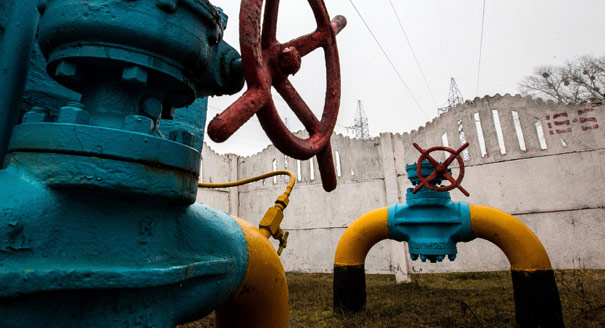
After the end of the Cold War, the West neglected the task of solving the “Russia problem” through integration. Trying to solve it now through economic warfare is not going to work.
U.S. President Barack Obama has led the other G7 leaders to impose new sanctions on Russia. The idea of steadily tightening the noose around the Russian economy is being consistently implemented. So far, the result has been more of a demonstration of the sanctions' capacity to hurt than a real pain. Yet, the ruble's depreciation by around 10 percent since January is a reality: the Russian stock market has plummeted, the capital outflow has reached 70 billion dollars in the first quarter, Russia's growth this year may lose no less than two percentage points, and become negative, and Russia's credit rating has just been downgraded to BBB-, with a negative forecast.
There is palpable resistance on the part of various Western business interests—from German manufacturers to U.S. big oil—against ratcheting up sanctions. The Obama administration's effort to talk Russia down is countered by the Kremlin's outreach to the CEOs of the companies that are doing well in Russia. The U.S. drive for Europe's independence from Russian gas is followed by Gazprom's calculations of how much more the Europeans will have to pay for their gas imports from the United States in the case of such exports will become legally and logistically possible. This competition will continue, but in the end the United States will probably get much of what it wants from its European and Asian allies.
What is less clear, however, is what these sanctions will actually achieve. Making Putin back down and concede defeat in Ukraine is improbable. Driving wedges between the Russian leader and his close associates is equally hopeless. The Russian liberal opposition, already marginalized, will hardly get a shot in the arm thanks to the sanctions. As to the bulk of the Russian people, their instinctive reaction to massive outside pressure against their country is more likely to be a patriotic surge rather than a regime change. The Russian government will now have an excellent reason to explain away the coming economic hardships: U.S. sanctions.
After the end of the Cold War, the West neglected the task of solving the “Russia problem” through integration. Trying to solve it now through economic warfare is not going to work.
Former Director, Carnegie Moscow Center
Trenin was director of the Carnegie Moscow Center from 2008 to early 2022.
Recent Work
Dmitri Trenin
Dmitri Trenin
Carnegie does not take institutional positions on public policy issues; the views represented herein are those of the author(s) and do not necessarily reflect the views of Carnegie, its staff, or its trustees.

If the Russian-speaking community in Latvia cannot articulate their interests without being seen as disloyal, they could end up embracing a pro-Kremlin agenda.

Sergejs Potapkins

Russia’s ruling party would have benefited from Putin appearing as its distant patron, but as an active frontman imposing his views on the public, he has done nothing but harm both the party’s election campaign and the ruling system overall.

Andrey Pertsev

Depleted financial reserves and a shrinking tax base mean it is no longer possible to simultaneously deliver high defense spending, price stability, and economic growth.

Alexandra Prokopenko
Blurring the line between humans and animals is a long-standing tradition in social utopian prose. In his latest novel, Leonid Bershidsky reminds us that in social experiments, people are often treated no differently than animals.

Alexander Baunov

In the tenth year of his presidency, President Mirziyoyev’s system is becoming even more personalized than that of his predecessor Karimov.

Galiya Ibragimova