

Q&A
Dara Massicot, Aaron David Miller, Andrew S. Weiss
{
  "authors": [
    "Andrew S. Weiss"
  ],
  "type": "legacyinthemedia",
  "centerAffiliationAll": "dc",
  "centers": [
    "Carnegie Endowment for International Peace"
  ],
  "collections": [],
  "englishNewsletterAll": "ctw",
  "nonEnglishNewsletterAll": "",
  "primaryCenter": "Carnegie Endowment for International Peace",
  "programAffiliation": "russia",
  "programs": [
    "Russia and Eurasia"
  ],
  "projects": [],
  "regions": [
    "North America",
    "United States",
    "Russia",
    "Eastern Europe",
    "Ukraine"
  ],
  "topics": [
    "Foreign Policy"
  ]
}
Source: Getty
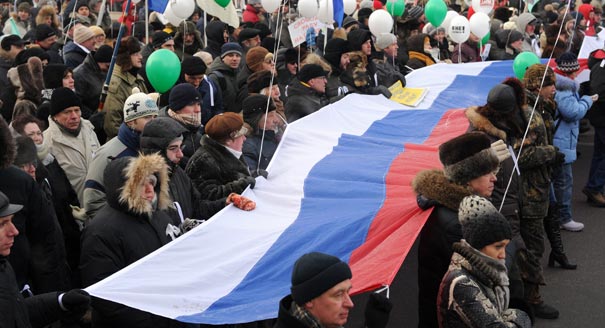
The people of Crimea, many of whom see themselves as either ex-Soviet or ethnically Russia, made the region ripe for Russian invasion and claims of human rights violations against the Russian minority living in Crimea were then used as justification for Russia’s invasion.
Source: Daily Show with Jon Stewart
Carnegie’s Andrew Weiss discussed Russia’s annexation of Crimea and his concern that Russia will continue to illegally expand its borders. The people of Crimea, many of whom see themselves as either ex-Soviet or ethnically Russia, made the region ripe for Russian invasion, he argued. Claims of human rights violations against the Russian minority living in Crimea were then used as justification for Russia’s invasion. Upon visiting ethnically Russian New York neighborhood Brighton Beach, The Daily Show’s Samantha Bee determined that Putin plans to invade America.
This interview originally aired on the Daily Show with Jon Stewart.
James Family Chair, Vice President for Studies
Andrew S. Weiss is the James Family Chair and vice president for studies at the Carnegie Endowment for International Peace, where he oversees research on Russia, Ukraine, and Eurasia. His graphic novel biography of Vladimir Putin, Accidental Czar: the Life and Lies of Vladimir Putin, was published by First Second/Macmillan in 2022.
Recent Work

Dara Massicot, Aaron David Miller, Andrew S. Weiss

Frances Z. Brown, Nate Reynolds, Priyal Singh, …
Carnegie does not take institutional positions on public policy issues; the views represented herein are those of the author(s) and do not necessarily reflect the views of Carnegie, its staff, or its trustees.

Sergei Kiriyenko used Russia’s parliamentary vote to further hone his strategy of corporate mobilization that is designed to maximize votes for United Russia.

Andrey Pertsev

Trump has promised Belarus a massive potash deal. But Minsk is seeking something greater: restored Western transit and greater room for maneuver from Russia.

Balázs Jarábik

The European far right might fail to steer EU policy in the direction Russia wants, but they will create enough chaos inside Europe to benefit the Kremlin.

Dimitar Bechev

Minsk clearly expected the dialogue with Washington to yield more results, in particular the lifting of EU sanctions and permission to export potash.

Artyom Shraibman

If the Russian-speaking community in Latvia cannot articulate their interests without being seen as disloyal, they could end up embracing a pro-Kremlin agenda.

Sergejs Potapkins