

Commentary
If the Russian-speaking community in Latvia cannot articulate their interests without being seen as disloyal, they could end up embracing a pro-Kremlin agenda.
Sergejs Potapkins
{
  "authors": [
    "Alexandra McLees",
    "Matthew Kupfer"
  ],
  "type": "commentary",
  "centerAffiliationAll": "",
  "centers": [
    "Carnegie Endowment for International Peace",
    "Carnegie Russia Eurasia Center"
  ],
  "collections": [],
  "englishNewsletterAll": "",
  "nonEnglishNewsletterAll": "",
  "primaryCenter": "Carnegie Endowment for International Peace",
  "programAffiliation": "",
  "programs": [],
  "projects": [],
  "regions": [
    "North America",
    "United States",
    "Middle East",
    "Iraq",
    "Caucasus",
    "Russia",
    "Georgia",
    "Eastern Europe",
    "Ukraine"
  ],
  "topics": [
    "Security",
    "Foreign Policy"
  ]
}
Source: Getty
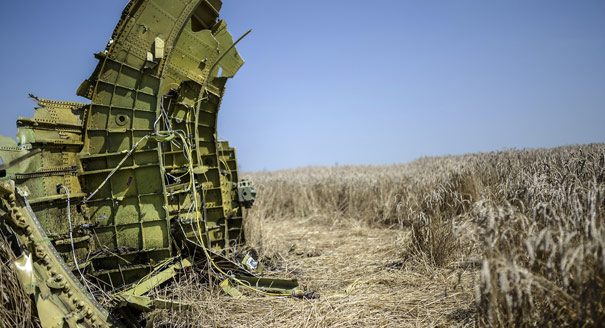
During the Cold War, both Washington and Moscow actively encouraged, financed, and supported proxy wars across Asia, Africa, and Latin America. In the eyes of many influential figures in Moscow, that is precisely what is happening in Ukraine today.
Moscow appears to have sloughed off recent suggestions in the New York Times that the Pentagon might provide the Ukrainian government with tactical data that could help target surface-to-air missiles controlled by pro-Russian separatists in the country’s east. In a conflict known for polarizing rhetoric, accusations, and sweeping conspiracy, that’s a bit surprising but also seems consistent with Moscow’s blanket denials that it is providing advanced weaponry to the separatists.
For its part, the Russian government has already made its anger about U.S. involvement in the Ukraine crisis abundantly clear. But it has consistently left the world of fact-based analysis behind, relying instead on doctored YouTube videos allegedly showing Blackwater mercenaries in Ukraine and, more recently, inflammatory claims in a formal statement by the Ministry of Foreign Affairs that Washington “pushed the regime [in Kyiv] to organize a severe reprisal against the Russian-speaking population.”
The sad reality is this kind of latter-day proxy war behavior has been visible in a number of conflict zones since the collapse of the Soviet Union. The most serious instance was in Georgia where the Bush administration helped train and equip the country’s military and intelligence services for a variety of peacekeeping and counter-terrorism missions. In August 2008 at the height of the Russian-Georgian war, the U.S. Department of Defense helped airlift Georgian forces deployed in Iraq so that they could return to Tbilisi after Russian troops moved to seize the breakaway provinces of South Ossetia and Abkhazia.From Washington’s perspective, the most serious incident prior to the Ukraine crisis may have been Russia’s provision of sensitive military equipment and intelligence to Iraq before and during the U.S. invasion in 2003. At the start of the Iraq War, U.S. officials discovered that Saddam Hussein’s troops were using Russian-supplied jamming equipment capable of disrupting U.S. missile guidance systems—and receiving on-the-ground consultations from the manufacturer’s experts. After the invasion, U.S. officials found documentary evidence that showed Moscow had also provided Iraq night-vision goggles and, according to a March 2006 U.S. Department of Defense study based on captured Iraqi documents, that Russian intelligence on American troop movements had been passed to Saddam Hussein during the early days of the war.
During the Cold War, both Washington and Moscow actively encouraged, financed, and supported proxy wars across Asia, Africa and Latin America. In the eyes of many influential figures in Moscow, that is precisely what is happening in Ukraine today. To be sure, Washington and many key European allies are quick to reject such characterizations, focusing instead on President Putin’s outrageous behavior in eastern Ukraine and shocking land-grab in Crimea. But from Putin on down, perception is often reality so it’s worth taking a close look at what the Cold War and post-Cold War period can teach us about the far-reaching and destabilizing effects of proxy wars on the overall east-west relationship. The provision of intelligence data on separatist missile launch sites to Kyiv may be a sound step for shoring up the Ukrainian military’s position in the East in the short-term. But given the all too present risk of escalation, such a move seems unlikely to go without a serious response. The Obama administration needs to be prepared.
Alexandra McLees is a junior fellow in the Carnegie Endowment for International Peace’s Russia and Eurasia Program. Follow her on Twitter: @OlaMcLees.
Matthew Kupfer is a junior fellow in the Carnegie Endowment for International Peace’s Russia and Eurasia Program. Follow him on Twitter: @Matthew_Kupfer.
Alexandra McLees
Former Junior Fellow, Russia and Eurasia and Energy and Climate Programs
Matthew Kupfer
Former Junior Fellow, Russia and Eurasia Program
Carnegie does not take institutional positions on public policy issues; the views represented herein are those of the author(s) and do not necessarily reflect the views of Carnegie, its staff, or its trustees.

If the Russian-speaking community in Latvia cannot articulate their interests without being seen as disloyal, they could end up embracing a pro-Kremlin agenda.

Sergejs Potapkins

Russia’s ruling party would have benefited from Putin appearing as its distant patron, but as an active frontman imposing his views on the public, he has done nothing but harm both the party’s election campaign and the ruling system overall.

Andrey Pertsev

Depleted financial reserves and a shrinking tax base mean it is no longer possible to simultaneously deliver high defense spending, price stability, and economic growth.

Alexandra Prokopenko

Blurring the line between humans and animals is a long-standing tradition in social utopian prose. In his latest novel, Leonid Bershidsky reminds us that in social experiments, people are often treated no differently than animals.

Alexander Baunov

While France and Australia are seeking to establish the legal obligations of messaging apps like Telegram, Russia wants total subordination.

Maria Kolomychenko