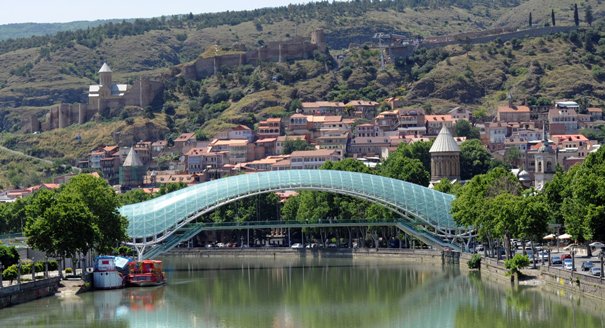
For nearly a generation now, Georgia has been on a Euro-Atlantic trajectory. The current government in Tbilisi has been unequivocal in its determination to continue this policy which enjoys both elite and grass root consensus. On June 27, 2014, it signed an Association Agreement with the European Union, another milestone on this path.
Every time Tbilisi appears to be coming closer to Europe, this is hailed with enormous public opinion enthusiasm. Essentially, this sentiment is still powered by the vision of “a return to Europe,” which, more than twenty years since our independence, is anything but passé.
Pursuing the same “European” vision, Georgia has been an enthusiastic contributor to NATO’s Partnership for Peace (PfP) program being one of the most significant contributors in joint operations in Kosovo,
Afghanistan, and the Mediterranean. By the way, Russia used to be an active participant of that program since the inception in conducting joint naval exercises in which they practiced techniques of communicating, maneuvering and jointly operating at sea. It is no secret that Tbilisi is now seeking a Membership Action Plan (MAP) at the NATO Summit in Wales this September. Georgia has spared no cost, human or material, to join the Euro-Atlantic community of values as a contributor rather than a “free rider.”
Recently, however, Georgia has taken every possible step to ensure that its western trajectory does not appear threatening to Russia. It has taken steps to deescalate conflict with Moscow. In the run-up and during the Sochi Olympics last February, Tbilisi made it clear that it was not seeking to destabilize the Russian North Caucasus. Bilateral trade has been growing. The explosive symbolism of the past is history.
Georgia is seeking a constructive regional role. It is a transit country that sits on an energy and transport highway from Astana and Baku to Ankara and, thereon, to Europe; it is Armenia’s gateway to the world, including to Russia. There are plenty more routes going through Tbilisi, from the greater Caucasus to the greater Middle East and from Central Europe to Central Asia. Georgia today is the only access from land-locked Central Asia to the European market.
Politically, Georgia is “on the fringes” of Europe. Russia shares little if any commitment to sovereignty and democratic governance and free trade that Georgia has embraced, ideologically and politically, since its independence. Georgia is of the West, even if not in the West. In view of the fact that Tbilisi has not been encouraged to expect the granting of a MAP this September in Wales, the hope of joining NATO’s collective security system remains elusive. Since European and “Eurasian” (Russian) trade regimes remain mutually exclusive, there is no hope for a common trade regime. And rather than regionalization paving the way to successful globalization, the South Caucasus amounts to little less than the sum of its individual states, each tormented by separatism. Across the region, fragmentation prevails.
And yet, Georgia has no choice but to be what it is, and where it is. The successful conclusion of the EU Association Agreement should not lead to too much elation, and the expected disappointment over NATO’s MAP should not be a reason for frustration. Georgia’s road is hard, but the only map it can use is one whose destination is decided by the Georgians themselves.
Tedo Japaridze is chairman of the foreign affairs committee in Georgia’s parliament, where he represents the Georgian Dream coalition. He has served as Georgia’s national security advisor, foreign minister and ambassador to the United States. This article expresses his personal views.