

Paper
Yezid Sayigh
{
  "authors": [
    "Yezid Sayigh"
  ],
  "type": "legacyinthemedia",
  "centerAffiliationAll": "dc",
  "centers": [
    "Carnegie Endowment for International Peace",
    "Malcolm H. Kerr Carnegie Middle East Center"
  ],
  "collections": [],
  "englishNewsletterAll": "menaTransitions",
  "nonEnglishNewsletterAll": "",
  "primaryCenter": "Malcolm H. Kerr Carnegie Middle East Center",
  "programAffiliation": "MEP",
  "programs": [
    "Middle East"
  ],
  "projects": [],
  "regions": [
    "Levant",
    "Israel",
    "Palestine",
    "Middle East"
  ],
  "topics": [
    "Political Reform",
    "Security",
    "Foreign Policy"
  ]
}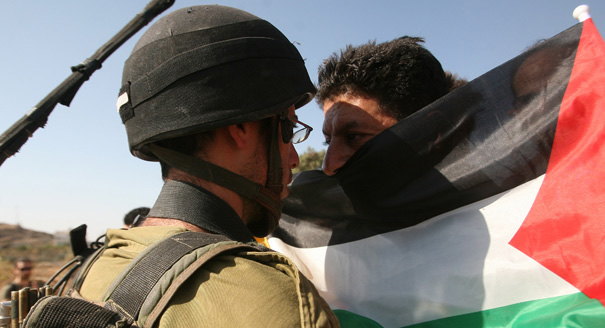
Source: Getty
Israel and Hamas have found themselves sucked into a conflict that neither side really wanted and that outside powers seem reluctant or unable to stop.
Source: France 24
ARMEN GEORGIAN: It’s a depressingly familiar pattern. Middle East peace talks collapse and a fresh round of Israeli-Palestinian bloodletting begins. With a grim inevitability, Israel and Hamas found themselves sucked into a conflict that neither side really wanted and that outside powers seems reluctant or impotent to stop. To discuss this situation, I’m pleased to welcome a very distinguished Middle East Analyst. Yezid Sayigh joins me from Beirut. In the early 90s, he was a negotiator in the Palestinian delegation in peace talks with Israel. He’s also an academic who has taught at Cambridge and at King’s College London. Yezid Sayigh has authored numerous books on the Middle East and he’s now senior associate at the Carnegie Middle East Center think tank.
France 24 the Interview’s Armen Georgian spoke with Carnegie’s Yezid Sayigh about why the Israeli-Egyptian blockade of the Gaza Strip is a dead-end strategy, the diplomatic efforts to stop the fighting, and the impact of the Gaza conflict both on Hamas and on the Palestinian Authority.
This interview was broadcasted on France 24’s the Interview.

Senior Fellow, Malcolm H. Kerr Carnegie Middle East Center
Yezid Sayigh is a senior fellow at the Malcolm H. Kerr Carnegie Middle East Center in Beirut, where he leads the program on Civil-Military Relations in Arab States (CMRAS). His work focuses on the comparative political and economic roles of Arab armed forces, the impact of war on states and societies, the politics of postconflict reconstruction and security sector transformation in Arab transitions, and authoritarian resurgence.
Recent Work
Yezid Sayigh
Yezid Sayigh
Carnegie does not take institutional positions on public policy issues; the views represented herein are those of the author(s) and do not necessarily reflect the views of Carnegie, its staff, or its trustees.

Sergei Kiriyenko used Russia’s parliamentary vote to further hone his strategy of corporate mobilization that is designed to maximize votes for United Russia.

Andrey Pertsev

The European far right might fail to steer EU policy in the direction Russia wants, but they will create enough chaos inside Europe to benefit the Kremlin.

Dimitar Bechev

Minsk clearly expected the dialogue with Washington to yield more results, in particular the lifting of EU sanctions and permission to export potash.

Artyom Shraibman

If the Russian-speaking community in Latvia cannot articulate their interests without being seen as disloyal, they could end up embracing a pro-Kremlin agenda.

Sergejs Potapkins

Russia’s ruling party would have benefited from Putin appearing as its distant patron, but as an active frontman imposing his views on the public, he has done nothing but harm both the party’s election campaign and the ruling system overall.
Andrey Pertsev