

Article
Frederic Wehrey, Charles H. Johnson
{
  "authors": [
    "Frederic Wehrey"
  ],
  "type": "legacyinthemedia",
  "centerAffiliationAll": "dc",
  "centers": [
    "Carnegie Endowment for International Peace",
    "Malcolm H. Kerr Carnegie Middle East Center"
  ],
  "collections": [],
  "englishNewsletterAll": "menaTransitions",
  "nonEnglishNewsletterAll": "",
  "primaryCenter": "Carnegie Endowment for International Peace",
  "programAffiliation": "MEP",
  "programs": [
    "Middle East"
  ],
  "projects": [],
  "regions": [
    "North Africa",
    "Libya",
    "Maghreb"
  ],
  "topics": [
    "Security",
    "Foreign Policy"
  ]
}
Source: Getty
The real story of Libya is that there is no one faction that can really compel or coerce the others.
Source: PBS Newshour
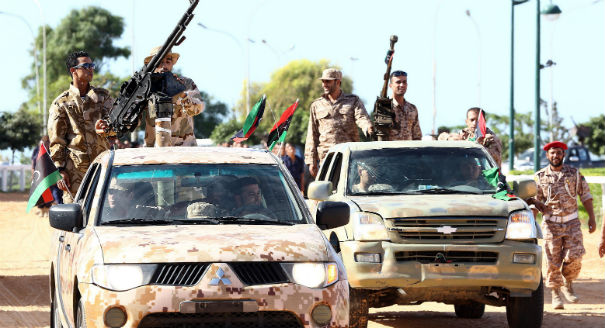
Speaking to Jeffrey Brown on PBS NewsHour, Carnegie’s Frederic Wehrey discussed the deteriorating situation in Libya, where violence has escalated between rival factions. The very complex web of dynamics and alliances has finally arrived to Tripoli, Wehrey said, where fighting has intensified over control of the airport.
Under Qaddafi, Libya didn’t have state institutions, an army, or police. It’s only gotten worst since the revolution, Wehrey said. “The militias are getting funding from Libya’s oil wealth and they’ve really mushroomed. They’ve become their own entities,” he argued. “The real story of Libya is that there’s no one faction that can really compel or coerce the others.”
In Washington, there’s a sense that there’s no partner on the other side, Wehrey explained. They want to help the Libyans but the Libyans first have to help themselves. “I do think the Libyans themselves need to step up to the plate before the outside community can help,” he argued.

Senior Fellow, Middle East Program
Frederic Wehrey is a senior fellow in the Middle East Program at the Carnegie Endowment for International Peace, where his research focuses on governance, conflict, and security in Libya, North Africa, and the Persian Gulf.
Recent Work
Frederic Wehrey, Charles H. Johnson
Frederic Wehrey, Charles H. Johnson
Carnegie does not take institutional positions on public policy issues; the views represented herein are those of the author(s) and do not necessarily reflect the views of Carnegie, its staff, or its trustees.

With the growth in points of friction between the great powers, organizations like the SCO will continue to play a role in the strategic adaptation of the smaller powers caught between them.

Temur Umarov

When faced with fuel shortages in the past, Central Asian governments could always count on additional supplies from Moscow. That safety net no longer exists.

Galiya Ibragimova

Two divergent trends—Putin’s hardline vision of how to prosecute the war in Ukraine, and a growing desire for change in Russia—could tear the regime apart.

Tatiana Stanovaya

Andrey Melnichenko’s essay offers no answer to the fundamental question of how, under any kind of negotiated settlement, Europe can protect itself from the Russian ressentiment that is inevitable in all scenarios except for an outright victory for Putin.

Leonid Bershidsky

Despite unhappiness on the ground, Moscow is determined to use both carrot and stick to ensure there is record support for United Russia in occupied Ukraine.

Konstantin Skorkin