

Commentary
Sarah Chayes
{
  "authors": [
    "Sarah Chayes"
  ],
  "type": "legacyinthemedia",
  "centerAffiliationAll": "dc",
  "centers": [
    "Carnegie Endowment for International Peace"
  ],
  "collections": [
    "Democracy and Governance"
  ],
  "englishNewsletterAll": "democracy",
  "nonEnglishNewsletterAll": "",
  "primaryCenter": "Carnegie Endowment for International Peace",
  "programAffiliation": "DCG",
  "programs": [
    "Democracy, Conflict, and Governance"
  ],
  "projects": [],
  "regions": [
    "North America",
    "United States",
    "South Asia",
    "Afghanistan"
  ],
  "topics": [
    "Democracy",
    "Security",
    "Foreign Policy"
  ]
}
Source: Getty
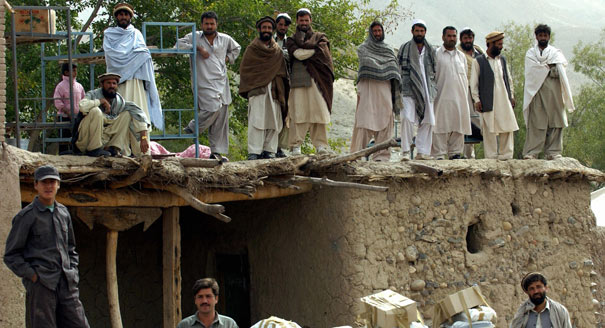
The Afghan government is lacking the type of legitimacy that is required of a government confronting a robust insurgency.
Source: NPR’s All Things Considered
ROBERT SIEGEL, HOST:
The Obama administration calls it an historic day, after years of negotiations the U.S. and Afghanistan have signed a security pact. It defines the U.S. military's relationship with that country after the American combat mission ends on December 31. The agreement will keep some 10,000 American troops on the ground for the next decade. Their stated mandate is to advise and train Afghan security forces.
RACHEL MARTIN, HOST:
Earlier today, we reached U.S. Ambassador James Cunningham in Kabul to talk about the security agreement and the U.S.' role going forward.
JAMES CUNNINGHAM: The Afghans have been in the lead in the field for some time now but they still need to build up their logistics, their management and they still need some training to get fully up to speed.
MARTIN: The security deal comes one day after the new Afghan president Ashraf Ghani took office. After a hotly contested election, marred by allegations of massive fraud, Ghani agreed to a so-called unity government. His main rival, Abdullah Abdullah, will take a newly created position of chief executive. That deal was negotiated by U.S. Secretary of State John Kerry. Ambassador Cunningham says it is a complicated alliance.
CUNNINGHAM: This is going to be a difficult process, everybody knows that, and they know it. But it is also what they agree and what most Afghans, I think, agree is the best possible way forward.
MARTIN: We now turn to someone who does not agree. Sarah Chayes is with the Carnegie Endowment for International Peace. She lived in Afghanistan for nearly 10 years and she advised U.S. military leadership on policy there. She also covered the fall of the Taliban for NPR back in 2001. Chayes told us Afghans she's spoken with feel that democracy in their country has been hijacked.
SARAH CHAYES: What I've heard from many people is distress that in the end the outcome was decided in negotiation - kind of in a back room, that was midwifed by the foreigners, as they put it - and, frankly, created an office that doesn't even exist in the Afghan Constitution.
MARTIN: You're referring to the chief executive office. This is the new position that Abdullah Abdullah will hold.
CHAYES: That's exactly right. So what you have is a government that from the get-go is lacking the type of legitimacy that really is required of a government that's confronting the kind of robust insurgency that the Afghan government still is.
MARTIN: There was a recount for this vote. International monitors were on the ground overseeing it and Ashraf Ghani was declared the winner. Ghani has spent much of his career thinking about issues of corruption and how to make governments work. Is there no room to think that he might be able to actually make some positive change?
CHAYES: He might. But if you already look at the distance between the promises he's making and the people that he's appointing into the positions that are expected to execute those promises - particularly a new office of governance and anticorruption, I can't remember the exact name of it - that's Ahmad Zia Massoud, one of the people most known for corruption, venality and even war crimes. So there's this gap between what Ghani is saying and what either he will do or he'll be able to do given the structure of how this new government is being put together, where so many people were provided basically promises in order to support one side or the other. And those people will be asking for their payoffs.
MARTIN: You worked for the Pentagon advising the U.S. military on Afghanistan, in the past. Is this a good idea, from a U.S. security standpoint, to keep 10,000 troops on the ground there? Is this a move that furthers U.S. national security interests?
CHAYES: I think it does in that it is likely to stave off the kind of sudden collapse that we've witnessed in Iraq. But it's not a long-term solution. And what distresses me is the inability of the United States government, in either Afghanistan or Iraq or a number of other places, to really focus and develop a strategy to address the underlying drivers of the conflict, and the rising extremism that the U.S. government is seeking to curb. And so the sort of knee-jerk reaction is let's keep military in place or let's increase the use of force in this context whereas at best the use of force can only buy time. And yet, the U.S. government has been unwilling to really develop a concerted strategy to address the underlying drivers of this extremism, which have to do with government legitimacy, which have to do with government responsiveness, corruption and, frankly, the behavior of neighboring states. And the U.S. government just has shied away again and again from addressing those deeper problems.
MARTIN: Sarah Chayes with the Carnegie Endowment for International Peace. She also served as an advisor to the U.S. military on Afghanistan. Thanks so much Sarah.
CHAYES: Pleasure.
Former Senior Fellow, Democracy, Conflict, and Governance Program
Sarah Chayes is internationally recognized for her innovative thinking on corruption and its implications. Her work explores how severe corruption can help prompt such crises as terrorism, revolutions and their violent aftermaths, and environmental degradation.
Recent Work
Sarah Chayes
Carnegie does not take institutional positions on public policy issues; the views represented herein are those of the author(s) and do not necessarily reflect the views of Carnegie, its staff, or its trustees.

Japan’s long-term security policy is driven by concerns about China, and there is little appetite for (or interest in) pursuing a confrontation with Moscow.

James D.J. Brown

The truth of the strategic situation is that Europe and Russia are extremely unlikely to be able to “turn the page” on their confrontation within the next two decades.

Arkady Moshes

Russia’s AI-driven propaganda campaigns operate in a fragmented, chaotic, and often illogical manner. That’s not necessarily a problem for the Kremlin, though: It’s much easier to mimic genuine public debate that way.

Ilya Klishin

Without a ceasefire with Ukraine on attacking each other’s energy infrastructure—to which the Kremlin is unlikely to agree—the diesel agreement between Putin and Trump is largely for show, rather than representing a genuine increase in the volumes of Russian diesel on the global market.

Sergey Vakulenko

Russian strikes are weakening the economy sustaining Ukraine’s war effort. Closing the growing funding gap will require more European support and politically contentious reforms in Kyiv.

Balázs Jarábik