

Commentary
Balázs Jarábik
{
  "authors": [
    "Balázs Jarábik"
  ],
  "type": "commentary",
  "centerAffiliationAll": "",
  "centers": [
    "Carnegie Endowment for International Peace",
    "Carnegie Russia Eurasia Center"
  ],
  "collections": [],
  "englishNewsletterAll": "",
  "nonEnglishNewsletterAll": "",
  "primaryCenter": "Carnegie Endowment for International Peace",
  "programAffiliation": "",
  "programs": [],
  "projects": [],
  "regions": [
    "Eastern Europe",
    "Ukraine"
  ],
  "topics": [
    "Political Reform",
    "Civil Society"
  ]
}
Source: Getty
Forthcoming elections give Ukraine a feeling of hope. However, for most Ukrainians the optimistic political advertisements contrast sharply with their own experiences. The war in the Donbas and the worsening economic and social situation are likely to bring more people to the parliament with no appetite for dialogue.
October in Kyiv has brought a gorgeous Indian summer. The reprieve from autumn's slow creep towards winter gives the city a feeling of hope as it prepares for parliamentary elections on October 26. Ubiquitous political advertisements for the twenty-nine parties running indicates serious change is coming.
However, a deeper look at the socio-political environment in Kyiv suggests that this picture of progress may only be a façade. For most Ukrainians the optimistic political advertisements (which were nearly absent during the presidential election in May) contrast sharply with their own experiences. The war in the Donbas and the worsening economic and social situation are likely to bring more people to the parliament with no appetite for dialogue. Rather, many will want to fight—literally—for what they believe is right.
The Petro Poroshenko Bloc's “party of peace” is the darling of pre-election polls. Poroshenko has designed the bloc, which has been campaigning in the name of unity, to include civil activists, soldiers fighting in the Donbas, oligarchs' proxies, traditional regional powerbrokers (the four Baloga brothers from western Ukraine are a prime example) and former Party of Regions lawmakers. Poroshenko has also tried to keep the ruling coalition in check. First, he managed to essentially absorb the UDAR party after cutting a deal with Kyiv Mayor Vitaliy Klitschko and oligarch Dmitry Firtash. For his loyalty, Klitschko received support from Poroshenko in the mayoral election, which he easily won. Second, Poroshenko appears to have made a “non-aggression” pact with Svoboda. Third, he seems to have made a tacit agreement with Arseniy Yatsenyuk's National Front—the “war party”—to weaken the actual military populists—Oleh Lyashko's Radical Party and former Prime Minister Yulia Tymoshenko's Batkivshchyna.
The mixed electoral system—half of MPs will be elected from single-member district and half from party lists—and the fact that one major party (the Poroshenko Bloc) is likely to control the new Rada means that the parliament will be more split than ever as party blocks will be able to assert less “centralized” will. Especially because it is becoming clear that radicals will hold a significant number of seats in the new Rada. Polls suggest six other parties may enter the new Rada, including the Radical Party, which is composed of celebrities, fighters, singers, civic activists, sportsmen, and lesser-known businessmen. Like Lyashko’s party, Batkyvshchyna is highly populist and pro-war: captured Ukrainian female pilot Nadia Savchenko is number one on Batkivshchyna's list. Her sister is running, too, emphasizing the lengths to which Tymoshenko will go to drum up popular support. The right wing Svoboda will also likely to get in as turnout in western Ukraine, where the party’s support based, is expected to be higher than elsewhere in the country.
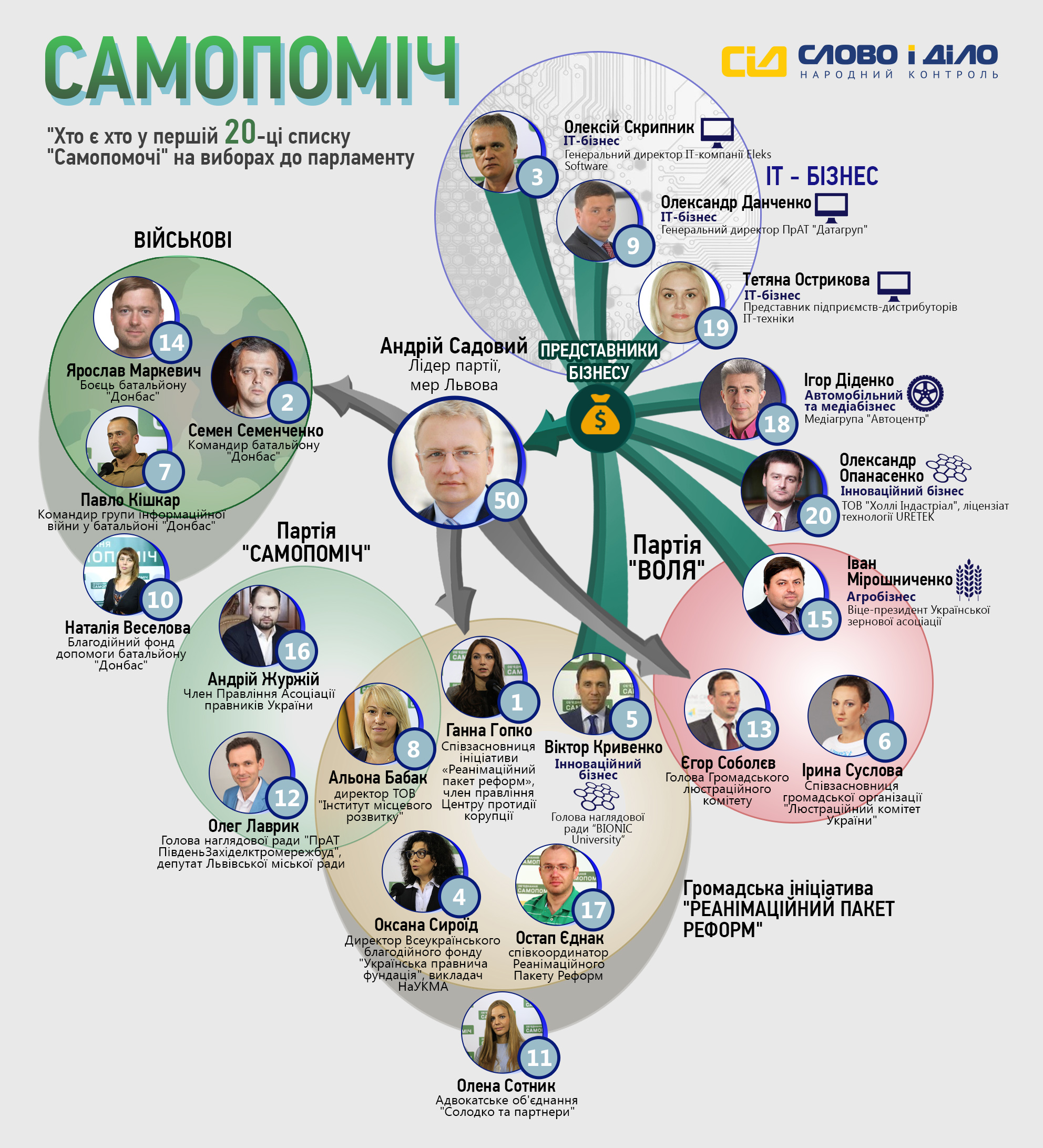
Out of the three “middle class” parties—Yatsenyuk's National Front, Anatoliy Hrytsenko's Civil Position, and Lviv Mayor Andriy Sadovyi's “Samopomich” (Self-help)—Civil Position and National Front will most likely win seats in parliament. The Lviv mayor’s party seems like a Lviv version of a typical Ukrainian political party: Sadovyi has co-opted regional businesses, an entire group of civil activists (Reanimation Package of Reforms), previous politicians, and a handful of soldiers in eastern Ukraine (including Donbas Battalion commander Semenchenko). Given that it is receiving less than two percent of support from likely voters it is unlikely to enter parliament (parties must win at least five percent of the vote for their representatives to enter the Rada). Anatoliy Hrytsenko, the former presidential candidate and minister of defense, made a pact with Democratic Alliance, Ukraine's only self-funded party, which was established by young political and civil activists. In Kyiv, Hrytsenko was described to me as “Lyashko for the educated.”
One lingering uncertainty about the election is whether the newly created Opposition Block or the Serhiy Tihipko run Strong Ukraine, both composed of former Party of Regions members, will garner enough votes. Both are polling at less than three percent, but a strong media campaign by its oligarch backers may tip the scales. Unlike previous elections, few businessmen are running for office, and most oligarchs have been keeping a low profile. Some of the oligarchs, like Dnipropetrovsk Governor Igor Kolomoyski, are clearly picking up part of the bill by financing a great number of candidates, and all of them are losing money in the current crisis. But in context, as one insider reminded me in Kyiv, it is better to lose part of your wealth than all of it like Viktor Yanukovych.
The presence of more than thirty civil society activists and dozens of fighters on various party lists ensures fresh blood in the Rada. The emergence of prominent civil activists is welcome as a positive sign as Ukraine in dire need of a new, responsible political elite. Whereas former pro-Yanukovych lawmakers are running mostly in majoritarian districts, civic activists have been essentially co-opted by political parties. Although those civil activities have a strong vision for and a commitment to Ukraine's European future, they also lack the experience necessary to implement crucial reforms. Further, as members of political parties, they may lose the freedom to act independently from those who have their way to power. They will also lose the credibility they gained by holding the ruling elite accountable by applying external pressure. They will enter a system that could easily absorb their best intentions. Cultivating new civil activists will be no problem for Ukraine, but gaining political credibility will take time.
Soldiers will be a new element in the parliament, reflecting the desires of many in society: to fight. Seventeen candidates are running from the Donbas Battalion alone. With Aydar, Dnipr, Luhansk, and Azov battalions' candidates in parliament, the Rada may became a new kind of battlefield. This trend should raise the question about whether other professionals—lawyers, doctors, economists, teachers—who could enter parliament and elevate Ukraine’s lawmaking.
Society is becoming more radical and aggressive. The so-called “trash bucket challenge” must be painful to watch for those believing Ukraine is moving closer towards European values. But the indicator of a real breakdown in society is not rare episodes, but rather the support they garner even among educated Ukrainians. The “you have to understand” choir is much louder than the few warning voices. What is even more worrisome is the lack of reaction from law enforcement and lack of legal accountability for the perpetrators.
What does this mean for the West? According to the famous Georgian toast, our desires should match our possibilities. The problem with Western policy in Ukraine is that it is beginning to look more like a desire than a policy. Holding early elections was supposed to legitimize central authority. But the opposite seems more likely by the day.
If Ukraine is to become a European country, the West must ensure rigorous election observation, press authorities to conduct the fairest elections ever held in Ukraine, and immediately condemn violations of any kind. Making the elections as transparent and fair as possible is the least the Poroshenko administration can do to give Ukrainians hope for a new future and an ethical and effective government. Yet in their cooperation with leaders from the government and civil society, the West seems to be continuing to chase a dream instead of addressing the swiftly changing reality on the ground.
For the majority of Ukrainians, the fight for survival is just about to begin. Lowering expectations from Kyiv, increasing support in fields that can bring immediate and practical improvement for Ukrainians should be the West’s immediate priority.

Political analyst, former Slovak diplomat, and consultant specializing in Eastern Europe
Recent Work
Balázs Jarábik
Balázs Jarábik
Carnegie does not take institutional positions on public policy issues; the views represented herein are those of the author(s) and do not necessarily reflect the views of Carnegie, its staff, or its trustees.

Sergei Kiriyenko used Russia’s parliamentary vote to further hone his strategy of corporate mobilization that is designed to maximize votes for United Russia.

Andrey Pertsev

The European far right might fail to steer EU policy in the direction Russia wants, but they will create enough chaos inside Europe to benefit the Kremlin.

Dimitar Bechev

If the Russian-speaking community in Latvia cannot articulate their interests without being seen as disloyal, they could end up embracing a pro-Kremlin agenda.

Sergejs Potapkins

Russia’s ruling party would have benefited from Putin appearing as its distant patron, but as an active frontman imposing his views on the public, he has done nothing but harm both the party’s election campaign and the ruling system overall.
Andrey Pertsev

In the tenth year of his presidency, President Mirziyoyev’s system is becoming even more personalized than that of his predecessor Karimov.

Galiya Ibragimova