

In The Media
Lina Khatib
{
  "authors": [
    "Lina Khatib"
  ],
  "type": "legacyinthemedia",
  "centerAffiliationAll": "dc",
  "centers": [
    "Carnegie Endowment for International Peace",
    "Malcolm H. Kerr Carnegie Middle East Center"
  ],
  "collections": [
    "Arab Awakening"
  ],
  "englishNewsletterAll": "menaTransitions",
  "nonEnglishNewsletterAll": "",
  "primaryCenter": "Malcolm H. Kerr Carnegie Middle East Center",
  "programAffiliation": "MEP",
  "programs": [
    "Middle East"
  ],
  "projects": [],
  "regions": [
    "Levant",
    "Maghreb",
    "Middle East",
    "North Africa"
  ],
  "topics": [
    "Political Reform"
  ]
}
Source: Getty
As the Arab Spring approaches its fourth anniversary, the Arab world generally is at risk of heading towards a future without politics.
Source: Al-Hayat
As the Arab Spring approaches its fourth anniversary, the Arab world generally is at risk of heading towards a future without politics. This statement may appear contradictory when one considers the rise of strongmen, the holding of elections in several Arab countries, and seemingly endless battles over power by state and non-state actors across the region. However, what seems to be lost in the middle of all those developments is the definition of politics itself.
Analysts are spending significant time trying to make sense of what is going on in the Arab world today and its implications for the region’s political future. But in addition to on-the-ground analysis, it is also worthwhile to take a momentary pause and turn to political philosophy for a reminder of what is at stake on a conceptual level. A closer look shows that the battles in the Arab world threaten not its political future, but the existence of politics in its fundamental meaning in the region.Here I would like to introduce the arguments of two political philosophers, who present different conceptualizations of the relationship between the rulers and the ruled in their writings that are instructive in the context of the contemporary Arab world. The first is Giorgio Agamben, whose seminal work, “Homo Sacer: Sovereign Power and Bare Life,” engages with the relationship between the sovereign and the citizen. Agamben argues that sovereignty carries with it the power to place the sovereign outside the rule of law. This creates what Agamben calls a “state of exception” in which the citizen becomes an embodiment of “bare life,” meaning that the citizen’s life and death become entirely dependent on the power of the sovereign. A crucial part of the argument is that this “state of exception” is not a temporary measure invoked in times of crises but is the norm upon which the relationship between the sovereign and the citizen is built.
Numerous Arab countries are witnessing this process, albeit in different forms. Perhaps the most extreme form is witnessed in Syria today, where President Bashar al-Assad had already ruled through a state of exception well before the outbreak of the Syrian uprising in 2011, and who has intensified the dynamics of difference between him and his people to justify escalating his actions against them. If the Syrian citizen becomes “bare life” in relation to the sovereign, then actions like barrel bombings become normalized as an expression of sovereignty. But even in countries not witnessing active warfare, the reduction of the citizen to “bare life” is prevalent.
The second political philosopher whose work is enlightening in this context is Jacques Ranciere. Ranciere presents a critique of the notion of politics by defining the practice of politics as being about disagreement. Politics is about going beyond the existence of government institutions, or even the reaching of consensus in any given context. For Ranciere, there can be no politics without there being the space for disagreement. Citizens must always be able to interrupt the political body and the social order. Politics, therefore, is about the normalization of permanent flux driven by the citizen. Taking this argument to its practical level, it becomes a statement on politics’ being about the acceptance of the continuous presence of activism and of its potential to disrupt the status quo.
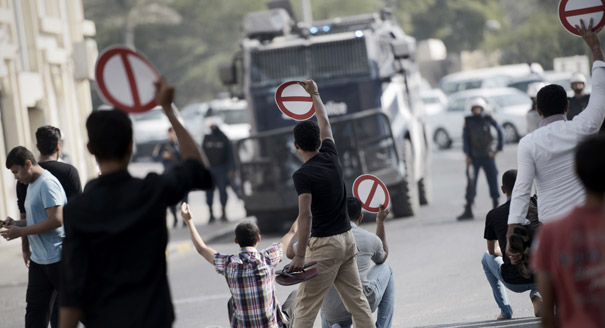
Activism has always existed in the Arab world, even under the most draconian of conditions. Even in Libya under Muammar al-Qaddafi’s rule, there were attempts at disrupting the state of exception, such as the demonstrations against the Abu Salim prison massacre of 1996 by the families of slaughtered prisoners, which continued until the uprising of 2011. But the existence of activism in such a context is not politics, because activism under Qaddafi’s Libya was only tolerated to the extent that it did not disrupt the political body of the regime. And those engaging in activism were still regarded as “bare life” that could be eliminated by the sovereign at any time. Four years after the revolutions erupted, activism continues across the region, from Bahrain to Egypt to Jordan, but this is activism without politics.
What the Arab world is witnessing today is a dangerous combination of Agamben’s “bare life” concept and Ranciere’s conceptualization of the absence of politics. New and established leaders are taking over, placing themselves above the rule of law, and asking their citizens to be grateful when their lives are spared. Non-free elections take place but are presented by governments as being representative of the will of the people. Government officials make loud statements about them working towards reaching consensus when the term is actually used to infer quashing difference. And whole generations of citizens are growing up not knowing that what they think is politics has nothing to do with the fundamental meaning of the word.
Tunisia so far presents a glimmer of hope as the country’s politicians have been responsive to citizens’ “interruptions” (to use Ranciere’s term) and appear to accept the concept of disagreement as a fundamental characteristic of the political process, with elections not presented as being about the elimination of opponents but about respect for diversity. But the rest of the region seems to be heading in the opposite direction. Lebanon’s parliament has once again extended its own mandate unconstitutionally. Bahrain hailed its parliamentary elections as progress despite their boycott by the opposition. The Egyptian government continues to propose new measures that curb freedom of expression. Libya has descended into a scenario of multiple exclusions, where each warring faction regards itself as sovereign and with the mandate to eliminate its challengers. Yemen risks doing away with the rule of law altogether.
If the Arab world continues down this slippery slope, then perhaps analysts should simply boycott the term “politics” when describing the processes happening in the region. Call them power, or conflict, or struggle, but let us restore the meaning of “politics” to what it should really be about.
This article was originally published in Arabic in Al-Hayat.
Former Director, Middle East Center
Khatib was director of the Carnegie Middle East Center in Beirut. Previously, she was the co-founding head of the Program on Arab Reform and Democracy at Stanford University’s Center on Democracy, Development, and the Rule of Law.
Recent Work
Lina Khatib
Lina Khatib
Carnegie does not take institutional positions on public policy issues; the views represented herein are those of the author(s) and do not necessarily reflect the views of Carnegie, its staff, or its trustees.

The European far right might fail to steer EU policy in the direction Russia wants, but they will create enough chaos inside Europe to benefit the Kremlin.

Dimitar Bechev

If the Russian-speaking community in Latvia cannot articulate their interests without being seen as disloyal, they could end up embracing a pro-Kremlin agenda.

Sergejs Potapkins

Russia’s ruling party would have benefited from Putin appearing as its distant patron, but as an active frontman imposing his views on the public, he has done nothing but harm both the party’s election campaign and the ruling system overall.

Andrey Pertsev

In the tenth year of his presidency, President Mirziyoyev’s system is becoming even more personalized than that of his predecessor Karimov.

Galiya Ibragimova
The greater threat to Zelensky comes not from Fedorov alone, but from the convergence between the former defense minister’s political campaign and the anti-corruption investigations moving ever closer to the presidential administration.

Balázs Jarábik