

Commentary
Russian strikes are weakening the economy sustaining Ukraine’s war effort. Closing the growing funding gap will require more European support and politically contentious reforms in Kyiv.
Balázs Jarábik
{
  "authors": [
    "Milan Vaishnav",
    "Neelanjan Sircar"
  ],
  "type": "legacyinthemedia",
  "centerAffiliationAll": "dc",
  "centers": [
    "Carnegie Endowment for International Peace"
  ],
  "collections": [],
  "englishNewsletterAll": "ctw",
  "nonEnglishNewsletterAll": "",
  "primaryCenter": "Carnegie Endowment for International Peace",
  "programAffiliation": "SAP",
  "programs": [
    "South Asia"
  ],
  "projects": [],
  "regions": [
    "South Asia",
    "India"
  ],
  "topics": [
    "Political Reform",
    "Security"
  ]
}
Source: Getty
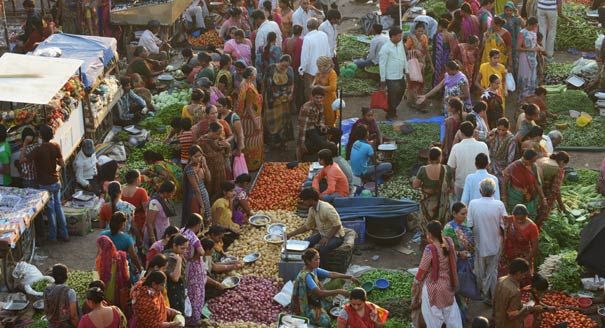
Perceptions of public safety in India are not driven by urbanisation per se; rather, these are likely driven by the infrastructure and amenities associated with the largest cities in India.
Source: Hindu
One of the most important functions of a modern state is to provide for basic law and order. Indeed, this idea emerges from some of the early foundational tracts on state authority, especially the work of sociologist Max Weber, who defined a modern state as a “human community that successfully claims the monopoly of the legitimate use of physical force within a given territory.”
In recent years, there has been increasing concern over the ability of the Indian state to ensure public safety. Horrific acts of violence — from Naxal attacks to gang-rapes — have almost become routinised. That is not to say that India has not witnessed progress: with the exception of Naxalite incidents, most measures of violence are actually enjoying historic lows. However, given the widespread errors found in most statistics on crime and violence, a healthy dose of scepticism is warranted.
Independent of what government statistics on law and order might say, an equally important issue concerns individuals’ perceptions of public safety: how do ordinary Indians regard threats to their safety? To try and gauge these perceptions, the Lok Survey asked respondents the following question: “What is the latest time in the day that you feel safe returning home alone?” Respondents were given hourly choices beginning with 5 p.m. and ending with “midnight or after.”Across India, 36 per cent of survey respondents stated that they did not feel safe returning home alone past 7 p.m. The most popular response was 8 p.m., an answer given by 22 per cent of respondents. Relatively few people offered responses at the extremes: just 3 per cent said 5 p.m. while 4.5 per cent stated midnight or after.
Of course, there is significant variation in responses across States. Residents of Gujarat, on average, felt comfortable staying out the latest; the average response was 9:37p.m., which backs up claims made by Prime Minister Narendra Modi that public safety is of less concern in his State. On the opposite end of the spectrum is Chhattisgarh, whose struggles with Naxal violence have been well-documented, and Punjab, perhaps due to greater social conservatism. The average response times in both States was around 6:30 p.m. But even State-wise aggregate measures mask considerable variation because there are large differences between urban and rural settings.

Source: Hindu
There is a pronounced difference between urban and rural dwellers. The average response for urban respondents was 8:31 p.m., whereas the average response for rural respondents was just 7:46 p.m. But this simple dichotomy masks significant differences within urban India. In order to understand how safety varies by the size of the city, we divided our sample of cities into four categories: megacities (at least 50 lakh inhabitants), large cities (between 10 and 50 lakh inhabitants), medium-sized cities (between 2 and 10 lakh inhabitants), and small towns (less than 2 lakh inhabitants).
Respondents living in megacities report an average response of 8:54 p.m., which dropped to 8:18 p.m. and 8:11 p.m. for respondents in large and medium-sized cities, respectively. In small towns, the average response was just 7:51 p.m., more than an hour less than those living in megacities and similar to rural India. This implies that perceptions of public safety are not driven by urbanisation per se; rather, they are likely driven by the infrastructure and amenities associated with the largest cities in India.
In order to understand the variation in response of the largest cities, we looked at the four biggest urban agglomerations: Chennai, Delhi, Kolkata, and Mumbai. Mumbai (9:27 p.m.) was perceived to be the safest megacity, followed by Chennai (9:16 p.m.), Kolkata (8:46 p.m.), and Delhi (8:16 p.m.). These data support the view of Delhi as an unusually unsafe megacity, with perceptions of safety on par with smaller cities in India.
The perception of public safety is a multifaceted issue. People may feel unsafe due to a larger context of conflict, as in places experiencing Naxal violence; little can be done to restore the perception of safety without reducing the underlying conflict in these places. Our data also show that urbanisation is not a panacea for concerns about public safety. Rather, cities must invest in the “right kind” of urbanisation, with the sort of infrastructure seen in the largest cities. These cities have better amenities (such as street lights) and often have buses or even a metro that runs reliably until late at night. This demonstrates the positive secondary effects on the larger social environment when building infrastructure. For these reasons, despite recent negative press, the largest cities continue to be perceived as the safest places to live in India.
The rapid rates of economic change India has experienced for at least the past quarter-century have undoubtedly shaken up rigid social structures and raised doubts about traditional social norms. A central element of this change is the emergence of new class structures, namely a growing middle class. As the first article in our series demonstrated (“Being middle class in India,” Dec.9, 2014), this class affiliation might be real or imagined, but either way, it has a profound impact on social behaviour. But this impact is not unambiguously positive. On the one hand, those who self-identify as belonging to the “middle class” appear more optimistic about the prospects of both themselves and the country. On the other hand, economic progress can also create new anxieties, which can reside both within the household as well as outside.
As previous pieces in the series have shown, economic change does not appear to be enough to remove entrenched preferences for boys or substantially weaken traditional forms of social control over women. Outside of the household, development and increasing urbanisation may be creating new forms of social and economic competition that help reproduce social biases, such as caste or religious discrimination. Indeed, it is precisely among socially mobile populations in our sample that social bias looms the largest. Of course, environmental factors too play their part: persistent gaps in the provision of basic law and order cannot be disassociated from the anxieties and aspirations of ordinary Indians.
Collectively, the central takeaway from the most recent Lok Survey is an obvious, though oft forgotten, one: that modernisation is not a linear process. In the long run, if history is any guide, democracy, economic development, urbanisation, increasing education, and social progressivism do tend to proceed hand in hand. But, this virtuous circle is neither foreordained nor without its share of bumps in the road.

Director and Senior Fellow, South Asia Program
Milan Vaishnav is a senior fellow and director of the South Asia Program and the host of the Grand Tamasha podcast at the Carnegie Endowment for International Peace. His primary research focus is the political economy of India, and he examines issues such as corruption and governance, state capacity, federalism, and electoral behavior. He also conducts research on the Indian diaspora.
Neelanjan Sircar
Associate Professor, Ahmedabad University
Neelanjan Sircar is an associate professor at Ahmedabad University and one of the country’s leading scholars of Indian politics. He has spent years studying party organizations, welfare politics, and electoral change across states—including West Bengal and Assam.
Carnegie does not take institutional positions on public policy issues; the views represented herein are those of the author(s) and do not necessarily reflect the views of Carnegie, its staff, or its trustees.

Russian strikes are weakening the economy sustaining Ukraine’s war effort. Closing the growing funding gap will require more European support and politically contentious reforms in Kyiv.

Balázs Jarábik

Ex-president Gurbanguly Berdimuhamedov remains interested in politics, but his son Serdar, Turkmenistan’s current president, is becoming increasingly independent and willing to break with his father’s legacy. If their covert rivalry goes too far, both risk losing power.

Galiya Ibragimova

Sergei Kiriyenko used Russia’s parliamentary vote to further hone his strategy of corporate mobilization that is designed to maximize votes for United Russia.

Andrey Pertsev

The European far right might fail to steer EU policy in the direction Russia wants, but they will create enough chaos inside Europe to benefit the Kremlin.

Dimitar Bechev

If the Russian-speaking community in Latvia cannot articulate their interests without being seen as disloyal, they could end up embracing a pro-Kremlin agenda.

Sergejs Potapkins