

Commentary
Andrei Kolesnikov
{
  "authors": [
    "Andrei Kolesnikov"
  ],
  "type": "legacyinthemedia",
  "centerAffiliationAll": "",
  "centers": [
    "Carnegie Endowment for International Peace",
    "Carnegie Russia Eurasia Center"
  ],
  "collections": [
    "Inside Russia"
  ],
  "englishNewsletterAll": "",
  "nonEnglishNewsletterAll": "",
  "primaryCenter": "Carnegie Endowment for International Peace",
  "programAffiliation": "",
  "programs": [],
  "projects": [],
  "regions": [
    "Russia",
    "Eastern Europe",
    "Ukraine"
  ],
  "topics": [
    "Political Reform",
    "Security",
    "Military",
    "Foreign Policy",
    "Nuclear Policy",
    "Arms Control"
  ]
}
Source: Getty
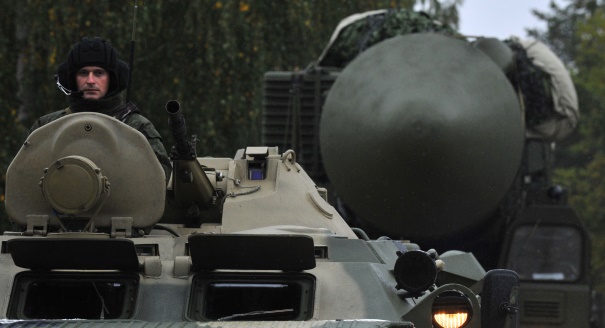
Putin stated that the Russian leadership was ready to use nuclear forces in the days of the Crimean annexation, bringing back the old threat of nuclear war.
Source: The New Times
In Michael Romm’s film Nine Days of One Year, a physicist who was exposed to radiation says to his father, “If we hadn’t created it, we wouldn’t be having this conversation. And half of mankind wouldn’t be here, either.” The word “it” is referring to the bomb.
This statement contains a simple, down-to-earth explanation of nuclear deterrence, which an ordinary Soviet citizen would have easily understood, especially in 1962—the year of the Cuban Missile Crisis, which strangely coincided with the year the film was released. They have a bomb, and so do we. We are balancing each other out. They are modernizing their weapons, and so are we. There is nuclear parity, and everyone understands that the first strike will lead to mutually assured destruction, which deters the superpowers and mankind from nuclear war.
In the years after the fall of the Iron Curtain, nuclear weapons were being reduced, and, at least in theory, the nonproliferation regime was upheld (although according to Alexei Arbatov’s estimates, the stockpiles of weapons are large enough to replicate 30,000 to 40,000 Hiroshima explosions). What is most important, nuclear war stopped being the main fear and was almost forgotten. But here comes Vladimir Putin in the new documentary Crimea. The Way Home with his statement that the Russian leadership was ready to use nuclear forces in the days of the Crimean annexation.So first, it was Nikita Khrushchev in 1962 with the threat of nuclear war over Cuba, and now Vladimir Putin is ready to do the same over Crimea. Incidentally, the Russian president repeatedly called Crimea the source of unique Russian “spirituality” (no one knows where he got it from, but this is not at issue now). But for Khrushchev, Cuba was also a source of genuine and pristine revolutionary “spirituality,” which had been lost by the Soviet Union.
Then, we heard from the people... In a poll conducted by the Moscow Speaks FM radio station, 62 percent of the listeners said they would be ready to use nuclear weapons for the sake of Crimea; the other 38 percent were not. Of course, we have to bear in mind that the station’s listening audience supports the regime, and those ready to participate in such polls belong to a specific and rather aggressive segment of the general population. Nevertheless, these numbers are representative of a certain mental shift among the country’s citizens, their lack of fear and responsibility.
And what else can they get into their heads when the commander-in-chief himself is demonstratively flexing his nuclear muscle?
The Russian leadership actually continues doing it. Three days after the movie was shown on national television, the North Sea naval strategic forces confirmed their combat readiness, and ten strategic Tu-22 bombers were redeployed to Crimea—an ironic twist of fate if one considers that Ukraine allegedly got to keep Crimea in exchange for the country’s nuclear-free status.
Of course, one can say that Putin is mostly speaking to the domestic audience, thus giving the people an extra shot of the “superpower steroid” that sustains his charisma. Such pronouncements are aimed at those who experience geopolitical orgasm after an earful of salacious military rhetoric.
But whether wittingly or not quite, the old threat of the nuclear war is back with this statement. Turning America into the heap of “radioactive ashes” is no longer a metaphor of a narcissistic TV show host. Apparently, nuclear deterrence doesn’t work that well after all under Putin.
This article originally appeared in Russian in The New Times.
Former Senior Fellow, Carnegie Russia Eurasia Center
Kolesnikov was a senior fellow at the Carnegie Russia Eurasia Center.
Recent Work
Andrei Kolesnikov
Andrei Kolesnikov
Carnegie does not take institutional positions on public policy issues; the views represented herein are those of the author(s) and do not necessarily reflect the views of Carnegie, its staff, or its trustees.

Sergei Kiriyenko used Russia’s parliamentary vote to further hone his strategy of corporate mobilization that is designed to maximize votes for United Russia.

Andrey Pertsev

The European far right might fail to steer EU policy in the direction Russia wants, but they will create enough chaos inside Europe to benefit the Kremlin.

Dimitar Bechev

Minsk clearly expected the dialogue with Washington to yield more results, in particular the lifting of EU sanctions and permission to export potash.

Artyom Shraibman

If the Russian-speaking community in Latvia cannot articulate their interests without being seen as disloyal, they could end up embracing a pro-Kremlin agenda.

Sergejs Potapkins

Russia’s ruling party would have benefited from Putin appearing as its distant patron, but as an active frontman imposing his views on the public, he has done nothing but harm both the party’s election campaign and the ruling system overall.
Andrey Pertsev