

Commentary
Andrei Kolesnikov
{
  "authors": [
    "Andrei Kolesnikov"
  ],
  "type": "legacyinthemedia",
  "centerAffiliationAll": "",
  "centers": [
    "Carnegie Endowment for International Peace",
    "Carnegie Russia Eurasia Center"
  ],
  "collections": [],
  "englishNewsletterAll": "",
  "nonEnglishNewsletterAll": "",
  "primaryCenter": "Carnegie Endowment for International Peace",
  "programAffiliation": "",
  "programs": [],
  "projects": [],
  "regions": [
    "Russia",
    "Caucasus"
  ],
  "topics": [
    "Political Reform",
    "Democracy",
    "Economy",
    "Foreign Policy"
  ]
}
Source: Getty
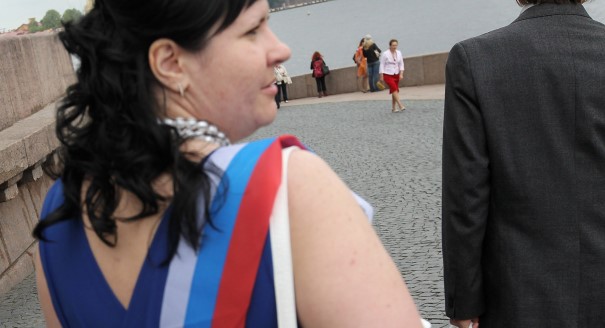
The Western approach to Russia is predicated on the supposition that continued pressure on the country will cause Vladimir Putin’s regime to make concessions or even crumble. However, this is far from the truth.
Source: Project Syndicate
The Western approach to Russia is predicated on the supposition that continued pressure on the country will cause President Vladimir Putin’s regime to make concessions or even crumble. Nothing could be further from the truth.
The assumption underlying the efficacy of Western sanctions is that the sharp economic deterioration that results from them will turn the Russian public, particularly the financial and political elite, against the Kremlin. Putin will not be able to withstand mounting dissent from affluent urban areas and the country’s burgeoning middle class.
Meanwhile, the thinking goes, military pressure – in the form of potential lethal aid to Ukraine – will similarly mobilize ordinary Russians against Putin. Unwilling to see their boys die for the Donbas, they will form an anti-war movement that will force him to rein in his territorial ambitions. Pressed at once from above and from below, the Kremlin will be have to change its policies, and perhaps even begin to democratize.What Western policymakers fail to understand is that such an approach is less likely to undermine the regime than to cause Russians to close ranks behind it. Opinion polls show that Russians perceive Western pressure and sanctions to be aimed not at Putin and his cronies, but at Russia and its citizens. In January, 69% of Russians supported the Kremlin’s policy in Ukraine, according to a poll by the independent Levada Center.
To be sure, Putin’s support is not rock-solid; indeed, there is widespread suspicion about corruption in his government. But Russians have a long tradition of defending their compatriots from outsiders. And in this case, the compatriots under attack are Putin and his government.
Russian propaganda taps a deep well of nationalism, artfully playing off sentiments and imagery from World War II. Known in the country as the Great Patriotic War, the effort to defend the country from German invasion remains sacred to many Russians. That is why the Kremlin has repackaged derogatory historical terms like “Nazis” to refer to Ukraine’s current political elites.
Russian society has been militarized for decades, if not centuries. Military preparedness was one of the most important shared values in the Soviet Union – a sentiment captured in the slogan emblazoned on the badges issued to children who excelled in athletics: “Ready for Work and Defense.”
It is in this context that Putin has been able to use Western pressure as a tool to regain the support of many Russians, who only a few years ago would have felt detached from, if not alienated by, his government. Presented with a real or imagined threat to the fatherland, the average Russian supports the country’s leaders.
Nor is the Russian middle class, which makes up some 20-30% of the population, likely to pose much of a threat to Putin. With many of its members owing their recent wealth to high oil prices and the economic recovery of the 2000s, loyalty to the Putin regime is one of the Russian middle class’s abiding characteristics.
Russian opinion polling and sociological research tends to show that the higher one’s position in society, the more likely one is to vote for the incumbents. The motives behind such voting patterns may vary – some voters made a fortune during the economic recovery, while others are simply satisfied with the status quo. But the bottom line is that such voters demonstrate a fundamental loyalty to the state and the regime.
Indeed, only a small portion of the middle class attended the protests that gathered force in late 2011 and early 2012, most of them concentrated in Moscow. And, in any case, Putin’s clampdown on dissent was predictably ruthless. He tightened legislation aimed at throttling civil society, pursued lawsuits against protesters, and blocked the activity of Alexei Navalny, a promising opposition politician. These efforts have had a lasting effect on the groups that were at the heart of the protest movement.
Russians of all walks of life have shown that they prefer passive adaptation over protest. In the face of growing economic pressures, Russia’s middle class is steering clear of political involvement. The working class is no different. The more the West increases its pressure, the less likely it becomes that this will change.
Former Senior Fellow, Carnegie Russia Eurasia Center
Kolesnikov was a senior fellow at the Carnegie Russia Eurasia Center.
Recent Work
Andrei Kolesnikov
Andrei Kolesnikov
Carnegie does not take institutional positions on public policy issues; the views represented herein are those of the author(s) and do not necessarily reflect the views of Carnegie, its staff, or its trustees.

Putin’s conservative staffing policies and search for ever greater control have cemented parliament’s transformation into a bureaucratic appendage of the executive branch.

Andrey Pertsev

Russia’s AI-driven propaganda campaigns operate in a fragmented, chaotic, and often illogical manner. That’s not necessarily a problem for the Kremlin, though: It’s much easier to mimic genuine public debate that way.

Ilya Klishin

Without a ceasefire with Ukraine on attacking each other’s energy infrastructure—to which the Kremlin is unlikely to agree—the diesel agreement between Putin and Trump is largely for show, rather than representing a genuine increase in the volumes of Russian diesel on the global market.

Sergey Vakulenko

Russian strikes are weakening the economy sustaining Ukraine’s war effort. Closing the growing funding gap will require more European support and politically contentious reforms in Kyiv.

Balázs Jarábik

Ex-president Gurbanguly Berdimuhamedov remains interested in politics, but his son Serdar, Turkmenistan’s current president, is becoming increasingly independent and willing to break with his father’s legacy. If their covert rivalry goes too far, both risk losing power.

Galiya Ibragimova