

Commentary
Andrei Kolesnikov
{
  "authors": [
    "Andrei Kolesnikov"
  ],
  "type": "commentary",
  "centerAffiliationAll": "",
  "centers": [
    "Carnegie Endowment for International Peace",
    "Carnegie Russia Eurasia Center"
  ],
  "collections": [
    "Inside Russia"
  ],
  "englishNewsletterAll": "",
  "nonEnglishNewsletterAll": "",
  "primaryCenter": "Carnegie Endowment for International Peace",
  "programAffiliation": "",
  "programs": [],
  "projects": [],
  "regions": [
    "Russia"
  ],
  "topics": [
    "Political Reform",
    "Democracy",
    "Civil Society"
  ]
}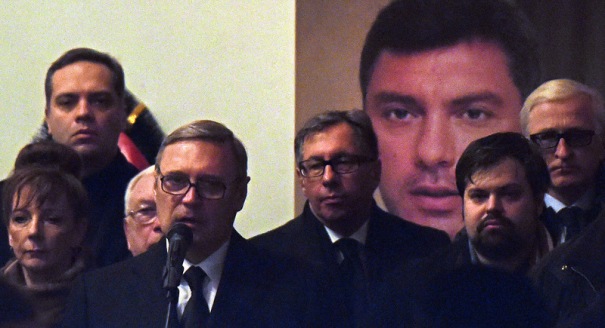
Source: Getty
In order to keep the ranks closed and to sustain the Stockholm syndrome of the fortress’s defenders there must be constant discoveries of “a fifth column” and “national traitors.” That’s the only sense in which Russian authorities need liberals.
Nearly three years after President Vladimir Putin’s return to the country’s top post, and a year after the annexation of Crimea , Russian authorities seem to have solved their liberal problem once and for all. Up until relatively recently, liberals were useful for a number of reasons: to imitate democracy and political process; to help let off steam; to retain, as strange as it may sound, some element of feedback.
But after the new low in relations with the West—unprecedented in probably the past 30 years—there is no need to imitate anything, including the existence of liberal parties, like Mikhail Prokhorov’s Civic Platform, which was recently abandoned by its founder. There is no need to pretend that whistleblower Alexei Navalny can exist as a legitimate political player; it’s enough to block his activity almost completely, besetting him for good measure with a criminal sentence. There is no need to be embarrassed about anything: On the contrary, the prosecution of the Bolotnaya demonstrators will always remind those who favor street protests what consequences could lie in store for them. And if the West has anything to say, the reply will come from Russian television—“senseless and merciless,” to borrow a quote from Pushkin. With the ranks now closed so tightly around a single person, the techniques for letting off steam have changed too: Say, the commuter trains have stopped running; out comes the nation’s leader with the words “Have you lost your minds?” and the trains start rolling again. Magic tricks at the request of the laboring masses. Superhero to the rescue.
Naturally, this situation will change. One reason is the need, in the medium term (or maybe the long term), for a genuinely liberal economic policy, not just, in the words of one insider, “a redistribution of the money that [civic activist and former Finance Minister Alexei] Kudrin socked away for them” in the Reserve Fund. A second reason is Russia’s inevitable pattern of alternating reforms and counter-reforms. This was equally inevitable 30 years ago when Mikhail Gorbachev came to power after the death of Konstantin Chernenko, when nobody—not the administrative core of the Communist Party’s Central Committee, not the regional party heads, not ordinary Soviet citizens—would have been able to bear another gerontocrat at the helm. Any contest has its limits, though, whether it be an arms race, a competition to see who can bury the most general secretaries the fastest, or a throwdown of “patriotic” foolishness. In line with this historical logic, here’s a hypothesis to consider: After Stalin died, Nikita Khrushchev emerged victorious from the internal battle for power among him, Georgy Malenkov and Lavrentiy Beria. With all due respect to Khrushchev’s achievements, it’s plausible that, had Malenkov come out on top, the kudos for de-Stalinization would have gone to him, and even Beria, had he been the winner, might have traded in his status as bloodthirsty executioner for a reformer’s mantle. That’s how the laws of history are: ironclad, not liberal.
This publication originally appeared in Russian in Vedomosti.
Former Senior Fellow, Carnegie Russia Eurasia Center
Kolesnikov was a senior fellow at the Carnegie Russia Eurasia Center.
Recent Work
Andrei Kolesnikov
Andrei Kolesnikov
Carnegie does not take institutional positions on public policy issues; the views represented herein are those of the author(s) and do not necessarily reflect the views of Carnegie, its staff, or its trustees.

If the Russian-speaking community in Latvia cannot articulate their interests without being seen as disloyal, they could end up embracing a pro-Kremlin agenda.

Sergejs Potapkins

Russia’s ruling party would have benefited from Putin appearing as its distant patron, but as an active frontman imposing his views on the public, he has done nothing but harm both the party’s election campaign and the ruling system overall.

Andrey Pertsev

Depleted financial reserves and a shrinking tax base mean it is no longer possible to simultaneously deliver high defense spending, price stability, and economic growth.

Alexandra Prokopenko

Blurring the line between humans and animals is a long-standing tradition in social utopian prose. In his latest novel, Leonid Bershidsky reminds us that in social experiments, people are often treated no differently than animals.

Alexander Baunov

In the tenth year of his presidency, President Mirziyoyev’s system is becoming even more personalized than that of his predecessor Karimov.

Galiya Ibragimova