

Article
C. Raja Mohan, Darshana M. Baruah
{
  "authors": [
    "C. Raja Mohan"
  ],
  "type": "legacyinthemedia",
  "centerAffiliationAll": "dc",
  "centers": [
    "Carnegie Endowment for International Peace",
    "Carnegie India"
  ],
  "collections": [],
  "englishNewsletterAll": "ctw",
  "nonEnglishNewsletterAll": "",
  "primaryCenter": "Carnegie India",
  "programAffiliation": "SAP",
  "programs": [
    "South Asia"
  ],
  "projects": [],
  "regions": [
    "South Asia",
    "India",
    "Russia"
  ],
  "topics": [
    "Foreign Policy"
  ]
}
Source: Getty
The Indian armed forces played a decisive role in winning the two World Wars. But national amnesia about India’s role in the two wars tended to diminish the subcontinent’s massive contributions to the shaping of the 20th century international order.
Source: Indian Express
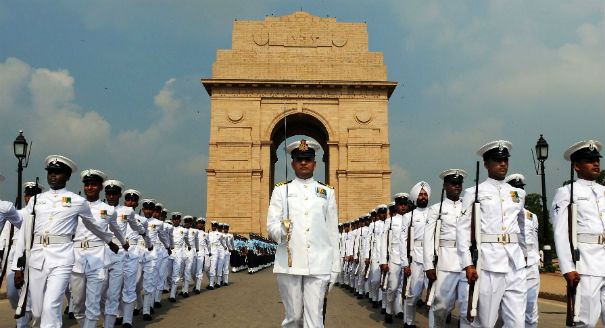
President Pranab Mukherjee’s visit to Moscow to join the celebrations marking the 70th anniversary of the Allied victory in World War II is important for more than one reason. The president’s presence at the Victory Day celebrations in Russia on May 9 for the first time is in part about extending New Delhi’s solidarity with Moscow at a time when many Western leaders have decided not to show up in protest against Russian President Vladimir Putin’s policy in Ukraine. It is also about reclaiming India’s expansive but forgotten role in WWII. Mukherjee will not be the only Indian at the parade. A contingent of the Indian army’s Grenadiers Regiment will march with the troops of Russia down the Red Square. This is the first time that an Indian army unit is joining the commemorative ceremonies of WWII.
In 2009, France invited an Indian army unit to march down the Champs Elysees in Paris on Bastille Day. Paris was reminding the people of France and Europe of India’s massive participation in World War I. The Indian armed forces played a decisive role in winning the two World Wars, with more than a million troops seeing action. But national amnesia about India’s role in the two wars tended to diminish the subcontinent’s massive contributions to the shaping of the 20th century international order.
The presence of the Indian army and its commander in chief in Moscow this week reflects the long overdue change in Delhi’s attitude to the two World Wars.Prime Minister Narendra Modi has not missed the opportunities over the last year to remind the nation and the world of the sacrifices that India made during the Great War, as WWI is known in Europe.
The significant Indian participation in the Great War did not generate too much of a political controversy in the subcontinent. Mahatma Gandhi himself volunteered to join the army in defence of colonial Britain. But WWII had deeply divided the Indian national movement. Sections of it, including communists, supported Britain and the Allies. Others like Subhas Chandra Bose chose to ally with Germany and Japan to accelerate Indian independence.
The Congress acknowledged the importance of fighting fascism, but refused to extend support to the war effort of the Raj. It walked out of the elected legislatures and launched the Quit India Movement that opened up huge political space for the Muslim League.
It serves no purpose today to sit in judgment on India’s divided response to WWII. But India needs to be aware of that complex history and recognise its critical role in helping the Allies win WWII. Mukherjee’s presence in Moscow takes us one important step towards that goal.
Reclaiming history must be a necessary part of India’s new ambition under Modi to become a leading power in the international system. Thanks to the resounding role of the Indian armed forces in WWII, India had an opportunity to shape the postwar order. But Partition of the subcontinent, India’s inward economic orientation and its increasing alienation from the West meant Delhi put itself on a path of relative decline on the world stage.
Seven decades later, India finds itself in a unique position. Its relations with all the major powers are improving. Growing economic weight offers India an opportunity to reintegrate the economy of the subcontinent, contribute to the creation of a new order in Asia and reshape international institutions.
It has been fashionable to claim in recent years that India is a “net security provider” in the Indian Ocean and beyond. Yet, if we look back at the first half of the 20th century, there is no denying the centrality of India and its military resources in dealing with the greatest threats to international peace and security. Mukherjee’s visit to Moscow must be followed by a celebration of India’s role in bringing WWII to a close in Asia. More than 7,00,000 Indian troops led the effort to end the Japanese occupation of Southeast Asia. Thousands of troops from the British Commonwealth, including Africa, joined the Indian army’s courageous march through Burma. The campaign in Asia saw an active partnership between the armed forces of India, America and Nationalist China. It was truly an international effort.
The war, of course, involved all of the undivided subcontinent and the 70th anniversary is a good occasion to bring the armies of South Asia together in commemorating it. Building a grand joint memorial in the subcontinent for the war is an idea whose time has come.
This article was originally published in the Indian Express.
Former Nonresident Senior Fellow, Carnegie India
A leading analyst of India’s foreign policy, Mohan is also an expert on South Asian security, great-power relations in Asia, and arms control.
Recent Work

C. Raja Mohan, Darshana M. Baruah


Alexander Gabuev, Paul Haenle, C. Raja Mohan, …
Carnegie does not take institutional positions on public policy issues; the views represented herein are those of the author(s) and do not necessarily reflect the views of Carnegie, its staff, or its trustees.

The European far right might fail to steer EU policy in the direction Russia wants, but they will create enough chaos inside Europe to benefit the Kremlin.

Dimitar Bechev

Minsk clearly expected the dialogue with Washington to yield more results, in particular the lifting of EU sanctions and permission to export potash.

Artyom Shraibman

Russia’s ruling party would have benefited from Putin appearing as its distant patron, but as an active frontman imposing his views on the public, he has done nothing but harm both the party’s election campaign and the ruling system overall.

Andrey Pertsev

Depleted financial reserves and a shrinking tax base mean it is no longer possible to simultaneously deliver high defense spending, price stability, and economic growth.

Alexandra Prokopenko

Blurring the line between humans and animals is a long-standing tradition in social utopian prose. In his latest novel, Leonid Bershidsky reminds us that in social experiments, people are often treated no differently than animals.

Alexander Baunov