

Article
C. Raja Mohan, Darshana M. Baruah
{
  "authors": [
    "C. Raja Mohan"
  ],
  "type": "legacyinthemedia",
  "centerAffiliationAll": "dc",
  "centers": [
    "Carnegie Endowment for International Peace",
    "Carnegie India"
  ],
  "collections": [],
  "englishNewsletterAll": "ctw",
  "nonEnglishNewsletterAll": "",
  "primaryCenter": "Carnegie Endowment for International Peace",
  "programAffiliation": "SAP",
  "programs": [
    "South Asia"
  ],
  "projects": [],
  "regions": [
    "India",
    "Southeast Asia",
    "China",
    "South Asia",
    "East Asia",
    "Myanmar"
  ],
  "topics": [
    "Foreign Policy"
  ]
}
Source: Getty
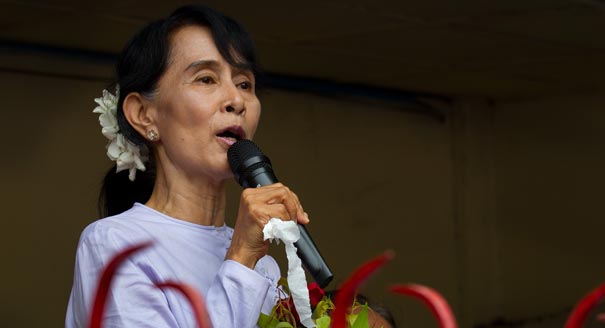
As Suu Kyi recasts the relations between Myanmar’s democratic forces and Beijing, Delhi can’t allow the security agenda dominate its ties with Naypyidaw.
Source: Indian Express
Transfixed by the Indian Army’s action against the militant groups at the Myanmar border last week, Delhi has tended to ignore another important event on our eastern frontiers: Aung San Suu Kyi’s first ever visit to China.
In rolling out the red carpet for Suu Kyi, Beijing hopes to put its future relations with Myanmar, which have seen much strain in recent years, on secure political foundation. As she comes close to installing her party in power in the elections later this year, Suu Kyi too recognised the need for a practical approach to China.
In Suu Kyi’s courageous struggle for democracy in Myanmar since the late 1980s, China was a major part of the problem. When the rest of the world was isolating the military regime that cracked down on the democracy movement, Beijing became the principal external backer for the junta.From the early 1990s to early 2010s, China’s weight and influence in Myanmar grew rapidly even as the hopes for the country’s democratisation dimmed. But the limited political reform initiated in 2011 resulted in a quick reversal of China’s political fortunes.
Popular protests against two major Chinese infrastructure projects — a hydroelectric dam and a copper mine — led the semi-civilian transitional government in Naypyidaw suspend work on both of them. New Chinese investments in Myanmar have reportedly dipped from nearly $ 8 billion in 2011 to 500 million to the year ending March 2015.
Political reform was also followed by the significant diversification of Myanmar’s foreign relations. Myanmar’s new warmth towards the United States and Japan is obviously of some strategic concern for Beijing.
Meanwhile there have been mounting tensions on the Sino-Myanmarese border with Naypyidaw accusing Beijing of supporting the Kokang rebels on their shared frontier.
Beijing is trying to overcome these setbacks in a country that is has long considered China’s backyard. It has chosen to intensify the engagement with Myanmar. It has begun to cultivate ties with all the major political formations at the national and regional levels in Myanmar after decades of enjoying the luxury of dealing with the military junta.
Beijing has also reached out to the civil society groups protesting against the Chinese infrastructure projects in Myanmar. As Suu Kyi headed to Beijing last week, it got the Kokang rebels in Myanmar’s north to announce a unilateral ceasefire.
Although Suu Kyi is barred from holding high constitutional office, she is bound to wield decisive influence over the government that will emerge out of Myanmar’s first democratic elections in quarter of a century. Suu Kyi’s party, the National League of Democracy is widely expected to very well in these elections to be held in November.
If China’s stakes in Myanmar are massive and enduring, Suu Kyi can’t ignore Myanmar’s deep historic ties with China and the logic of geography. Economic partnership with Beijing will necessarily remain a critical consideration for the next government in Naypyidaw led by the NLD.
As Suu Kyi recasts the relations between Myanmar’s democratic forces and Beijing, Delhi can’t allow the security agenda dominate its ties with Naypyidaw. Although an effective management of the border with Myanmar will remain a high priority for India for the foreseeable future, India has much else to do with Myanmar.
India’s economic, political and strategic engagement with Myanmar remains way below potential. Changing that must be as important as chasing militants along and across the vast frontier with Myanmar.
This article was originally published by the Indian Express.
Former Nonresident Senior Fellow, Carnegie India
A leading analyst of India’s foreign policy, Mohan is also an expert on South Asian security, great-power relations in Asia, and arms control.
Recent Work

C. Raja Mohan, Darshana M. Baruah


Alexander Gabuev, Paul Haenle, C. Raja Mohan, …
Carnegie does not take institutional positions on public policy issues; the views represented herein are those of the author(s) and do not necessarily reflect the views of Carnegie, its staff, or its trustees.

Without a ceasefire with Ukraine on attacking each other’s energy infrastructure—to which the Kremlin is unlikely to agree—the diesel agreement between Putin and Trump is largely for show, rather than representing a genuine increase in the volumes of Russian diesel on the global market.

Sergey Vakulenko

Despite a new textbook, an influx of Russian teachers and managers, and an end to the teaching of Ukrainian, the Kremlin is unlikely to have “reprogrammed” locals.

Konstantin Skorkin

Cargo traffic through Russia’s Northern Sea Route has increased because of the disruption caused by the conflict in the Middle East, the Ukraine war, and U.S.-China tensions.

Mikhail Korostikov

Minsk clearly expected the dialogue with Washington to yield more results, in particular the lifting of EU sanctions and permission to export potash.

Artyom Shraibman

With the growth in points of friction between the great powers, organizations like the SCO will continue to play a role in the strategic adaptation of the smaller powers caught between them.

Temur Umarov