

Commentary
Evan A. Feigenbaum
{
  "authors": [
    "Evan A. Feigenbaum"
  ],
  "type": "legacyinthemedia",
  "centerAffiliationAll": "dc",
  "centers": [
    "Carnegie Endowment for International Peace",
    "Carnegie China"
  ],
  "collections": [],
  "englishNewsletterAll": "asia",
  "nonEnglishNewsletterAll": "",
  "primaryCenter": "Carnegie China",
  "programAffiliation": "AP",
  "programs": [
    "Asia"
  ],
  "projects": [],
  "regions": [
    "North America",
    "United States",
    "East Asia",
    "China",
    "South Korea",
    "Central Asia"
  ],
  "topics": [
    "Foreign Policy"
  ]
}
Source: Getty
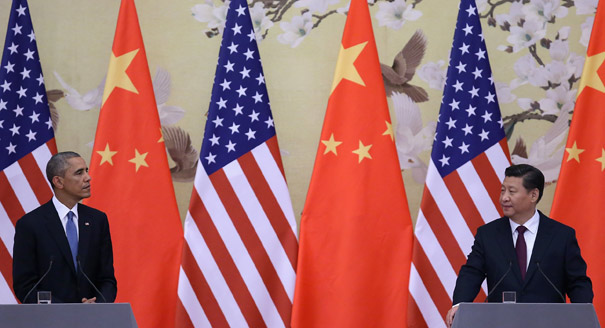
As tensions increase between China and the United States over the value of the yuan, alleged cyber attacks, and other issues, how should the Obama administration conduct the upcoming state visit by Chinese President Xi Jinping?
Source: ChinaFile
It has long been presumed that economic integration can and will mitigate U.S.-China security competition. But to put it bluntly, this does not seem to be happening. So when President Xi Jinping visits Washington next month, it is essential that the U.S. and China use his visit to confront, not tiptoe around, the underlying reasons for this.
The central problem in Asia today is the collision between economics and security. In “Economic Asia,” a dynamic group of countries, including China and the United States, trades, invests, and increasingly innovates together. This Asia is a prosperous $21 trillion juggernaut and, especially since the 2008 global financial crisis, has become the center of gravity in the world economy. But another Asia, “Security Asia,” has locked many of these same countries into an increasingly debilitating cycle of competition, arms buildups, and clashing security concepts. Instead of an “Asian century,” the region’s story resembles a “Tale of Two Asias,” with economics and security colliding, not running in parallel.That is precisely the dynamic that confronts Presidents Xi and Obama. The United States and China have never been so economically integrated: Two-way trade has reached nearly $600 billion, and the total value of Chinese investments in the United States, once minuscule, has passed a staggering $54 billion, with (very) considerable room to grow. Yet despite that integration, security tensions have escalated apace.
At the simplest level, the problem involves choices and policies in the South China Sea, cyber-related tensions, and so on. But there are four deeper problems that exacerbate security tensions and, more strikingly, make coordination difficult even on issues where the two sides share interests:
First, Washington and Beijing have some clashing security concepts in Asia and, as a result, increasingly are talking past each other. In the South China Sea, for example, Beijing asserts maritime rights and interests, while Washington talks mostly about international norms, rules, and law. The two governments disagree, fundamentally, on how to interpret some important aspects of international law. Indeed, the U.S. perceives that China acts as if its interests trump international law.
Second, even when the two sides share interests, these are, too often, overly general in nature—“peace,” “stability,” “security,” “non-provocation,” and so on.
Third, the two sides often view one another’s policies as undermining their ostensibly “shared” interests. Take North Korea: some Americans argue that Chinese policies have shielded Pyongyang from the effects of the international sanctions Beijing voted for. Or look at Central Asia, where the two sides repeatedly have declared a shared commitment to “stability” and “security.” As Deputy Assistant Secretary of State for the region in 2006 and 2007, `I heard Chinese officials argue ad infinitum that U.S. actions to promote political reform would undermine this shared interest and, ultimately, destabilize these countries.
Fourth, the U.S. and China have had trouble turning (abstract) common interests into (concrete) complementary policies because of countervailing interests that, too often, obstruct cooperation. In Afghanistan, for example, China certainly has shared America’s core interest for over a decade: a stable Afghan state that does not harbor, nurture, or export terrorism. But cooperation proved elusive for much of this period because Beijing never relished a path to victory that might yield a long-term NATO presence on China’s western border or require U.S. access agreements in Central Asia.
For one, the U.S. and China need to thicken economic cooperation, and soon, especially around two-way investment. This will not overcome security competition but at least it will help to anchor it in a strengthened framework. This would mean, for example, making real gains toward a serious Bilateral Investment Treaty and demonstrable progress on the cyber problem, which threatens to ride the relationship off the rails and, in collateral damage, undermine support for U.S.-China ties in corporate America.
Similarly, the U.S. and China badly need a track record of concrete successes in places where shared strategic interests exist but remain too abstract. This doesn’t require joint projects and actions, merely complementary ones. Take, for example, counternarcotics in Afghanistan and Central Asia: China works bilaterally and through the Shanghai Cooperation Organization; the United States works mostly bilaterally through security assistance and capacity building. But Washington and Beijing don’t need joint efforts, just to coordinate areas of focus, direct their financial assistance at similar drugs-related goals, and build complementary capacity while maintaining separate efforts.
Ultimately, to deploy an American baseball metaphor, this means not always “swinging for the fences.” Often, the U.S. has sought security cooperation with China, but failed. But working on more peripheral issues can give the two countries a chance to work over time toward more significant strategic issues. For instance, coordinating some international economic policies will likely prove easier than coordinating security policies. One example would be to encourage coordination between the international financial institutions and the new China-backed Asian Infrastructure Investment Bank. That would provide both sides some multilateral “cover,” and thus prove easier than coordinating bilaterally.

Vice President for Studies
Evan A. Feigenbaum is vice president for studies at the Carnegie Endowment for International Peace, where he oversees work at its offices in Washington, New Delhi, and Singapore on a dynamic region encompassing both East Asia and South Asia. He served twice as Deputy Assistant Secretary of State and advised two Secretaries of State and a former Treasury Secretary on Asia.
Recent Work
Evan A. Feigenbaum
Evan A. Feigenbaum
Carnegie does not take institutional positions on public policy issues; the views represented herein are those of the author(s) and do not necessarily reflect the views of Carnegie, its staff, or its trustees.

Japan’s long-term security policy is driven by concerns about China, and there is little appetite for (or interest in) pursuing a confrontation with Moscow.

James D.J. Brown

Without a ceasefire with Ukraine on attacking each other’s energy infrastructure—to which the Kremlin is unlikely to agree—the diesel agreement between Putin and Trump is largely for show, rather than representing a genuine increase in the volumes of Russian diesel on the global market.

Sergey Vakulenko

Ex-president Gurbanguly Berdimuhamedov remains interested in politics, but his son Serdar, Turkmenistan’s current president, is becoming increasingly independent and willing to break with his father’s legacy. If their covert rivalry goes too far, both risk losing power.

Galiya Ibragimova

Despite a new textbook, an influx of Russian teachers and managers, and an end to the teaching of Ukrainian, the Kremlin is unlikely to have “reprogrammed” locals.

Konstantin Skorkin

Cargo traffic through Russia’s Northern Sea Route has increased because of the disruption caused by the conflict in the Middle East, the Ukraine war, and U.S.-China tensions.

Mikhail Korostikov