

Article
C. Raja Mohan, Darshana M. Baruah
{
  "authors": [
    "C. Raja Mohan"
  ],
  "type": "legacyinthemedia",
  "centerAffiliationAll": "dc",
  "centers": [
    "Carnegie Endowment for International Peace",
    "Carnegie India"
  ],
  "collections": [],
  "englishNewsletterAll": "ctw",
  "nonEnglishNewsletterAll": "",
  "primaryCenter": "Carnegie India",
  "programAffiliation": "SAP",
  "programs": [
    "South Asia"
  ],
  "projects": [],
  "regions": [
    "South Asia",
    "Pakistan",
    "India"
  ],
  "topics": [
    "Foreign Policy"
  ]
}
Source: Getty
In refusing to call off the talks between Indian and Pakistani national security advisers, Modi might be signalling the strength to rethink the core assumptions of India’s recent Pakistan policy.
Source: Indian Express
Prime Minister Narendra Modi’s Pakistan policy continues to surprise. A year ago, the Modi government called off the foreign secretary’s visit to Islamabad when Pakistan’s high commissioner in Delhi, Abdul Basit, met a group of Kashmiri separatists.
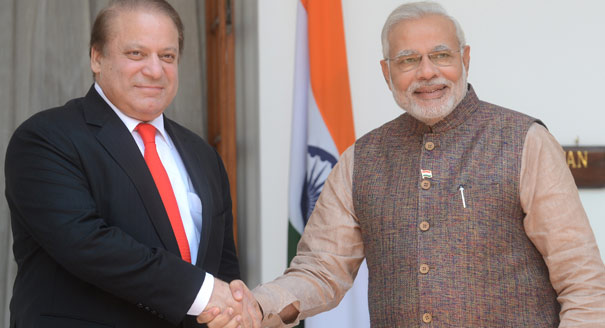
Modi has decided not to respond in the same manner when confronted with a similar situation on the eve of the talks in Delhi between the two national security advisers, Ajit Doval and Sartaj Aziz.
Senior officials in Delhi have made no secret of their anger at Pakistan’s decision to invite the Hurriyat leaders to meet Aziz who is arriving here on Sunday.They have also said that Islamabad’s decision follows Pakistan army’s deliberate provocations on the Line of Control, and the recent terrorist incidents at Gurdaspur and Udhampur.
Delhi believes that the civilian government in Pakistan is under pressure from its army to walk back from the understandings reached last month between Prime Minister Nawaz Sharif and Modi on the margins of a multilateral gathering in Ufa, Russia.
The two leaders had agreed to convene a dialogue on terrorism between the two national security advisers and get their security forces to find ways to de-escalate the military tensions on the Line of Control.
In Pakistan, there was a strong view that Sharif had ceded too much ground to Modi by agreeing to ‘stand alone’ talks on terrorism. The tradition in Pakistan is to put the question of Jammu & Kashmir on par with India’s concerns on cross-border terrorism.
If the Pakistan army was hoping that its provocations might compel India to call off the talks again, Delhi says it is in no mood to oblige. For the moment, the Modi government has chosen “anger management” as it contemplates the next steps in dealing with Pakistan.
Some reports suggest that Delhi might have a ‘surprise’ in store for Pakistan at the talks between the Doval and Aziz this weekend. Unpredictability is not without its value in international diplomacy. Its keeps your adversaries guessing and off balance.
Unpredictability, however, complicates the domestic management of negotiations with rivals and difficult partners. The Modi government is already under attack at home for its flip-flops on Pakistan.
Critics point to Modi’s decision to invite Sharif for his swearing in ceremony last May, the abrupt cancellation of talks a few months later and the decision to renew the dialogue last month.
Modi government is not the first one in Delhi to find itself on a roller coaster with Pakistan. “On again, off again” has been the general pattern of the engagement between India and Pakistan for many years.
What we don’t know yet is whether Modi’s Pakistan policy is falling into this mould. Unlike many of its recent predecessors, Modi has the domestic political clout to avoid bending to the volatile domestic mood swings in Pakistan.
In the last few weeks, Modi has shown the capacity to ‘grin and bear it’ as Sharif could not sustain his Ufa commitments. In refusing to act in a predictable manner and call off the NSA talks, Modi might be signalling the strength to rethink the core assumptions of India’s recent Pakistan policy.
But unpredictability, can’t be an end itself. The ability to generate frequent tactical surprise must be part of a well-crafted strategy. Sooner than later, Modi will have tell the nation that he has one and what it is.
This article was originally published in the Indian Express.
Former Nonresident Senior Fellow, Carnegie India
A leading analyst of India’s foreign policy, Mohan is also an expert on South Asian security, great-power relations in Asia, and arms control.
Recent Work

C. Raja Mohan, Darshana M. Baruah


Alexander Gabuev, Paul Haenle, C. Raja Mohan, …
Carnegie does not take institutional positions on public policy issues; the views represented herein are those of the author(s) and do not necessarily reflect the views of Carnegie, its staff, or its trustees.

Japan’s long-term security policy is driven by concerns about China, and there is little appetite for (or interest in) pursuing a confrontation with Moscow.

James D.J. Brown

Without a ceasefire with Ukraine on attacking each other’s energy infrastructure—to which the Kremlin is unlikely to agree—the diesel agreement between Putin and Trump is largely for show, rather than representing a genuine increase in the volumes of Russian diesel on the global market.

Sergey Vakulenko

Despite a new textbook, an influx of Russian teachers and managers, and an end to the teaching of Ukrainian, the Kremlin is unlikely to have “reprogrammed” locals.

Konstantin Skorkin

Cargo traffic through Russia’s Northern Sea Route has increased because of the disruption caused by the conflict in the Middle East, the Ukraine war, and U.S.-China tensions.

Mikhail Korostikov

Minsk clearly expected the dialogue with Washington to yield more results, in particular the lifting of EU sanctions and permission to export potash.

Artyom Shraibman