

Article
Paul Stronski
{
  "authors": [
    "Paul Stronski"
  ],
  "type": "legacyinthemedia",
  "centerAffiliationAll": "dc",
  "centers": [
    "Carnegie Endowment for International Peace"
  ],
  "collections": [
    "Inside Russia"
  ],
  "englishNewsletterAll": "ctw",
  "nonEnglishNewsletterAll": "",
  "primaryCenter": "Carnegie Endowment for International Peace",
  "programAffiliation": "russia",
  "programs": [
    "Russia and Eurasia"
  ],
  "projects": [],
  "regions": [
    "North America",
    "United States",
    "Russia",
    "Western Europe"
  ],
  "topics": [
    "Climate Change",
    "Foreign Policy"
  ]
}
Source: Getty
The newest Russian territorial claim in the Arctic is not so much an attempt at further expansionism as it is a theatrical means of distracting from growing economic and social problems at home.
Source: Reuters
In the wake of Moscow’s aggression in Ukraine, many of Russia’s neighbors in the Arctic are feeling antsy. Yet some observers’ attempts to blast Moscow’s recent claim to 463,000 square miles of the Arctic as an aggressive “land grab,” evidence of another Obama administration foreign policy failure, or the creation of a next “front” in a New Cold War don’t ring true.
This is less about President Barack Obama and more about Russian President Vladimir Putin and his efforts to consolidate power at home. Russian living standards are falling and the state budget is shrinking — due in part to the global isolation Moscow faces from its Ukraine policies. So, the Kremlin is increasingly resorting to theatrics and trying to “stick it to the West” in any way it can in an attempt to divert public attention from growing social and economic problems.It is unlikely Russia will really succeed in this expansive territorial claim. Russia is just one of several Arctic states claiming territory — including the natural resources — through the United Nations Convention on the Law of the Sea. This convention allows littoral nations to establish an exclusive economic zone more than 200 nautical miles off their coast if they prove this area lies over a natural extension of that country’s continental shelf. Denmark, for example, submitted a claim to the United Nations last December; Canada is expected to do so soon.
Moscow made a similar claim in 2002, but was rejected by the United Nations for lack of scientific evidence. So, for the past decade Russia and other Arctic states have been mapping their coastlines to try to prove their continental shelves extend up to the North Pole. Because the science here is not exact, the United Nations will have to mediate between competing national claims.
When making this claim, Russia abided by international law — in contrast to its 2014 illegal annexation of Crimea and the subsequent war in Ukraine.
One obvious reason Russia and the other nations are making these claims now is that global warming has opened up the Arctic. There has been greater human activity, including oil and gas exploration, new shipping lanes that can reduce sea transit times between continents and adventure tourism in the far north. All could prove lucrative.
Russia’s Arctic gamble, however, is also an attempt to focus the Russian public’s attention from the Ukraine war — which isn’t going terribly well — and the growing problems at home. The Kremlin’s grand plans for establishing Novorossiya in Ukraine have collapsed. Russian proxies now control only two small separatist statelets.
They do so only with active help of the Russian military, which has given up all pretense of non-involvement in Ukraine. Russian mothers, who remember Chechnya and Afghanistan, are nervous about their sons being sent off to a third futile war in a generation. The Kremlin is increasingly worried about the political toll such casualties might have on Putin’s hold on power. Because problems abound for the Kremlin.
The Russian economy is shrinking, hammered by a combination of weak oil prices and Western sanctions. It is confronting inflation and local budget deficits, as well as popular grumbling. Russian liberal elites are unhappy that the relationship with the West has gotten so toxic. Conservatives are displeased that the Ukraine war has not led to a decisive victory for Moscow. Meanwhile, China, now struggling economically, is clearly not going to be the economic lifeline that the Kremlin hoped for.
In addition, Russia’s Arctic claim is another instrument in the Kremlin’s tool-kit for standing up to the West. Consider, all the other Arctic states are either European or North American — and have joined in levying sanctions on Moscow. So this claim is a win-win for the Kremlin: If the United Nations sides with Russia, the Kremlin can present it as a victory for Putin’s foreign policy; if it rejects Russia’s claim, the Kremlin can spin it as yet another example of the West undermining Russia.
The United States need not be alarmist about Russia’s Arctic claim or its ambitious plans for the region. Moscow’s bark — for example, a new Arctic Commission to promote economic development and ambitious plans to increase its military footprint there — is likely to be a lot worse than its bite.
Because the money to implement all these ambitious plans is not there. The Russian economy is projected to shrink by 4 percent to 5 percent this year and again in 2016. When it again starts to grow, its pace is likely to be anemic. Cut off from international credit markets by Western sanctions, Russia cannot pony up or borrow the funds it needs to develop the region.
Western sanctions have also sharply reduced Moscow’s ability to attract foreign investors. Western oil majors, for example, are explicitly blocked by the sanctions regime from working in the Arctic. Yet Russia needs the oil industry’s cash and resources to follow through on its ambitious plans.
Nonetheless Moscow’s moves should be a wake-up call for Washington to focus on its own Arctic strategy. The United States has the second-largest Arctic population after Russia. However, Washington cannot claim an exclusive zone off the coast of Alaska because it never ratified the U.N. Convention on the Law of the Sea,, which dates back to 1982. Because it never signed on to the convention, Washington has limited say in the U.N. body that mediates these claims.
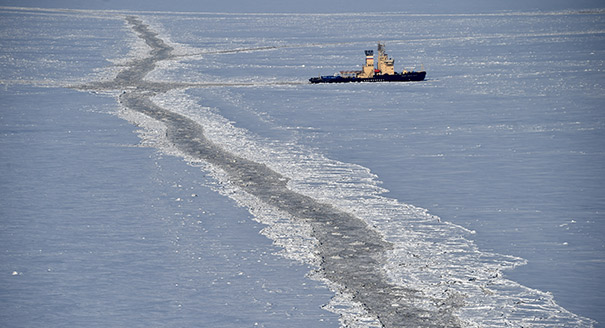
For years, the United States has under-invested in capabilities to navigate and patrol the Arctic. It has only two active polar icebreakers in its Coast Guard fleet. Only one of them, commissioned in 1976 and already past its 30-year service life, has the capability to patrol the Arctic year round. Overall, the United States has fewer icebreakers than Russia, Finland, Sweden or Canada.
Instead of focusing on Russian posturing, the United States should concentrate on its major challenge — becoming a real Arctic state by first funding and building modern icebreakers.
Otherwise, Russia’s claim will not matter. Because the United States will lack the basic ability to navigate the changing Arctic over the long term.
Former Senior Fellow, Russia and Eurasia Program
Paul Stronski was a senior fellow in Carnegie’s Russia and Eurasia Program, where his research focuses on the relationship between Russia and neighboring countries in Central Asia and the South Caucasus.
Recent Work
Paul Stronski
Paul Stronski
Carnegie does not take institutional positions on public policy issues; the views represented herein are those of the author(s) and do not necessarily reflect the views of Carnegie, its staff, or its trustees.

Russia’s ruling party would have benefited from Putin appearing as its distant patron, but as an active frontman imposing his views on the public, he has done nothing but harm both the party’s election campaign and the ruling system overall.

Andrey Pertsev

Depleted financial reserves and a shrinking tax base mean it is no longer possible to simultaneously deliver high defense spending, price stability, and economic growth.

Alexandra Prokopenko

Blurring the line between humans and animals is a long-standing tradition in social utopian prose. In his latest novel, Leonid Bershidsky reminds us that in social experiments, people are often treated no differently than animals.

Alexander Baunov

While France and Australia are seeking to establish the legal obligations of messaging apps like Telegram, Russia wants total subordination.

Maria Kolomychenko

The recent uncovering of Dmitry Donskoy’s relics in the Cathedral of the Archangel is yet another attempt by the Russian Orthodox Church to help the state solve its problems. However, parroting the state’s version of Russian history leaves the Church with no message except “patriotism.”
Alexander Zanemonets