

Commentary
Putin’s conservative staffing policies and search for ever greater control have cemented parliament’s transformation into a bureaucratic appendage of the executive branch.
Andrey Pertsev
{
  "authors": [],
  "type": "other",
  "centerAffiliationAll": "dc",
  "centers": [
    "Carnegie Endowment for International Peace"
  ],
  "collections": [],
  "englishNewsletterAll": "asia",
  "nonEnglishNewsletterAll": "",
  "primaryCenter": "Carnegie Endowment for International Peace",
  "programAffiliation": "AP",
  "programs": [
    "Asia"
  ],
  "projects": [],
  "regions": [
    "East Asia",
    "Taiwan"
  ],
  "topics": [
    "Political Reform",
    "Democracy"
  ]
}
Source: Getty
Background to the candidates and issues at stake in Taiwan’s 2016 presidential election.
This piece is the first in a series on Taiwan’s 2016 elections. It was compiled by Ko Ching-chi who is sponsored by the Vincent Siew International Exchange Program. Carnegie’s work on Taiwan also benefits from the generous support of TECRO.
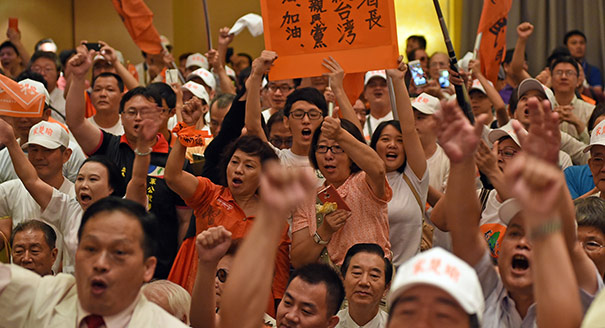
Taiwan will hold its sixth direct presidential election on January 16 next year. The 2016 election is unique in several respects, including that Taiwan’s two major political parties have unprecedentedly nominated women as presidential candidates, making it look likely that Taiwan could have its first female president soon.
Tsai Ing-wen, chairperson for the Democratic Progressive Party (DPP), is running her second time for president after losing to current leader Ma Ying-jeou in 2012. Tsai was a lawyer and university professor who was educated at Cornell University and the London School of Economics before entering public service. In the 1990s, she was a negotiator for Taiwan’s accession to the World Trade Organization. She was then asked to serve on the National Security Council as an advisor to former President Lee Teng-hui. Tsai served as minister of the Mainland Affairs Council from 2000 to 2004 and as vice premier from 2006 to 2007.
Hung Hsiu-chu, a former teacher and the current deputy legislative speaker, will take on the presidential race after getting the nod from Taiwan’s ruling Kuomintang (KMT) party for the nomination. Hung grew up in poverty and suffered numerous hardships throughout her childhood because her father was a political prisoner for alleged Communist connections during Taiwan’s “White Terror” era. Hung started her political career working in the women’s division of the KMT’s Taiwan Provincial Branch in 1980. Afterward, she ran her first legislative campaign in 1989 and has kept her seat in Taiwan’s legislature for eight consecutive terms.
It is interesting to note that Tsai and Hung are both atypical candidates from their parties. Tsai is the wealthiest candidate in the history of DPP; Hung called herself the “poorest” presidential candidate in the KMT’s history. Tsai is perceived to be less emotional and has a milder stance than traditional DPP politicians; Hung’s fiery style and bold speeches on government bills have earned her the nickname “Little Hot Pepper.” Additionally, Tsai and Hung both lack the credentials of provincial leadership since neither has ever led a local administration.
Soong Chu-yu, better known as James Soong, chairperson of Taiwan’s minority People First Party (PFP), announced on August 6 that he would run in the presidential election, taking on the two female candidates. James Soong is a veteran of Taiwanese politics. He began his political career as an English interpreter for then premier Chiang Ching-kuo in 1974 after getting advanced degrees in the United States at the University of California, Berkeley and Georgetown University. He then served as a government spokesman in the early 1980s, and in the 1990s he was governor of Taiwan province. In the 2000 presidential election, James Soong left the KMT to run as an independent. He split the KMT vote, winning 4.6 million votes out of the 12 million cast. However, the opposition DPP’s candidate Chen Shui-bien narrowly won the election by 4.9 million votes or 39.3 percent of the total vote. Therefore, many political observers say Soong may inevitably split Taiwan’s ruling Pan-Blue Coalition vote with Hung in the 2016 election.
The following data show the latest polls have Tsai Ing-wen holding a commanding lead over the other candidates in most surveys. The average of polls, which reflect uneven findings, showed approximately 38 percent of respondents supporting Tsai Ing-wen, 18 percent supporting Hung Hsiu-chu, and 20 percent supporting James Soong.
Sources | Date (in 2015) | Tsai Ing-wen | Hung Hsiu-chu | James Soong |
| UDN1 | August 6 | 36.00% | 17.00% | 24.00% |
| Next TV2 | August 6 | 35.30% | 14.90% | 22.20% |
| TREND3 | August 7 | 38.50% | 16.10% | 21.60% |
| CSPA | August 9 | 42.90% | 16.8% | 23.30% |
| TVBS4 | August 11 | 38.00% | 17.00% | 20.00% |
| TCF5 | August 11 | 36.00% | 26.90% | 15.50% |
| TISR6 | August 12 | 37.10% | 13.90% | 20.50% |
| KMT7 | August 17 | 37.00% | 18.00% | 19.00% |
| TISR8 | August 28 | 37.30% | 12.70% | 19.10% |
| TVBS9 | August 31 | 40.00% | 23.00% | 16.00% |
| Average | 37.81% | 17.63% | 20.12% |
Recent events in Taiwan, including the Sunflower Movement Student Protest in 2014, the 2014 municipal elections, and the recent High School Edition Protest over how to teach history indicate a shifting political landscape and the prevalence identity issues in Taiwan. As with other democratic elections, domestic social and economic concerns are major issues, but cross-Strait relations indeed will be in the limelight of the campaign.
After losing the 2012 election during the final mile over cross-Strait relations, Tsai is campaigning on a new platform. Tsai Ing-wen has proposed five reforms: generation justice, improving government efficiency, legislative reform, transitional justice, and an end to partisan bickering. In terms of cross-Strait relations, she expressed her support for maintaining the status quo and seeking stability in cross-Strait relations. Moreover, she pledged to comply with the constitutional framework of the Republic of China. These two pledges have been perceived in Washington as more tempered compared to her views on the Taiwan Consensus during the 2012 presidential election. However, incumbent President Ma, Hung and others have voiced criticism that it remains highly questionable whether Tsai would be able to maintain the status quo in relations with the mainland.
Hung Hsiu-chu took a strong stand on anti-Taiwan independence, and anti-populism during her KMT speech. She is opposed to abolishing nuclear energy, whereas Tsai is aiming to turn Taiwan into a “nuclear-free homeland” by 2050. Hung had initially advocated the “one China, same interpretation” and “cross-Strait Peace Agreement” policies, but was resisted by senior party members. She has now returned to the KMT’s official framework for defining cross-Strait ties laid out in the 1992 consensus.
James Soong has vowed to facilitate communication among different political parties, ethnic groups, and social classes. He also promised to establish a coalition government to put an end to one-party rule, and highlighted his determination to resolve the economic issues facing the nation in his campaign statement. On August 21 for the first time Soong apologized for the suppressions of press freedom and freedom of expression while he served under the KMT during Taiwan’s martial law era. With regard to his cross-Strait policy, Soong said his objective is to maintain the status quo, and he promised to ensure public participation, transparency, open scrutiny, and legislative supervision in cross-Strait policies.
| 1996 | 2000 | 2004 | 2008 | 2012 |
KMT | Lee Teng-hui/Lien Zhan | Lien Zhan/Xiao Wan-chang | Lien Zhan/James Soong | Ma Ying-jeou/Xiao Wan-chang | Ma Ying-jeou/Wu Den-yih |
| (54.0%) | (23.1%) | (49.9%) | (58.5%) | (51.6%) | |
DPP | Peng Ming-min/Hsieh Chang-ting | Chen Shui-bian/ Lu Hsiu-lien | Chen Shui-bian/ Lu Hsiu-lien | Hsieh Chang-ting/Su Tseng-chang | Tsai Ing-wen/Su Chia-chyuan |
| (21.1%) | (39.3%) | (50.1%) | (41.6%) | (45.6%) | |
PFP | NA | NA | NA | NA | James Soong/Lin Ruey-shiung |
| (2.8%) | |||||
New Party | NA | Lee Ao/Fung Hu-hsiang | NA | NA | NA |
| (0.1%) | |||||
No Party Affiliation | Lin Yang-gang/Hau Pei-tsun | James Soong/Chang Chau-Hsiung | NA | NA | NA |
| (14.9%) | (36.8%) | ||||
No Party Affiliation | Chen Li-an/Wang Ching | Hsu Hsin-liang/Chu Hui-liang | NA | NA | NA |
| (10.0%) | (0.6%) |
Source: Central Election Commission, http://data.cec.gov.tw/votedata.zip, last modified April 23, 2015
1 http://udn.com/news/story/7741/1105494
2 http://millenniummag-realtimenews.blogspot.tw/2015/08/07-2.html
3 http://www.setn.com/News.aspx?NewsID=89095
4 http://www.ntdtv.com/xtr/b5/2015/08/12/a1216955.html
5 http://www.chinatimes.com/newspapers/20150812000835-260301
6 http://www.tisr.com.tw/?p=5722#more-5722
7 http://news.ltn.com.tw/news/focus/paper/908241
Carnegie does not take institutional positions on public policy issues; the views represented herein are those of the author(s) and do not necessarily reflect the views of Carnegie, its staff, or its trustees.

Putin’s conservative staffing policies and search for ever greater control have cemented parliament’s transformation into a bureaucratic appendage of the executive branch.

Andrey Pertsev

Ex-president Gurbanguly Berdimuhamedov remains interested in politics, but his son Serdar, Turkmenistan’s current president, is becoming increasingly independent and willing to break with his father’s legacy. If their covert rivalry goes too far, both risk losing power.

Galiya Ibragimova

Sergei Kiriyenko used Russia’s parliamentary vote to further hone his strategy of corporate mobilization that is designed to maximize votes for United Russia.
Andrey Pertsev

The European far right might fail to steer EU policy in the direction Russia wants, but they will create enough chaos inside Europe to benefit the Kremlin.

Dimitar Bechev

If the Russian-speaking community in Latvia cannot articulate their interests without being seen as disloyal, they could end up embracing a pro-Kremlin agenda.

Sergejs Potapkins