

Commentary
Andrei Kolesnikov
{
  "authors": [
    "Andrei Kolesnikov"
  ],
  "type": "commentary",
  "centerAffiliationAll": "",
  "centers": [
    "Carnegie Endowment for International Peace",
    "Carnegie Russia Eurasia Center"
  ],
  "collections": [],
  "englishNewsletterAll": "",
  "nonEnglishNewsletterAll": "",
  "primaryCenter": "Carnegie Endowment for International Peace",
  "programAffiliation": "",
  "programs": [],
  "projects": [],
  "regions": [
    "Russia",
    "Eastern Europe",
    "Ukraine"
  ],
  "topics": [
    "Political Reform",
    "Foreign Policy"
  ]
}
Source: Getty
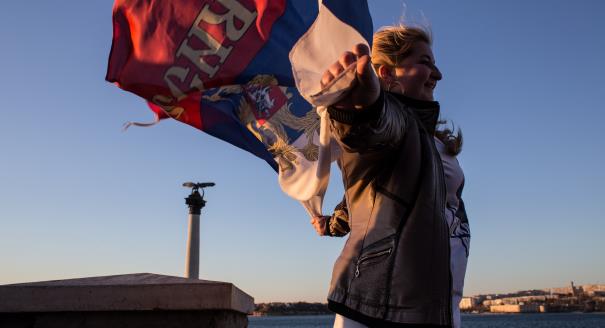
A new Ukrainian campaign to blockade Crimea is a gift for the Kremlin as it tries to distract the public’s attention away from the major challenges facing the peninsula and the questionable actions being undertaken by the Russian government against its population.
Source: Gazeta.ru
If the Ukrainian activists had not started their recent trade blockade against Crimea, the Kremlin spin doctors would have had to invent it. In Russia the anesthetic effect of the “Crimea is Ours” slogan has been steadily wearing off and the topic of Donbas has started to lose popularity with the public.
The Russian propaganda machine was forced to supplement those issues with a bit of Syrian drama and an exciting corruption scandal with the arrest of the governor of Komi Republic.
But it seems that acts of stupidity and emotional outbursts can recharge a spent cartridge. Thanks to the new Ukrainian blockade, Crimea is again a besieged fortress to be defended with military valor and patriotic fervor. The Russian government has won another chance to whip up “Crimea is Ours” sentiments. In Crimea itself residents get to sport a popular T-shirt featuring Nikita Khrushchev and Vladimir Putin and the captions “Surrendered Crimea” and “Took back Crimea.”
Given the lack of reliable electoral and polling data, it is hard to measure the level of support for Russia and its president on the peninsula. The problem is not really that Crimea has accepted Russia, it is more that Russia has not fully accepted Crimea.
Russian investors are staying away. Real estate sales are sluggish. All transactions are carried out in cash at the same exorbitant prices as in Moscow. The many flights in and out are extremely inconvenient, although still much easier than the ferry across the Kerch Strait. The highway between Simferopol and Alushta highway was partially widened by the Yanukovych regime but is not finished. There is not even that much to steal.
This actually makes sense. Why taint a symbol and a holy relic with earthly concerns? Why invest in it when we don’t even have enough money to pay for ourselves? However, it is not very convenient to live this kind of “symbolic” existence, especially if you have to live in Crimea.
Now the new Ukrainian siege is again mobilizing patriotic sentiments, which were beginning to fade. Even high inflation rates, which actually originate in Moscow, can be blamed on Ukraine.As always happens in cases like this, the activists’ target is the political leadership but ordinary people and their human connections are the ones taking the hit. A market economy, either formal or informal, allows people to survive under any conditions. But if that economy stops working, everything else stops too, and everything begins to return to a state of war.
All this brouhaha over Crimea is one more episode in the slow disintegration of the Soviet empire, which is happening more slowly than anyone could have expected. It seems a quarter of a century is not so long in historical terms.
Russia, or rather its elites, still feel as if they inherited the metropolitan core of an empire and they are not actually too happy about being dragged into this problem on the periphery. They have rather cool feelings toward the actual territory of Crimea and its poor population, even as they feel ardent love for the symbolic land of Crimea, with its invented Russian holy sites.
Crimea and its people are hostages to this ongoing imperial disintegration. So is the renowned human rights activist and Crimean Tatar leader Mustafa Dzhemilev, who has been leading the campaign for a blockade of his homeland. You could say that Dzhemilev has been a hostage of history ever since the entire Crimean Tatar people was deported by Stalin in 1944—and that the latest confrontation was first provoked back then by Moscow.
Dzhemilev and his friends deserve sympathy. But surely they have unwittingly bestowed a generous gift on both the far-right Ukrainian movement, Right Sector, which is outlawed in Russia, and on the Russian leadership.
Now Russia’s political players can play a number of cards both today and in the future. As well as half-frozen Donbas, the genuinely frozen Arctic, and hot Syria, they have balmy Crimea.
The more pressure points that are put on the West, the better it is for Russia, or rather for its current leadership—that at any rate is the view of those who formulate Russia’s domestic and foreign policy.
The omnipresent Russian leadership believes it is playing on a grand chessboard, dictating rules, moving the masses, and changing borders. It thinks that it can manage a new world order. It would be more accurate to say it is creating a new disorder, laying down geopolitical time bombs that will last for decades and may explode under our country as well.
This publication originally appeared in Russian on Gazeta.ru.
Former Senior Fellow, Carnegie Russia Eurasia Center
Kolesnikov was a senior fellow at the Carnegie Russia Eurasia Center.
Recent Work
Andrei Kolesnikov
Andrei Kolesnikov
Carnegie does not take institutional positions on public policy issues; the views represented herein are those of the author(s) and do not necessarily reflect the views of Carnegie, its staff, or its trustees.

In the discussions made possible by the State Duma election campaign, one question is being asked more and more loudly. “What next?”

Andrey Pertsev
While the Nazis rushed ahead in a revolutionary fervor, Russia’s modern crusaders against enemies of the state work methodically, giving their targets time to adjust to restrictions before closing the loopholes.

Leonid Bershidsky

When faced with fuel shortages in the past, Central Asian governments could always count on additional supplies from Moscow. That safety net no longer exists.

Galiya Ibragimova
Reading the purported correspondence of celebrity Ksenia Sobchak sheds light on her role within the system, and how journalism and politics function in Putin’s Russia.
Vladislav Gorin
When political power is concentrated in the hands of a small circle of people, a country invariably ends up with technological stagnation.
Aleksei Kiselev