

Commentary
Farea Al-Muslimi
{
  "authors": [
    "Farea Al-Muslimi"
  ],
  "type": "legacyinthemedia",
  "centerAffiliationAll": "dc",
  "centers": [
    "Carnegie Endowment for International Peace",
    "Malcolm H. Kerr Carnegie Middle East Center"
  ],
  "collections": [],
  "englishNewsletterAll": "menaTransitions",
  "nonEnglishNewsletterAll": "",
  "primaryCenter": "Malcolm H. Kerr Carnegie Middle East Center",
  "programAffiliation": "MEP",
  "programs": [
    "Middle East"
  ],
  "projects": [],
  "regions": [
    "Gulf",
    "Yemen",
    "Middle East"
  ],
  "topics": [
    "Political Reform",
    "Security"
  ]
}
Source: Getty
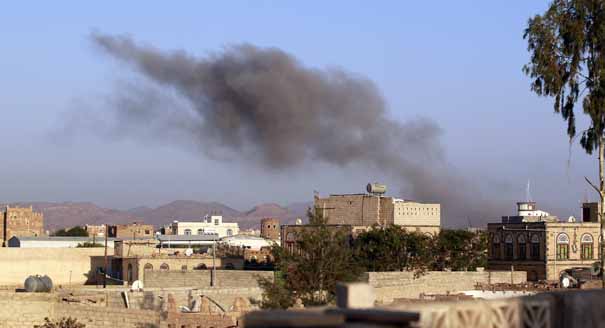
The conflict in Yemen exposes a number of problems that the Middle East is facing in the post Arab Spring era, as more youths join extremist groups for varying reasons.
Source: Foreign Policy
Carnegie’s Farea al-Muslimi joined Elizabeth Dickinson to discuss the current situation in Yemen, and what it will take to end the conflict. Al-Muslimi talked about the political and security vacuum that is pushing more Yemeni youth toward radicalization and armed groups. A new social contract must be struck between people and the new governments in the Middle East to counter the rise of extremism, he said. Al-Muslimi argued that the war in Yemen is not essentially sectarian in nature, despite what many claim, and that a peaceful solution is still possible. However, the only way forward would be a comprehensive solution that addresses not only local grievances and but also regional rivalries, namely between Saudi Arabia and Iran.
This podcast was originally produced by Foreign Policy’s Global Thinkers podcast series.
Research fellow at Chatham House’s Middle East and North Africa Programme
Farea Al-Muslimi is a research fellow at Chatham House’s Middle East and North Africa Programme.
Recent Work
Farea Al-Muslimi
Farea Al-Muslimi
Carnegie does not take institutional positions on public policy issues; the views represented herein are those of the author(s) and do not necessarily reflect the views of Carnegie, its staff, or its trustees.

Sergei Kiriyenko used Russia’s parliamentary vote to further hone his strategy of corporate mobilization that is designed to maximize votes for United Russia.

Andrey Pertsev

The European far right might fail to steer EU policy in the direction Russia wants, but they will create enough chaos inside Europe to benefit the Kremlin.

Dimitar Bechev

If the Russian-speaking community in Latvia cannot articulate their interests without being seen as disloyal, they could end up embracing a pro-Kremlin agenda.

Sergejs Potapkins

Russia’s ruling party would have benefited from Putin appearing as its distant patron, but as an active frontman imposing his views on the public, he has done nothing but harm both the party’s election campaign and the ruling system overall.
Andrey Pertsev

In the tenth year of his presidency, President Mirziyoyev’s system is becoming even more personalized than that of his predecessor Karimov.

Galiya Ibragimova