

Article
C. Raja Mohan, Darshana M. Baruah
{
  "authors": [
    "C. Raja Mohan"
  ],
  "type": "legacyinthemedia",
  "centerAffiliationAll": "dc",
  "centers": [
    "Carnegie Endowment for International Peace",
    "Carnegie India"
  ],
  "collections": [],
  "englishNewsletterAll": "ctw",
  "nonEnglishNewsletterAll": "",
  "primaryCenter": "Carnegie India",
  "programAffiliation": "SAP",
  "programs": [
    "South Asia"
  ],
  "projects": [],
  "regions": [
    "United States",
    "South Asia",
    "Pakistan",
    "India"
  ],
  "topics": [
    "Foreign Policy",
    "Security"
  ]
}
Source: Getty
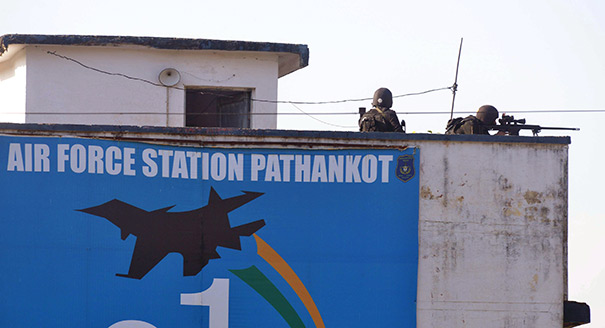
In the wake of the attack on Pathankot, Washington must remember India-Pakistan ties improve when it refuses to intercede.
Source: Indian Express
If speech is silver, silence is golden. That old adage might be specially relevant to Washington, whose words since the terror attack on the Pathankot airbase have generated some confusion. America may have been well-intentioned in injecting itself into the messy India-Pakistan diplomacy. But it could end up pleasing neither New Delhi nor Rawalpindi.
When official spokespersons speak too often, they tie themselves in knots trying to manage the perceived contradictions between their different statements, cope with the unintended signals they generate and lose control over the basic message.Washington’s immediate reaction to the Pathankot attack had two elements: One was to ask Pakistan to act against anti-India terror groups and the other was to urge India not to suspend talks. That seemed reasonable and helped reinforce the mature reactions in both Delhi and Islamabad. Even more important, the American position was more positive than that of other powers. China, for example, urged India and Pakistan not to allow the terrorists to disrupt the dialogue. Beijing had no direct appeal to Pakistan on acting against terror groups on its soil targeting India.
The problem began a few days later, last Thursday, when US State Department Spokesman John Kirby’s comments seemed to suggest an American wobble towards Pakistan. His comments were interpreted in Pakistan as giving Islamabad much leeway in determining the pace of its promised probe on Pathankot.
For Delhi, the comments were irksome just when it had put out the word that the scheduled visit of Foreign Secretary S. Jaishankar to Islamabad later this week will depend upon Pakistan taking quick and visible action against those who organised the terror attack on Pathankot.
Sensing the damage in Delhi, the State Department did a quick flip to brief the Indian media in Washington that the Obama administration was not letting Pakistan “off the hook” on Pathankot. A couple of days later, Secretary of State John Kerry stepped in to reinforce the original messages to India and Pakistan on talks and terror in his telephonic conversation with Pakistan Prime Minister Nawaz Sharif. The public readout on Kerry’s phonecall affirmed the importance of sustaining the renewed dialogue between India and Pakistan and the urgency of concluding Pakistan’s investigation into the leads provided by Delhi and action against the Jaish-e-Muhammad.
But it’s never easy to take back the spoken word. The episode only reinforces the lingering suspicion in Delhi that the State Department and the White House have returned to the old American habit of tilting towards Pakistan on regional issues.
Evidence? Delhi cites Washington’s recent botched effort to offer a nuclear deal to Pakistan and finding other interesting ways to reward the Pakistan army. They also believe Washington is ceding too much ground to Pakistan and China in Afghanistan.
Although not everyone would concur with Delhi’s assessment of the current US approach to Pakistan, there is no escaping an important trend line. Nearly 18 months after Prime Minister Narendra Modi and President Barack Obama set a scorching pace for elevating the US-India strategic partnership, the old demons relating to Pakistan may be returning to haunt the relationship.
At the purely diplomatic level, US diplomats have long known the perils of public hectoring India and Pakistan on what to do with each other. In a region that is quick to see conspiracies, especially those plotted by outsiders, American public appeals always have an effect opposite of that intended.
The greater the American anxiety on continued talks between India and Pakistan, the lesser the support in Delhi and more room for spoilers in Islamabad. India does not like third-party intervention in its engagement with Pakistan, while Pakistan never misses an opportunity to “internationalise” its disputes with India. But no Pakistani leader would want to be seen as “appeasing” India under American pressure.
Sceptics of America’s South Asia policy take the argument a step forward by insisting that America has no real leverage over Pakistan. They ask a simple question. If Washington could not get the Pakistan army to behave in Afghanistan, where the US was spending much blood and treasure over the last decade, how can the Obama administration persuade Islamabad to do the right thing on the sources of anti-India terror?
The fact is that much progress in India-Pakistan relations occurred when Washington, during the years of George W. Bush, refused to intercede in India-Pakistan affairs on a routine basis. During 2004-07, Delhi and Islamabad found ways and means to limit cross-border terrorism, discuss Kashmir-related issues and expand confidence-building measures. An America that is less anxious about India-Pakistan relations, separates its bilateral relations with Delhi and Islamabad, and manages the tension between the two sets of policies might be more successful in achieving its broader regional objectives in the subcontinent. Less is often more in diplomacy. Diplomatic persuasion works a lot better in private than in public.
Former Nonresident Senior Fellow, Carnegie India
A leading analyst of India’s foreign policy, Mohan is also an expert on South Asian security, great-power relations in Asia, and arms control.
Recent Work

C. Raja Mohan, Darshana M. Baruah


Alexander Gabuev, Paul Haenle, C. Raja Mohan, …
Carnegie does not take institutional positions on public policy issues; the views represented herein are those of the author(s) and do not necessarily reflect the views of Carnegie, its staff, or its trustees.

Minsk clearly expected the dialogue with Washington to yield more results, in particular the lifting of EU sanctions and permission to export potash.

Artyom Shraibman

With the growth in points of friction between the great powers, organizations like the SCO will continue to play a role in the strategic adaptation of the smaller powers caught between them.

Temur Umarov

When faced with fuel shortages in the past, Central Asian governments could always count on additional supplies from Moscow. That safety net no longer exists.

Galiya Ibragimova

Two divergent trends—Putin’s hardline vision of how to prosecute the war in Ukraine, and a growing desire for change in Russia—could tear the regime apart.

Tatiana Stanovaya

Andrey Melnichenko’s essay offers no answer to the fundamental question of how, under any kind of negotiated settlement, Europe can protect itself from the Russian ressentiment that is inevitable in all scenarios except for an outright victory for Putin.

Leonid Bershidsky