

Paper
James M. Acton, Ankit Panda
{
  "authors": [
    "James M. Acton"
  ],
  "type": "other",
  "centerAffiliationAll": "dc",
  "centers": [
    "Carnegie Endowment for International Peace"
  ],
  "collections": [
    "Hypersonic Weapons"
  ],
  "englishNewsletterAll": "ctw",
  "nonEnglishNewsletterAll": "",
  "primaryCenter": "Carnegie Endowment for International Peace",
  "programAffiliation": "NPP",
  "programs": [
    "Nuclear Policy"
  ],
  "projects": [],
  "regions": [
    "Russia"
  ],
  "topics": [
    "Security",
    "Military"
  ]
}
Source: Getty
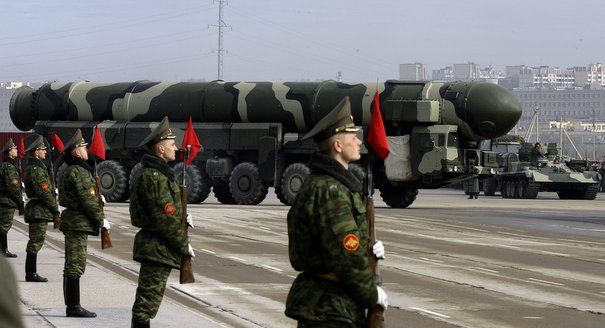
Russian political leaders and military strategists are growing increasingly concerned about strategic conventional weapons, particularly long-range, hypersonic weapons. Some fear that strategic conventional weapons could prove decisive in a major conflict and that Russia is lagging behind in their development.
Source: Nonproliferation Review
Russian President Vladimir Putin must have a special place in his heart for the US Conventional Prompt Global Strike (CPGS) program. Since they were first unveiled in 2006, he has publicly decried US plans to develop hypersonic, long-range, non-nuclear munitions on at least five occasions—including at such high-profile occasions as his State of the Nation address in December 2013. In that speech, he criticized the CPGS program by name and stated that, in combination with US ballistic missile defense, it “could negate all previous agreements on the limitation and reduction of strategic nuclear weapons, and disrupt the strategic balance of power.” ...
This article was originally published in Nonproliferation Review.

Jessica T. Mathews Chair, Co-director, Nuclear Policy Program
Acton holds the Jessica T. Mathews Chair and is co-director of the Nuclear Policy Program at the Carnegie Endowment for International Peace.
Recent Work

James M. Acton, Ankit Panda
James M. Acton

Japan’s long-term security policy is driven by concerns about China, and there is little appetite for (or interest in) pursuing a confrontation with Moscow.

James D.J. Brown

The truth of the strategic situation is that Europe and Russia are extremely unlikely to be able to “turn the page” on their confrontation within the next two decades.

Arkady Moshes

Russia spent years building a “sovereign internet,” concentrating web infrastructure exclusively within Russian territory. Ukrainian drone attacks have shown how vulnerable that approach has left the Russian internet.

Maria Kolomychenko

Putin’s conservative staffing policies and search for ever greater control have cemented parliament’s transformation into a bureaucratic appendage of the executive branch.

Andrey Pertsev

Russia’s AI-driven propaganda campaigns operate in a fragmented, chaotic, and often illogical manner. That’s not necessarily a problem for the Kremlin, though: It’s much easier to mimic genuine public debate that way.

Ilya Klishin