

Commentary
Maha Yahya
{
  "authors": [
    "Maha Yahya"
  ],
  "type": "legacyinthemedia",
  "centerAffiliationAll": "dc",
  "centers": [
    "Carnegie Endowment for International Peace",
    "Malcolm H. Kerr Carnegie Middle East Center"
  ],
  "collections": [],
  "englishNewsletterAll": "menaTransitions",
  "nonEnglishNewsletterAll": "",
  "primaryCenter": "Malcolm H. Kerr Carnegie Middle East Center",
  "programAffiliation": "MEP",
  "programs": [
    "Middle East"
  ],
  "projects": [],
  "regions": [
    "Levant",
    "Syria",
    "Middle East"
  ],
  "topics": [
    "Political Reform"
  ]
}
Source: Getty
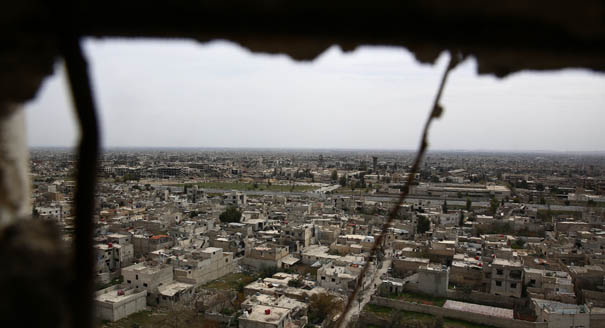
With no clear end to the Syria conflict in sight , the idea of federalism, which has attracted considerable attention and controversy, is being discussed.
Source: Al-Jazeera
The resumption of talks in Geneva coincides with the fifth anniversary of the conflict in Syria. The fighting has slowed considerably since a fragile ceasefire brokered by the US and Russia, came into force almost two weeks ago. However, a permanent peace deal and full ceasefire remain a distant possibility. As Staffan de Mistura, the UN special envoy for Syria, prepares to meet delegations from the government and opposition groups, the idea of federalism is being discussed. The idea has attracted considerable attention and controversy. But could both sides consider federalism? And will the latest round of talks yield any concrete results?
Marwan Kabalan, Syrian academic and writer and Associate Analyst at the Doha Institute for Graduate Studies, Maha Yahya, acting director of the Carnegie Middle East Center, and Julien Barnes-Dacey, senior policy fellow in the Middle East and North Africa Program at the European Council on Foreign Relations, discuss whether both sides could consider federalism and assess whether the latest round of talks will yield any concrete results.

Director, Malcolm H. Kerr Carnegie Middle East Center
Maha Yahya is director of the Malcolm H. Kerr Carnegie Middle East Center, where her research focuses on citizenship, pluralism, and social justice in the aftermath of the Arab uprisings.
Recent Work
Maha Yahya
Maha Yahya
Carnegie does not take institutional positions on public policy issues; the views represented herein are those of the author(s) and do not necessarily reflect the views of Carnegie, its staff, or its trustees.

In the discussions made possible by the State Duma election campaign, one question is being asked more and more loudly. “What next?”

Andrey Pertsev

Two divergent trends—Putin’s hardline vision of how to prosecute the war in Ukraine, and a growing desire for change in Russia—could tear the regime apart.

Tatiana Stanovaya

Ultimately, Zelensky sided neither with the reform camp nor with the military establishment as such, but with political control.

Balázs Jarábik
Tokayev’s predecessor, Nursultan Nazarbayev, outlined arrangements for a power transition too soon and in too much detail, ultimately losing control over the process. Tokayev is determined not to meet the same fate.

Temur Umarov

Despite unhappiness on the ground, Moscow is determined to use both carrot and stick to ensure there is record support for United Russia in occupied Ukraine.

Konstantin Skorkin