
• Research
  • Politika
  • About
Carnegie Russia Eurasia center logoCarnegie lettermark logo
  • Donate
{
  "authors": [
    "Marc Lynch",
    "Merouan Mekouar"
  ],
  "type": "legacyinthemedia",
  "centerAffiliationAll": "dc",
  "centers": [
    "Carnegie Endowment for International Peace",
    "Malcolm H. Kerr Carnegie Middle East Center"
  ],
  "collections": [
    "Arab Awakening"
  ],
  "englishNewsletterAll": "menaTransitions",
  "nonEnglishNewsletterAll": "",
  "primaryCenter": "Carnegie Endowment for International Peace",
  "programAffiliation": "MEP",
  "programs": [
    "Middle East"
  ],
  "projects": [],
  "regions": [
    "North Africa",
    "Morocco",
    "Maghreb"
  ],
  "topics": [
    "Political Reform",
    "Democracy",
    "Civil Society"
  ]
}

Source: Getty

In The Media

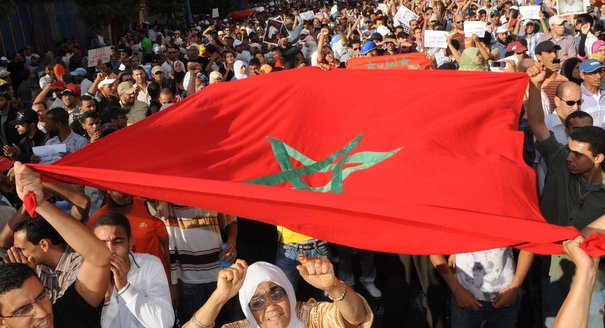
Morocco’s Arab Spring

Reforms and development in the wake of the Arab Spring protests in Morocco have addressed some surface issues but have failed to resolve underlying structural problems.

Link Copied
By Marc Lynch and Merouan Mekouar
Published on Mar 21, 2016

Source: Project on Middle East Political Science

Carnegie’s Marc Lynch discusses reform in the wake of the Arab Spring protests in Morocco and the political future of the country with Merouan Mekouar.

This interview originally appeared at the Project on Middle East Political Science.

About the Authors

Marc Lynch

Former Nonresident Senior Fellow, Middle East Program

Marc Lynch was a nonresident senior fellow in Carnegie’s Middle East Program where his work focuses on the politics of the Arab world.

Merouan Mekouar

Authors

Marc Lynch
Former Nonresident Senior Fellow, Middle East Program
Marc Lynch
Merouan Mekouar
Political ReformDemocracyCivil SocietyNorth AfricaMoroccoMaghreb

Carnegie does not take institutional positions on public policy issues; the views represented herein are those of the author(s) and do not necessarily reflect the views of Carnegie, its staff, or its trustees.

More Work from Carnegie Russia Eurasia Center

  • Commentary
    Carnegie Politika
    Conspiracy Theories Are Eclipsing the Real Dangers of Russia’s Messaging App Max

    The internet is awash not only with instructions from digital security experts, but also with urban legends and conspiracy theories that divert attention away from the real dangers of Max.

      David Frenkel

  • Commentary
    Carnegie Politika
    Blocking of Telegram App Sparks Rare Public Rift Among Russia’s Elites

    The prospect of a total block on Russia’s most popular messaging app has sparked disagreement between the regime’s political managers and its security agencies.

      Andrey Pertsev

  • Commentary
    Carnegie Politika
    After Ilia II: What Will a New Patriarch Mean for Georgia?

    The front-runner to succeed Ilia II, Metropolitan Shio, is prone to harsh anti-Western rhetoric and frequent criticism of “liberal ideologies” that he claims threaten the Georgian state. This raises fears that under his leadership the Georgian Orthodox Church will lose its unifying role and become an instrument of ultraconservative ideology.

      Bashir Kitachaev

  • Commentary
    Carnegie Politika
    “Mr. Nobody Against Putin”: A Deep Dive Into Russian Propaganda

    Talankin and Borenstein’s documentary is a unique inside look at a regime that threatens the world and has killed thousands of people in its neighboring country. And many critics and general viewers alike draw parallels between the Putin regime and their own governments.

      Ekaterina Barabash

  • Commentary
    Carnegie Politika
    Why Did Messaging App Telegram Fall From Grace in Russia?

    The history of Telegram’s relations with the Russian state offers a salutary lesson for international platforms that believe they can reach a compromise with the Kremlin.

      Maria Kolomychenko

Get more news and analysis from
Carnegie Russia Eurasia Center
Carnegie Russia Eurasia logo, white
  • Research
  • Politika
  • About
  • Experts
  • Events
  • Contact
  • Privacy
  • For Media
Get more news and analysis from
Carnegie Russia Eurasia Center
© 2026 Carnegie Endowment for International Peace. All rights reserved.







