

Paper
Ashley J. Tellis
{
  "authors": [
    "Ashley J. Tellis"
  ],
  "type": "other",
  "centerAffiliationAll": "dc",
  "centers": [
    "Carnegie Endowment for International Peace"
  ],
  "collections": [],
  "englishNewsletterAll": "ctw",
  "nonEnglishNewsletterAll": "",
  "primaryCenter": "Carnegie Endowment for International Peace",
  "programAffiliation": "SAP",
  "programs": [
    "South Asia"
  ],
  "projects": [],
  "regions": [
    "North America",
    "United States",
    "South Asia",
    "India"
  ],
  "topics": [
    "Foreign Policy"
  ]
}
Source: Getty
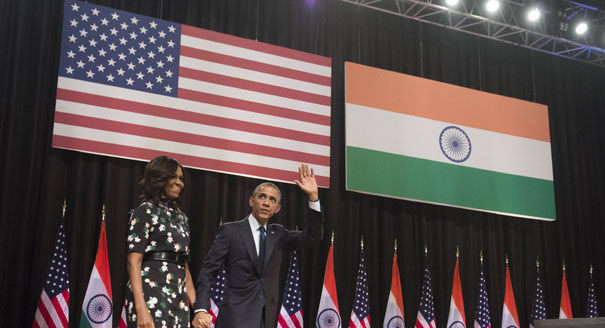
The signing of the Logistics Exchange Memorandum of Agreement by India and the United States is the most recent step in the transformation of their bilateral relationship, but it does not create a military alliance.
Source: Hindu
On Monday, India and the U.S. signed the Logistics Exchange Memorandum of Agreement (LEMOA) that will give the militaries of both countries access to each other’s facilities for supplies and repairs. The agreement has been a controversial one, and two previous governments – led by A.B. Vajpayee and Manmohan Singh – did not sign it though it has been on the table since 2002.
Ashley J. Tellis, Senior Associate, Carnegie Endowment for International Peace explains what the pact is and what it does to India-U.S. defence ties:
It represents both: the nuclear deal was the epitome of overcoming the hesitations of history on both sides. The signing of the LEMOA is a small — actually quite trivial — example of the continuing transformation of the bilateral relationship.
No, it does not make India either a de jure or a de facto ally. All the LEMOA does is that it allows both countries to seamlessly pay for military goods, services, and supplies consumed during their exercises and other interactions. The decision to engage in any of these activities remains a sovereign decision of each government — nothing in the LEMOA changes that. So the issue of India becoming an ally of any sort does not arise.
I am mystified by this obsession with bases. The U.S. has LEMOA agreements with over 100 countries but basing agreements — which are different — with only a fraction of those partners. Two examples of the LEMOA’s utility: A U.S. carrier battle group steams from the Persian Gulf to the western Pacific through the Straits of Malacca. Along the way, Indian Navy ships operating off Cochin are authorised by the GOI to conduct a previously unprogrammed passing exercise with the U.S. flotilla. During the exercise, the U.S. vessels offload fuel and supplies from their Indian counterparts. Instead of having to pay in cash for the victuals, India simply maintains a ledger balance for the transactions, which is cleared in one go at the end of the fiscal year. Similarly, an Indian naval vessel suffers a maintenance problem while visiting the U.S. for an exercise. The repairs are done at an American port. The LEMOA will permit the costs of the repairs to be defrayed against any comparable debts the U.S. may owe India for supplies and services received in other circumstances through a simple “balancing of the books” at the end of the fiscal year.
Former Senior Fellow
Ashley J. Tellis was a senior fellow at the Carnegie Endowment for International Peace.
Recent Work
Ashley J. Tellis
Ashley J. Tellis
Carnegie does not take institutional positions on public policy issues; the views represented herein are those of the author(s) and do not necessarily reflect the views of Carnegie, its staff, or its trustees.

Without a ceasefire with Ukraine on attacking each other’s energy infrastructure—to which the Kremlin is unlikely to agree—the diesel agreement between Putin and Trump is largely for show, rather than representing a genuine increase in the volumes of Russian diesel on the global market.

Sergey Vakulenko

Despite a new textbook, an influx of Russian teachers and managers, and an end to the teaching of Ukrainian, the Kremlin is unlikely to have “reprogrammed” locals.

Konstantin Skorkin

Cargo traffic through Russia’s Northern Sea Route has increased because of the disruption caused by the conflict in the Middle East, the Ukraine war, and U.S.-China tensions.

Mikhail Korostikov

Trump has promised Belarus a massive potash deal. But Minsk is seeking something greater: restored Western transit and greater room for maneuver from Russia.

Balázs Jarábik

Minsk clearly expected the dialogue with Washington to yield more results, in particular the lifting of EU sanctions and permission to export potash.

Artyom Shraibman