

Commentary
Alexander Gabuev
{
  "authors": [
    "Alexander Gabuev"
  ],
  "type": "legacyinthemedia",
  "centerAffiliationAll": "",
  "centers": [
    "Carnegie Endowment for International Peace",
    "Carnegie China",
    "Carnegie Russia Eurasia Center"
  ],
  "collections": [
    "China’s Foreign Relations",
    "U.S.-China Relations"
  ],
  "englishNewsletterAll": "",
  "nonEnglishNewsletterAll": "",
  "primaryCenter": "Carnegie Endowment for International Peace",
  "programAffiliation": "",
  "programs": [],
  "projects": [],
  "regions": [
    "North America",
    "United States",
    "East Asia",
    "China",
    "Russia"
  ],
  "topics": [
    "Foreign Policy",
    "Security",
    "Arms Control"
  ]
}
Source: Getty
In its clumsy attempt to exploit the vulnerabilities of the Sino-Russian axis, the Trump administration misunderstands not only the strength of relations, but also its own desirability as a useful ally.
Source: South China Morning Post
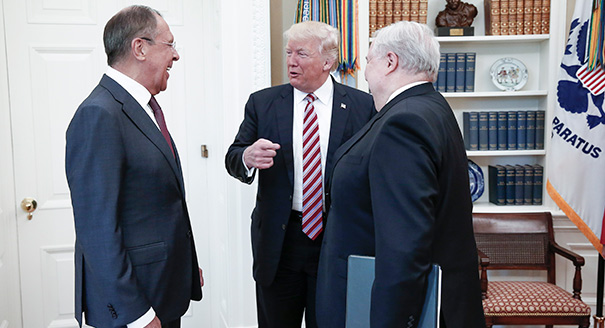
Amid all the furore about US President Donald Trump’s handling of sensitive intelligence material during his recent meeting with Russian Foreign Minister Sergey Lavrov, one fundamental question remains unanswered: why is Trump going to so much trouble to patch things up with Moscow? For understandable reasons, most attention has focused on the ongoing investigation of ties between the Trump team and the Kremlin and Trump’s assertions on the campaign trail that he wanted to team up with the Kremlin to “knock the hell out of” Islamic State.
Yet there is another undercurrent at work: the perceived threat to US interests from a rising China. As Reuters reported recently, one of the key themes of high-level contacts between the Trump camp and Russian representatives was how to contain China. To all appearances, it seems that the Trump administration is trying to borrow a page from Henry Kissinger’s template of “triangular diplomacy” for managing relations with Russia and China. When Richard Nixon made his famous overture to China in 1972, the core idea was to position Washington in the beneficial corner of the triangle – that is, as the power that has better relations with the other two corners than they have between themselves.
For several of the armchair strategists who recently arrived in the White House, it appears that they believe now is an opportune moment for a concerted effort to disrupt the emerging axis between Beijing and Moscow. Such an approach, however, is based on deeply flawed assumptions about the key drivers behind the growing rapport between two powers.
At first glance, it may seem logical to exploit the vulnerabilities of the Sino-Russian axis. Proponents argue that the bromance between Russian President Vladimir Putin and Chinese President Xi Jinping (習近平) is just a façade and that, deep down, the relationship is hampered by mutual mistrust. It is hard to miss Kremlin concerns about the asymmetries in its relationship with its powerful neighbour. Among these are imbalances between sparsely populated Siberia, and overpopulated regions just across the border. For decades, China has brazenly helped itself to sensitive Russian military technologies. Then there is Beijing’s rapidly growing influence in Central Asia, including through Xi’s Belt and Road Initiative. By playing on those fears and providing carrots to Putin, some of Trump’s advisers think that they can engineer a correction in Moscow’s approach on China.
This approach suffers from at least four fundamental misunderstandings about why Putin is unlikely to be seduced by any grand bargain on China.
First, the Kremlin is well aware of the costs that an adverse relationship with China would entail. Decades of costly military build-up along the Sino-Soviet border have taught leaders in Beijing and in Moscow that an amicable relationship has plenty to recommend it. With both countries facing major security challenges in other regions, the 4,200km boundary between them needs to remain peaceful.
Second, before rushing into China’s arms in 2014 in the wake of the war in Ukraine, the Kremlin for the first time in history conducted an inter-agency study of potential risks of partnership with Beijing. The results have dispelled many of Moscow’s worries. As it turns out, Moscow needn’t be afraid of creeping Chinese colonisation of Siberia. The Chinese population there doesn’t exceed 300,000, and it has been decreasing following the sharp rouble devaluation.
Beijing is also no longer reverse-engineering Russian weapons. Rather, Russian arms exporters are afraid that their window of opportunity in China is shrinking thanks to Beijing’s advances in research and development. Sales of the S-400 surface-to-air missile system and Su-35 fighter jets, a taboo idea just three years ago, is a testament to a major change in policy.
Moscow has also discovered that Beijing’s growing economic footprint in Central Asia is here to stay: all five countries of the region produce commodities, and China is the only big buyer.
Thirdly, Chinese and Russian leaders have more in common, when it comes to global governance, than they do with the US. They are united by a desire to shape an international order that values sovereignty and limits foreign interference in domestic affairs, a prerequisite for protecting their authoritarian political systems.
Last but not least, the Kremlin is aware of unpredictable dynamics in the US political system. Putin is sensible enough to appreciate that Trump is not going to occupy the White House forever. Unlike crisis-wracked Washington, China is vastly more stable when it comes to setting a foreign policy course. Putin will not move a finger to harm the interests of China in order to pursue a long shot of mending ties with Trump.
Russia is, of course, acutely aware of the growing asymmetry with China, but seems happy to accept the new reality. Ironically, Trump’s own missteps on Russia, as well as his naive embrace of Xi after the Mar-a-Lago summit mean that China, America’s only competitor for global leadership, will continue to occupy the beneficial corner of the triangle.

Director, Carnegie Russia Eurasia Center
Alexander Gabuev is director of the Carnegie Russia Eurasia Center. Gabuev’s research is focused on Russian foreign policy with particular focus on the impact of the war in Ukraine and the Sino-Russia relationship. Since joining Carnegie in 2015, Gabuev has contributed commentary and analysis to a wide range of publications, including the Financial Times, the New York Times, the Wall Street Journal, and the Economist.
Recent Work
Alexander Gabuev
Alexander Gabuev
Carnegie does not take institutional positions on public policy issues; the views represented herein are those of the author(s) and do not necessarily reflect the views of Carnegie, its staff, or its trustees.

Despite a new textbook, an influx of Russian teachers and managers, and an end to the teaching of Ukrainian, the Kremlin is unlikely to have “reprogrammed” locals.

Konstantin Skorkin

For every ruble allocated to social policy, health, and education in 2027, double that amount is earmarked for the army, the police, and the security services.

Alexandra Prokopenko

Cargo traffic through Russia’s Northern Sea Route has increased because of the disruption caused by the conflict in the Middle East, the Ukraine war, and U.S.-China tensions.

Mikhail Korostikov

An analysis of traffic accident data suggests that Ukrainian drone attacks caused a material but not disastrous fall in Russian gasoline consumption over the summer.

Sergey Vakulenko

Sergei Kiriyenko used Russia’s parliamentary vote to further hone his strategy of corporate mobilization that is designed to maximize votes for United Russia.

Andrey Pertsev