

Paper
James M. Acton, Ankit Panda
{
  "authors": [
    "James M. Acton"
  ],
  "type": "legacyinthemedia",
  "centerAffiliationAll": "dc",
  "centers": [
    "Carnegie Endowment for International Peace",
    "Carnegie Russia Eurasia Center"
  ],
  "collections": [
    "Korean Peninsula"
  ],
  "englishNewsletterAll": "ctw",
  "nonEnglishNewsletterAll": "",
  "primaryCenter": "Carnegie Endowment for International Peace",
  "programAffiliation": "NPP",
  "programs": [
    "Nuclear Policy"
  ],
  "projects": [],
  "regions": [
    "East Asia",
    "North Korea"
  ],
  "topics": [
    "Nuclear Policy"
  ]
}
Source: Getty
Deterring North Korea is less risky than a preventative war.
Source: Diplomat
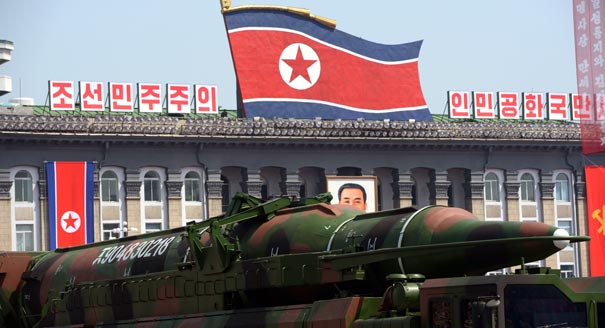
War between the United States and North Korea has begun to seem like a real possibility. Within hours of the Sunday, September 3 test of what Pyongyang claimed was a thermonuclear weapon, President Donald Trump tweeted that the North Koreans “only understand one thing.” The next day, his ambassador to the United Nations, Nikki Haley, claimed that North Korea’s leader, Kim Jong-un, was “begging for war.” Then on Thursday, Trump described military action – using “new and beautiful equipment, the best in the world” – as “something certainly that could happen.”
The Trump administration seems to be considering military action because it appears to recognize that there is now little chance of denuclearizing North Korea and is concerned that “North Korea might not be able to be deterred.” But it is focused on the wrong question. The right question is not whether North Korea can be deterred, but rather how the risks of trying to do so compare to the risks of the alternative – a preventative war. When these risks are weighed up, deterrence turns out to be the less dangerous option.
Military action would run the risk of nuclear strikes against U.S. bases in South Korea, Japan, and Guam, as well as American cities. The U.S. intelligence community has reportedly assessed that North Korea is now capable of fitting a nuclear warhead onto a ballistic missile. Launching military action in the hope that Kim did not yet have a functioning nuclear arsenal would be insanity.
This article was originally published in the Diplomat.

Jessica T. Mathews Chair, Co-director, Nuclear Policy Program
Acton holds the Jessica T. Mathews Chair and is co-director of the Nuclear Policy Program at the Carnegie Endowment for International Peace.
Recent Work

James M. Acton, Ankit Panda
James M. Acton
Carnegie does not take institutional positions on public policy issues; the views represented herein are those of the author(s) and do not necessarily reflect the views of Carnegie, its staff, or its trustees.

Tokyo would have to surmount a lot of obstacles—not least Western sanctions—if it wanted to return Russian oil imports to even modest pre-2022 volumes.

Vladislav Pashchenko
Troubled by the growing salience of nuclear debates in East Asia, Moscow has responded in its usual way: with condemnation and threats. But by exacerbating insecurity, Russia is forcing South Korea and Japan to consider radical security options.

James D.J. Brown
For Putin, upgrading Russia’s nuclear forces was a secondary goal. The main aim was to gain an advantage over the West, including by strengthening the nuclear threat on all fronts. That made growth in missile arsenals and a new arms race inevitable.

Maxim Starchak
The Kremlin will only be prepared to negotiate strategic arms limitations if it is confident it can secure significant concessions from the United States. Otherwise, meaningful dialogue is unlikely, and the international system of strategic stability will continue to teeter on the brink of total collapse.
Maxim Starchak
The collapse of the Budapest summit is an inevitable result of the Russian system of artificially creating foreign policy crises in order to achieve a desired outcome.

Alexander Baunov