

Article
C. Raja Mohan, Darshana M. Baruah
{
  "authors": [
    "C. Raja Mohan"
  ],
  "type": "legacyinthemedia",
  "centerAffiliationAll": "dc",
  "centers": [
    "Carnegie Endowment for International Peace",
    "Carnegie China",
    "Carnegie India"
  ],
  "collections": [],
  "englishNewsletterAll": "ctw",
  "nonEnglishNewsletterAll": "",
  "primaryCenter": "Carnegie India",
  "programAffiliation": "SAP",
  "programs": [
    "South Asia"
  ],
  "projects": [],
  "regions": [
    "United States",
    "Asia",
    "South Asia",
    "India"
  ],
  "topics": [
    "Foreign Policy"
  ]
}
Source: Getty
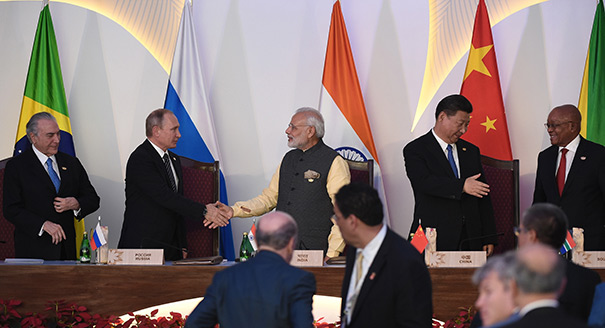
The BRICS summit highlights the need for India’s foreign policy relations with China, Russia, and the United States to reflect pragmatism and realism rather than idealism.
Source: Indian Express
For more than two decades, building a multipolar world has been one of the central themes of India’s foreign policy. For nearly a decade, the BRICS, the forum that brings together Brazil, Russia, India, China and South Africa, has been the main forum for the pursuit of that objective. But China’s rapid rise has compelled India to rethink the virtues of a multipolar world.
As Beijing squeezes India’s space in the Subcontinent and the Indian Ocean and becomes a lot more assertive in the bilateral disputes with Delhi, the construction of a “multipolar Asia” — or balancing China — is turning out to be as important as the search for a “multipolar world”, for long the code words for hedging against American unilateralism. That Washington has become more empathetic to India’s regional and global concerns — ranging from terrorism in Pakistan to Delhi’s membership of the Nuclear Suppliers Group — has made a recalibration of India’s great power relations inevitable.
After the Cold War, India faced a twin challenge. The collapse of the Soviet Union and the logic of adapting to a globalising world saw Delhi re-engage the United States and the West. Even as India reached out to the West after the Cold War, it was deeply wary of its interventionist policies on a range of issues — including human rights, Kashmir and nuclear non-proliferation. To insure against the negative fall-out from the unipolar world, Delhi chose to line up under Moscow’s banner for a great “strategic triangle” of eastern powers, involving Russia, China and India, to blunt America’s edge in the post-Cold War world.
This saw a significant tension in India’s engagement with the great powers. Indian leaders would stand up in Washington and talk of a “natural alliance” with the sole super power, America. At the same time, India would sit down with Russia and China to call for a “multipolar world”. This was not about hypocrisy — which is quite common in the brutal world of international relations — but of managing multiple contradictions that confronted India after the Cold War.
The strategic triangle involving India, China and Russia eventually expanded into the BRICS with the inclusion of Brazil and South Africa. But the internal changes within the BRICS and external environment altered the dynamics of the BRICS and posed new challenges for India’s engagement with the forum.
For one, the rise of China dramatically altered the orientation of the BRICS. China’s massive economic weight in the forum — its GDP at nearly $12 trillion is now more than twice that of the other four members put together — has meant the internal balance in the BRICS has changed in favour of Beijing.
Second, if Moscow saw the BRICS as a way of creating political leverage against the United States and the West, Beijing saw it as an instrument to expand China’s own global economic influence. Apprehension about US-led globalisation was one of the motivations behind India’s quest for a multipolar world in the past. Delhi is now struggling to come to terms with China-led globalisation.
As resistance to globalisation gains ground in the US and the West, it is Beijing that now claims to be the champion of free markets. India has a hard time endorsing that claim as it battles a massive annual trade deficit of nearly $50 billion with China. President Xi Jinping’s Belt and Road initiative, which has become the main vehicle for Beijing’s economic power projection, has added to India’s concerns about China’s rise.
Third, India’s play with the BRICS while deepening the strategic partnership with Washington and Tokyo looked quite cute so long as there were no major tensions between the great powers — US, Russia, China and Japan. But India’s “multi-alignment” has become harder as the great power harmony was followed by renewed tensions between them. In the past, India was tempted to privilege the BRICS over the partnership with the West. Today, Delhi seems more inclined towards judging issues by their implications for India’s national interest rather than the metric of a presumed ideological correctness.
Many in India see the BRICS forum as a continuation of the past attachment to non-alignment and third worldism. But Delhi is acutely conscious of the fact that the BRICS is not about North-South politics. Nor is it about staying away from the great powers and maintaining equidistance between them — for it involves two of them, China and Russia, as members of the forum.
That India now faces relentless pressure from the Middle Kingdom on a range of issues, must cope with the new strategic warmth between Moscow and Beijing, and the willingness of both Russia and China to cut deals with the US (on their own terms), makes the BRICS less about ideological posturing, more about repositioning India in changing great power equations.
This would mean India standing up to China where necessary and cooperating with it where possible, salvaging the essence of the long-standing partnership with Russia but recognising Moscow has its own imperatives, and deepening the strategic ties with Washington but acknowledging America’s sharp internal divisions and the enduring compulsions to find compromises with a rising China. This transition in India’s worldview towards unsentimental realism has been in the making for a while, but has become the defining feature of the current government’s foreign policy.
This article was originally published in the Indian Express.
Former Nonresident Senior Fellow, Carnegie India
A leading analyst of India’s foreign policy, Mohan is also an expert on South Asian security, great-power relations in Asia, and arms control.
Recent Work

C. Raja Mohan, Darshana M. Baruah


Alexander Gabuev, Paul Haenle, C. Raja Mohan, …
Carnegie does not take institutional positions on public policy issues; the views represented herein are those of the author(s) and do not necessarily reflect the views of Carnegie, its staff, or its trustees.

Despite a new textbook, an influx of Russian teachers and managers, and an end to the teaching of Ukrainian, the Kremlin is unlikely to have “reprogrammed” locals.

Konstantin Skorkin

Cargo traffic through Russia’s Northern Sea Route has increased because of the disruption caused by the conflict in the Middle East, the Ukraine war, and U.S.-China tensions.

Mikhail Korostikov

Trump has promised Belarus a massive potash deal. But Minsk is seeking something greater: restored Western transit and greater room for maneuver from Russia.

Balázs Jarábik

Minsk clearly expected the dialogue with Washington to yield more results, in particular the lifting of EU sanctions and permission to export potash.

Artyom Shraibman

With the growth in points of friction between the great powers, organizations like the SCO will continue to play a role in the strategic adaptation of the smaller powers caught between them.

Temur Umarov