

Other
- +18
James M. Acton, Saskia Brechenmacher, Cecily Brewer, …
{
  "authors": [
    "Tong Zhao"
  ],
  "type": "legacyinthemedia",
  "centerAffiliationAll": "",
  "centers": [
    "Carnegie Endowment for International Peace",
    "Carnegie China"
  ],
  "collections": [
    "U.S.-China Relations"
  ],
  "englishNewsletterAll": "",
  "nonEnglishNewsletterAll": "",
  "primaryCenter": "Carnegie China",
  "programAffiliation": "",
  "programs": [],
  "projects": [],
  "regions": [
    "North America",
    "United States",
    "East Asia",
    "China",
    "North Korea"
  ],
  "topics": [
    "Arms Control",
    "Security",
    "Foreign Policy",
    "Nuclear Policy"
  ]
}
Source: Getty
The gap between the Chinese and U.S. views on North Korea is too deep and fundamental, and any illusion it can be bridged in a relatively short period of time will only set the two powers on a path to collision with each other.
Source: Atlantic
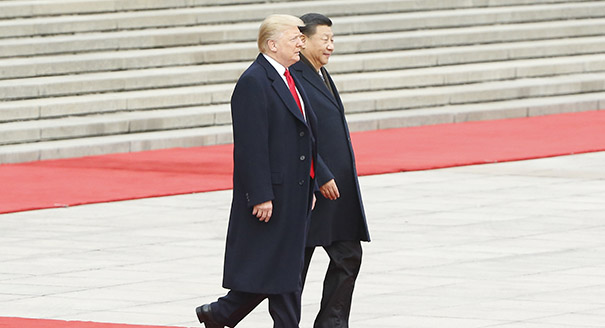
The American president may have expected to use his meeting with China’s Xi Jinping on Wednesday to press China to “do more” to address the North Korean nuclear threat. As the 19th Congress of the Chinese Communist Party has just concluded, securing Xi’s place at the top of Chinese politics for at least the next five years, many analysts believe Xi now has more latitude to address the North Korean crisis and to take tougher measures against Pyongyang. In particular, Trump may be hoping to use this opportunity to persuade his Chinese counterpart to finally pull the plug on North Korea by cutting all economic ties and thus forcing Pyongyang to face the ultimate risk of regime collapse. Indeed, in South Korea ahead of his China visit, he called on all countries to cease trade with North Korea. But in China’s case, this is likely to be a dead end. The gap between the Chinese and American views on North Korea is too deep and fundamental, and any illusion it can be bridged in a relatively short period of time through further pressuring Beijing is only setting the two major powers on a path to collision with each other.
The U.S. and China differ over whether international efforts should focus on coercive pressure or diplomatic overture. In large part, this results from their differing views on the nature of the North Korean regime and its trustworthiness as a negotiating partner. Washington and Beijing have genuinely divergent interpretations about Pyongyang’s past behaviors and about what caused the previous negotiations with Pyongyang to fail. Washington accuses Pyongyang of cheating on every agreement ever reached, but Beijing rejects the view that Pyongyang bears the sole responsibility for previous diplomatic failures. As a result, when Washington rejects any deal short of complete denuclearization, and dismisses Pyongyang’s proposals of suspending nuclear and missile tests as tactics for buying time, Beijing believes that a political solution starting with such a freeze still exists and that Pyongyang can be a reasonable negotiating partner.
Furthermore, Beijing believes Washington does not know what it is asking for in demanding an embargo on Pyongyang’s foreign income, fuel, and other key supplies. Even if such an embargo could threaten the survival of the North Korean regime, the critical issue is how Pyongyang would react in a desperate situation. Based on the Chinese understanding of North Korea, instead of simply backing down, Pyongyang is much more likely to ramp up its provocative activities and further escalate the risk of war. Believing its own resolve is greater than Washington’s, Pyongyang probably figures it has the upper hand in brinksmanship. If this happens, would the international community—including the United States—have a good counter strategy? Could we get out of the crisis safely without triggering a war? Beijing does not think so.
Even if the international community can somehow overthrow the North Korean regime peacefully, Beijing and Washington would still have fundamental disagreements on an acceptable end state on the Korean peninsula. The two countries have never discussed this question formally, due to political sensitivity; academic discussions at the unofficial level are still preliminary, with positions far apart. The U.S. may not trust the North Koreans as negotiating partners; Chinese mistrust of American intentions is just as profound. Chinese experts frequently express the concern that somehow Washington and Pyongyang might suddenly set aside their disputes through secret talks and collude to work against a common strategic concern—Beijing. This may sound unimaginable to American experts, but it points to the extreme difficulty of reassuring China about what happens in the case where the peninsula’s status quo fundamentally changes. Thus, China has its own reasons for declining to throw its weight behind U.S. initiatives, beyond propping up a troublesome ally or warding off potential chaos on its border.
There’s not much a summit can do to change this. It’s possible it could be an opportunity to make explicit the different assumptions underlying America and China’s respective North Korea policies, which would at least be a first step toward promoting better understanding and realistic expectations. Given Beijing’s growing frustrations with North Korean behavior, Trump may have the opportunity to start a substantive dialogue with China to discuss mutually agreeable responses in case Kim Jong Un chose to carry out more aggressive provocations—such as shooting missiles near Guam or detonating a nuclear warhead in the Pacific Ocean.
More importantly, perhaps, the two leaders need to set reasonable near-term objectives for North Korea. From Beijing’s perspective, it is unrealistic to expect an immediate denuclearization of North Korea—especially since the world has so far proved unable to even prevent the North’s present capabilities from growing. At the same time, though, it is also dangerous to allow the risk of war to further escalate, leaving no time for relevant parties to work out a practical roadmap for denuclearization. The White House, on the other hand, has not detailed any near-term policy objectives other than the ultimate goal of denuclearization. Mr. Trump’s own advisers may not have challenged him on whether this is still realistic and advisable—and if not what the alternatives are, along with their associated costs. But Xi certainly will.

Senior Fellow with the Nuclear Policy Program and Carnegie China
Tong Zhao is a senior fellow with the Nuclear Policy Program and Carnegie China, Carnegie’s East Asia-based research center on contemporary China. Formerly based in Beijing, he now conducts research in Washington on strategic security issues.
Recent Work



James M. Acton, Saskia Brechenmacher, Cecily Brewer, …
Tong Zhao
Carnegie does not take institutional positions on public policy issues; the views represented herein are those of the author(s) and do not necessarily reflect the views of Carnegie, its staff, or its trustees.

With the growth in points of friction between the great powers, organizations like the SCO will continue to play a role in the strategic adaptation of the smaller powers caught between them.

Temur Umarov

When faced with fuel shortages in the past, Central Asian governments could always count on additional supplies from Moscow. That safety net no longer exists.

Galiya Ibragimova

Two divergent trends—Putin’s hardline vision of how to prosecute the war in Ukraine, and a growing desire for change in Russia—could tear the regime apart.

Tatiana Stanovaya

Andrey Melnichenko’s essay offers no answer to the fundamental question of how, under any kind of negotiated settlement, Europe can protect itself from the Russian ressentiment that is inevitable in all scenarios except for an outright victory for Putin.

Leonid Bershidsky

Despite unhappiness on the ground, Moscow is determined to use both carrot and stick to ensure there is record support for United Russia in occupied Ukraine.

Konstantin Skorkin