

Article
C. Raja Mohan, Darshana M. Baruah
{
  "authors": [
    "C. Raja Mohan"
  ],
  "type": "legacyinthemedia",
  "centerAffiliationAll": "dc",
  "centers": [
    "Carnegie Endowment for International Peace",
    "Carnegie India",
    "Malcolm H. Kerr Carnegie Middle East Center"
  ],
  "collections": [],
  "englishNewsletterAll": "ctw",
  "nonEnglishNewsletterAll": "",
  "primaryCenter": "Carnegie India",
  "programAffiliation": "SAP",
  "programs": [
    "South Asia"
  ],
  "projects": [],
  "regions": [
    "Asia",
    "India",
    "Gulf",
    "Middle East",
    "Qatar",
    "United Arab Emirates",
    "South Asia"
  ],
  "topics": [
    "Foreign Policy",
    "Economy",
    "Political Reform",
    "Global Governance"
  ]
}
Source: Getty
While New Delhi has begun to build on the synergies with the United Arab Emirates on counter-terrorism and long-term strategic economic cooperation, it has barely scratched the surface of what is possible in the domain of defense.
Source: Indian Express
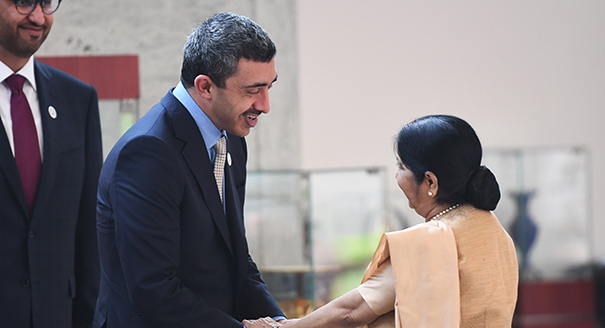
The United Arab Emirates, whose foreign minister, Abdullah bin Zayed al Nahyan, is in India this week, is not the only country to punch way above its weight. Norway and Singapore in the east readily come to mind. Cuba during the Cold War had an image and influence that was larger than life.
More recently, the tiny state of Qatar has had an outsized impact on the Middle East and beyond. But few small states have matched the scale of the Gulf kingdom’s strategic ambition and the breadth of its reach — in financial, political and strategic affairs.
Thanks to the special personal bond between Prime Minister Narendra Modi and the rulers of the UAE, the bilateral relationship with the Gulf kingdom has been radically re-framed in the last four years. But Delhi is a long way from realising the full potential of the strategic partnership with Abu Dhabi.
But first to the political chutzpah of a kingdom with an indigenous population of barely 1.5 million. The UAE is awash in oil. But what marks it apart from other petro-states is a rare purposefulness that has turned it into a strategic actor of consequence in our western neighbourhood.
Foreign minister Sheikh Abdullah will spend much time in Delhi explaining the kingdom’s air, sea and naval operations in Yemen. That a small nation is intervening so boldly in Yemen’s civil war comes as a surprise only to those who have not been paying attention to the rise of the Emirates.
The Iraqi annexation of Kuwait in 1990 and the intensity of the American military effort needed to liberate it from Saddam Hussein perhaps convinced Abu Dhabi’s rulers of one thing — without a measure of military strength it will be at the mercy of larger neighbours and great powers. Since then, the UAE focused on building strong military forces. And the watershed events of 9/11 and the Arab Spring reinforced Abu Dhabi’s determination that it must act boldly to survive amidst the regional turbulence.
Consider for a moment the defence budget of the UAE. Some reports put it around $22 billion, which is nearly 40 per cent of India’s defence spending of about $52 billion. The UAE was the fourth-largest importer of weapons during 2013-17. It has built a mean air force, impressive special forces, and invested massively in the combat training of its forces. A small contingent of the UAE troops reportedly made quite an impression in Delhi when they marched on Rajpath during the Republic Day celebrations of 2017.
Since the early 1990s, the UAE forces joined a number of US coalition operations ranging from Somalia to Kosovo and Afghanistan. They also participated in the Anglo-French military effort to oust Muammar Gaddafi from power. The UAE also took a leading role in anti-Daesh coalition in the Middle East.
It is this military activism that led the then US Centcom commander, General James Mattis (now the US Defence Secretary) to call UAE the “little Sparta”. The comparison of the UAE to the warrior city-state from ancient Greece might have been over the top, but the moniker has stuck.
As it embarked on expeditionary operations, it was perhaps inevitable that the UAE would look for military bases in its neighbourhood. It has developed the Assab military base in Eritrea, from where its forces have conducted operations in Yemen. The UAE is also developing other strategic port facilities in Berbera in Somaliland and Bossaso in Puntland, both provinces of Somalia.
But why in the world is the UAE trying to do the kind of things that major powers do? Three reasons stand out. One is the threat that it faces from Sunni extremist forces like the Taliban, al Qaeda, Muslim Brotherhood and the Daesh. Even as it cracks down hard on these forces at home, Abu Dhabi has bet on confronting them across the region. Fighting for “moderate Islam” is not a mere slogan for the UAE, it is an existential necessity for the Emiratis.
Second, the UAE has long been wary of Iran ever since the Islamic Republic was founded in 1979. As Iran’s influence grows across the Middle East, the UAE has accused Tehran of intervening in the internal affairs of the Sunni kingdoms. Confronting the Iran (Shia) challenge has become a major objective for the UAE and Saudi Arabia.
Third, the UAE and other Gulf states, which entirely depended on the US in the past to secure the region, now worry that the US is in retrenchment mode. Diversification of security partnerships has become an important national objective for the UAE. And that precisely is where India comes in.
The UAE, of course, wants to sustain the partnership with the US and the West to the maximum extent possible. At the same time, it has stepped up strategic coordination with Saudi Arabia. It has also reached out to India with an ambitious agenda of defence cooperation. While Delhi has begun to build on the synergies with the UAE on counter-terrorism and long-term strategic economic cooperation, it has barely scratched the surface of what is possible in the domain of defence.
This article was originally published in the Indian Express.
Former Nonresident Senior Fellow, Carnegie India
A leading analyst of India’s foreign policy, Mohan is also an expert on South Asian security, great-power relations in Asia, and arms control.
Recent Work

C. Raja Mohan, Darshana M. Baruah


Alexander Gabuev, Paul Haenle, C. Raja Mohan, …
Carnegie does not take institutional positions on public policy issues; the views represented herein are those of the author(s) and do not necessarily reflect the views of Carnegie, its staff, or its trustees.

Putin’s conservative staffing policies and search for ever greater control have cemented parliament’s transformation into a bureaucratic appendage of the executive branch.

Andrey Pertsev

Russia’s AI-driven propaganda campaigns operate in a fragmented, chaotic, and often illogical manner. That’s not necessarily a problem for the Kremlin, though: It’s much easier to mimic genuine public debate that way.

Ilya Klishin

Without a ceasefire with Ukraine on attacking each other’s energy infrastructure—to which the Kremlin is unlikely to agree—the diesel agreement between Putin and Trump is largely for show, rather than representing a genuine increase in the volumes of Russian diesel on the global market.

Sergey Vakulenko

Russian strikes are weakening the economy sustaining Ukraine’s war effort. Closing the growing funding gap will require more European support and politically contentious reforms in Kyiv.

Balázs Jarábik

Ex-president Gurbanguly Berdimuhamedov remains interested in politics, but his son Serdar, Turkmenistan’s current president, is becoming increasingly independent and willing to break with his father’s legacy. If their covert rivalry goes too far, both risk losing power.

Galiya Ibragimova