

Commentary
If the Russian-speaking community in Latvia cannot articulate their interests without being seen as disloyal, they could end up embracing a pro-Kremlin agenda.
Sergejs Potapkins
{
  "authors": [
    "Thomas Carothers",
    "Christopher Carothers"
  ],
  "type": "legacyinthemedia",
  "centerAffiliationAll": "dc",
  "centers": [
    "Carnegie Endowment for International Peace"
  ],
  "collections": [
    "Anti-Corruption"
  ],
  "englishNewsletterAll": "democracy",
  "nonEnglishNewsletterAll": "",
  "primaryCenter": "Carnegie Endowment for International Peace",
  "programAffiliation": "DCG",
  "programs": [
    "Democracy, Conflict, and Governance"
  ],
  "projects": [],
  "regions": [
    "North America",
    "Middle East",
    "North Africa",
    "Southern, Eastern, and Western Africa",
    "South Asia",
    "East Asia",
    "Central Asia",
    "Southeast Asia",
    "Caucasus",
    "Eastern Europe",
    "Western Europe"
  ],
  "topics": [
    "Democracy",
    "Global Governance"
  ]
}
Source: Getty
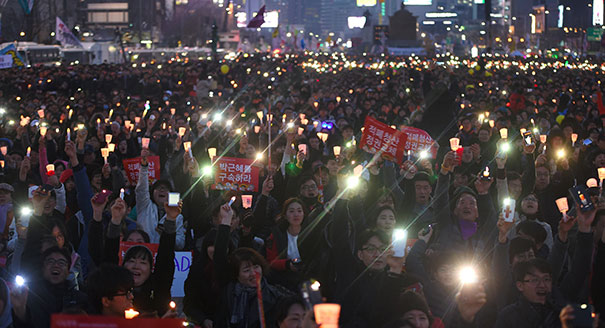
Public anger at corruption has become perhaps the most powerful driver of political change around the world.
Source: Foreign Policy
There is a striking trend in global politics: A growing number of presidents and prime ministers are being toppled before the end of their term by public anger and legal action relating to corruption. In just the last six months, corruption dominoes have fallen in countries as diverse as Armenia, Malaysia, Peru, Slovakia, South Africa, and Spain. Stepping back a bit, a startling fact deserves attention: In the past five years, more than 10 percent of countries in the world have experienced corruption-driven leadership change.
In these 21 countries, embattled leaders have either resigned, been ousted by a no-confidence vote, or been impeached or removed from office. Their alleged wrongdoings range from the relatively mild—an Icelandic prime minister seemingly trying to conceal the existence of overseas assets—to extensive influence-peddling and abuse of power for private gain. Most cases are unrelated to each other, but the 2016 release of the Panama Papers and the investigation into the Brazilian conglomerate Odebrecht have triggered political scandals in multiple countries.
Not only is corruption driving out many leaders before their time, but it is also contributing significantly to the electoral defeats of numerous incumbents. Consider the surprising defeat of Malaysian Prime Minister Najib Razak in the May elections that ousted the party that had governed Malaysia continuously for more than 60 years. In the run-up to the contest, Najib’s reputation was fatally weakened by accusations that he siphoned hundreds of millions of dollars from the state investment fund 1Malaysia Development Berhad into his personal account. In the past several years, Argentina, Benin, Costa Rica, Ghana, India, Nigeria, Sierra Leone, and Sri Lanka have all seen incumbent candidates or parties defeated as a partial or significant result of corruption scandals.
Even where corrupt leaders are surviving the storm, protests fueled primarily or partially by corruption often shake up politics, as they have in the Czech Republic, Honduras, Iran, Malta, and elsewhere.
Corruption has become a remarkably powerful—arguably the most powerful—issue driving political change in the world today. This reality is a crucial counterpoint to the troubling idea that has emerged in the last year or two that with media manipulation, populist appeals, and restrictions on civic space, corrupt politicians are simply able do whatever they want and not pay any price for it. Citizens all over are demonstrating a growing unwillingness to put up with corrupt behavior and other forms of bad governance. By doing so, they are changing global politics for the better.

Harvey V. Fineberg Chair for Democracy Studies; Senior Fellow, Democracy, Conflict, and Governance Program
Thomas Carothers, a senior fellow in the Carnegie Endowment for International Peace’s Democracy, Conflict, and Governance Program, is a leading expert on comparative democratization and international support for democracy.
Christopher Carothers
Christopher Carothers, a Ph.D. Candidate in Government and an Ashford Fellow at Harvard University, is carrying out research on anti-corruption policies of authoritarian governments.
Carnegie does not take institutional positions on public policy issues; the views represented herein are those of the author(s) and do not necessarily reflect the views of Carnegie, its staff, or its trustees.

If the Russian-speaking community in Latvia cannot articulate their interests without being seen as disloyal, they could end up embracing a pro-Kremlin agenda.

Sergejs Potapkins

In the tenth year of his presidency, President Mirziyoyev’s system is becoming even more personalized than that of his predecessor Karimov.

Galiya Ibragimova

With the growth in points of friction between the great powers, organizations like the SCO will continue to play a role in the strategic adaptation of the smaller powers caught between them.

Temur Umarov

When faced with fuel shortages in the past, Central Asian governments could always count on additional supplies from Moscow. That safety net no longer exists.
Galiya Ibragimova
Ultimately, Zelensky sided neither with the reform camp nor with the military establishment as such, but with political control.

Balázs Jarábik