

Commentary
Judy Dempsey
{
  "authors": [
    "Judy Dempsey"
  ],
  "type": "legacyinthemedia",
  "centerAffiliationAll": "dc",
  "centers": [
    "Carnegie Endowment for International Peace",
    "Carnegie Europe"
  ],
  "collections": [
    "Europe’s Eastern Neighborhood"
  ],
  "englishNewsletterAll": "ctw",
  "nonEnglishNewsletterAll": "",
  "primaryCenter": "Carnegie Europe",
  "programAffiliation": "EP",
  "programs": [
    "Europe"
  ],
  "projects": [],
  "regions": [
    "Russia",
    "Europe",
    "Western Europe",
    "Germany",
    "Iran"
  ],
  "topics": [
    "EU",
    "Economy",
    "Climate Change"
  ]
}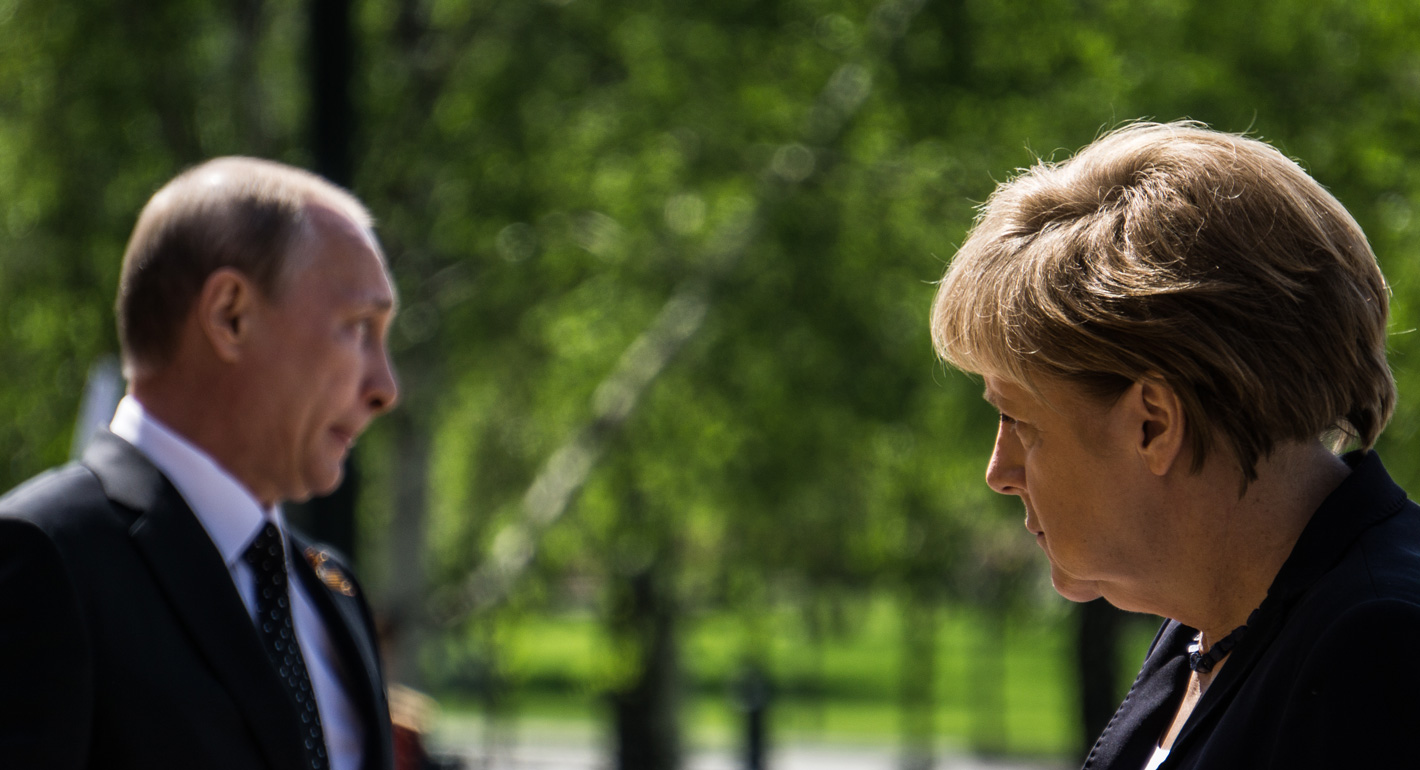
Source: Getty
Merkel should bury Nord Stream 2 and speed up renewable energy. That could be one of the Chancellor’s signature legacies: breaking Russia’s energy grip on Germany and on Europe.
Source: Washington Post
One of the top candidates vying to replace Chancellor Angela Merkel as leader of the Christian Democrats has waded into the controversial Nord Stream 2 gas pipeline, which will increase Germany’s dependence on Russian gas.
Annegret Kramp-Karrenbauer said withdrawing political support for the project would be “too radical.” Instead, she said, Germany should reduce the amount of gas flowing into the pipeline.
Her comments will be a relief to industry, which has been lobbying hard for Nord Stream 2. But there is increasing cross-party opposition to the pipeline, which has become more vocal after Russia’s recent attack on Ukrainian ships in the Kerch Strait.
This is a replay of Moscow’s illegal annexation of the Crimean Peninsula in 2014 and its subsequent proxy invasion of parts of Eastern Ukraine. By blocking Ukraine’s access to the ports of Mariupol and Berdyansk that are reached through the Kerch Strait, Russia is chiseling away at the territorial integrity of Ukraine.
And how is the West reacting?With the usual high-level meetings in the European Union, NATO and the U.N. Security Council. These hand-wringing gatherings — in which the participants express “concern” and at the same time repeat support for Ukraine’s territorial integrity — are not only hypocritical. They betray a shocking lack of intelligence and strategy by these organizations.
The West is in reaction mode as Russia once again flagrantly breaks international law — two laws, in fact: The U.N. Convention on the Law of the Sea and a bilateral Ukrainian-Russian agreement of 2003 in which both countries agreed to unhindered access to the Azov Sea via the Kerch Strait.
The E.U. will try to look resolute. To give an impression of action, E.U. leaders next week will roll over the economic sanctions they have imposed on Russia since 2014. Yet, given that sanctions don’t seem to have deterred President Vladimir Putin from committing aggressive acts, it may be time to consider a much bigger stick than the E.U. (and Germany, in particular) could wield. That would be Nord Stream 2.
The monster gas pipeline, which runs under the Baltic Sea to Germany, is problematic for a number of reasons. It gives Russia’s state-owned energy giant Gazprom a permanent foothold in Europe, increasing European dependence on Russian energy. It deprives Ukraine of the transit fees it earns by allowing Russia to transport gas to Europe through its territory. If Ukraine loses its leverage as a transit country, that makes it more vulnerable to Russian pressure over gas prices and quantities.
All the more reason that it is high time that Merkel buried this big, Russian-led project that her predecessor, the Social Democrat Gerhard Schröder, has supported since 2005. Schröder, an old pal of Putin (whom he once described as an “impeccable democrat”), now sits on the boards of Nord Stream 2 and Gazprom.
Now in her fourth term, Merkel should bite the bullet.
She has nothing to lose. She’s not going to stand again as chancellor. She’s on her way out. Stopping Nord Stream 2 would win her support from the Poles, from Ukraine, from the Baltic States, and from the E.U. Commission, which has lobbied against Nord Stream 2 despite bullying and pressure from Berlin.
Were Merkel to take this leap, it would break Germany’s growing dependence on Russian energy. It would show that Germany is committed to diversification of energy sources, a key element of E.U. energy policy. It would end the disturbingly ambivalent ties between German political elites and Russia. Above all, it would finally break the cozy nontransparent relationship between Gazprom and the big German, Dutch and Austrian energy companies. That could be one of Merkel’s signature legacies: breaking Russia’s energy grip on Germany and on Europe.
She faces huge pressure from Nord Stream 2 stakeholders: Germany’s Uniper and Wintershall (a subsidiary of the giant BASF chemicals group), Austria’s OMV, France’s Engie and the Anglo-Dutch Royal Dutch Shell.
A BASF executive recently told me Merkel had to stick to Nord Stream 2. “Why?” I asked. “Because it will give us secure supplies and cheaper gas.” He then explained that Merkel’s decision to phase out nuclear power by 2022 was ill-thought out: Germany needed more energy for its energy-intensive industries, he argued. “Merkel didn’t have any viable renewables energy strategy in place to fill the gap once we gave up nuclear energy,” he added. “We need Nord Stream because we need cheap energy.”
Merkel’s decision to phase out nuclear energy played into the hands of Gazprom. The United States was not yet in a position to deliver liquid natural gas (LNG) supplies to Europe. German industry leaned on the chancellor.
So here we are, 2018. President Trump, in his weird, confusing policies toward Russia, wants Germany to abandon Nord Stream 2 and import American LNG. Merkel can’t be seen to be giving into Trump’s economic interests; nor can she hurt German industry.
In typical Merkel fashion, she agreed to locate an LNG terminal in Germany by the end of this year. She should go further. Putin should not benefit from Russia’s latest violation of international law. Merkel should bury Nord Stream 2 and speed up renewable energy.
This article was originally published by the Washington Post.

Nonresident Senior Fellow, Carnegie Europe
Judy Dempsey is a nonresident senior fellow at Carnegie Europe
Recent Work
Judy Dempsey
Judy Dempsey
Carnegie does not take institutional positions on public policy issues; the views represented herein are those of the author(s) and do not necessarily reflect the views of Carnegie, its staff, or its trustees.

If the Russian-speaking community in Latvia cannot articulate their interests without being seen as disloyal, they could end up embracing a pro-Kremlin agenda.

Sergejs Potapkins

Russia’s ruling party would have benefited from Putin appearing as its distant patron, but as an active frontman imposing his views on the public, he has done nothing but harm both the party’s election campaign and the ruling system overall.

Andrey Pertsev

Depleted financial reserves and a shrinking tax base mean it is no longer possible to simultaneously deliver high defense spending, price stability, and economic growth.

Alexandra Prokopenko
Blurring the line between humans and animals is a long-standing tradition in social utopian prose. In his latest novel, Leonid Bershidsky reminds us that in social experiments, people are often treated no differently than animals.

Alexander Baunov
While France and Australia are seeking to establish the legal obligations of messaging apps like Telegram, Russia wants total subordination.

Maria Kolomychenko