

Commentary
Tatiana Stanovaya
{
  "authors": [
    "Tatiana Stanovaya"
  ],
  "type": "commentary",
  "centerAffiliationAll": "",
  "centers": [
    "Carnegie Endowment for International Peace",
    "Carnegie Russia Eurasia Center"
  ],
  "collections": [
    "Inside Russia"
  ],
  "englishNewsletterAll": "",
  "nonEnglishNewsletterAll": "",
  "primaryCenter": "Carnegie Endowment for International Peace",
  "programAffiliation": "",
  "programs": [],
  "projects": [],
  "regions": [],
  "topics": [
    "Economy"
  ]
}
Source: Getty
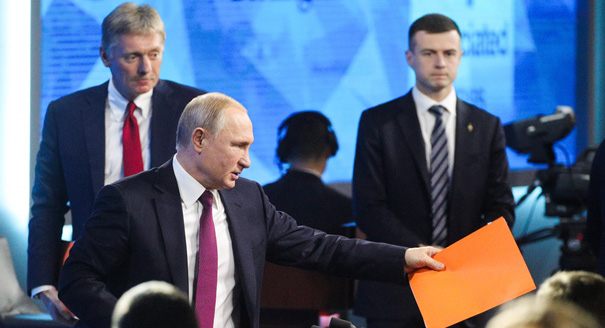
The main takeaways from Putin’s end-of-the-year press conference are that he has less and less room to maneuver on foreign policy, and that his optimism about a “breakthrough” in the domestic arena is clearly divorced from reality. Circumstances are forcing Putin to turn from geopolitical problems to domestic ones, and that is proving difficult.
Russian President Vladimir Putin held his annual press conference on December 20. While the format of one of his main public appearances has long become routine, the president’s interaction with the media remains one of the few opportunities to better understand his motives and intentions, especially as the Russian regime’s decisionmaking becomes increasingly closed.
As in recent years, most of the questions consisted of requests, expressions of gratitude, and very local issues that had little to do with the political agenda. The audience is unable to challenge him because of the event format and the composition of the press corps, and in any case, the Kremlin sees the end-of-year press conference as a form of social therapy rather than negotiations, so it’s increasingly removed from real politics.
Nevertheless, these events shouldn’t be underestimated. However scripted the questions and answers might appear (the degree of control over this event should not be overstated either), the president has to react to a wide variety of subjects, including unpleasant ones. The latest press conference, therefore, allows us to draw several conclusions significant for both Russian and international audiences.
The first conclusion is that Putin and the Russian regime as a whole won’t be taking any meaningful steps toward reconciliation with the West. Putin made it clear that the Russian leadership has not set itself the task of getting sanctions lifted. Instead, it’s bracing itself for a lengthy existence in a hostile environment.
The Russian president is convinced that foreign pressure will only mount, whatever gestures or concessions Russia makes. Putin said accusations that Russian agents poisoned former military intelligence officer Sergei Skripal in the UK are an attack aimed at containing Russia as a competitor, and that the West sees any move by the Kremlin as an excuse to increase pressure.
“This is a politically driven, Russophobic approach. It serves as a pretext for attacking Russia yet again. If there hadn’t been the Skripal case, they would have come up with something else,” said the president.
Putin’s logic is unchanged: if Russia wants to remain sovereign and self-sufficient (a goal that no one questions), it’s destined to live with sanctions. This belief reflects a certain degree of resignation and the conviction that it’s pointless to seek understanding in the West. At the same time, the Russian leader clearly underestimates the real extent to which sanctions are impacting the country’s economy.
As a result, the Kremlin isn’t holding any serious discussions on how to ease sanctions (which doesn’t mean, however, that those close to the Kremlin, in-system liberals, and the business community aren’t discussing the subject either). Putin can’t relate to such conversations, and views them as corporate and self-serving. The Kremlin will not make any real concessions out of nowhere, so we shouldn’t expect Russia to release the Ukrainian sailors seized by Russia off the coast of Crimea, loosen its grip on Donbas, or stop its information campaign in the West.
The second conclusion is that Russia is preparing for the inevitable deterioration of the balance of nuclear forces and the growing risk of a nuclear war. Putin made it clear that Russia is not ruling out worst-case scenarios, and warned that the threshold for a nuclear strike has been lowered (he blames the United States for this, but under Putin’s logic, Russia needs to respond).
Putin assured his people that Russia has the means to respond to these threats. Nuclear weapons are the Kremlin’s argument of last resort in its confrontation with the West. This also points to the greater role now assigned to the scientific and military community responsible for the country’s nuclear potential: their overall influence on the thinking behind Russian foreign policy will become increasingly pronounced.
The third domestic policy conclusion is that the Kremlin is not planning to launch any significant economic reforms. It regards the situation in the country as positive, stable, and conducive to implementing the ambitious plans set out in Putin’s May decree upon his reelection. The social consequences of tax reforms—including hikes in fuel prices, VAT, and utilities payments—are clearly being underestimated.
Putin didn’t respond with much enthusiasm to numerous questions about worsening socioeconomic conditions, including questions from pro-regime media outlets. When asked by a reporter about the gap between the living standards of government officials and ordinary people, the president admitted that the problem exists, but ignored Russia’s deteriorating conditions, noting that Western countries have an income gap, too.
The fourth conclusion is that the Russian president clearly assigns enormous importance to national projects designed to improve areas including infrastructure, education, and healthcare, and believes they can be implemented. Yet few government officials and experts believe that the national projects can in fact be successfully realized. There is an astonishing disconnect between the president and the state bureaucracy that is supposed to carry out his orders.
Another disconnect is evident between Putin’s political entourage and government executives, including regional governors. The former caters to the president’s wishes and moods, and shares his optimism about implementing his May decree, while bearing no public responsibility for realizing national projects. The latter don’t really believe that the national projects are realistic, but lack the political resources to tell the president directly about economic problems. This conflict between the political superstructure and the executive branch will only grow, and will inevitably lead to major personnel reshuffles in the next two to three years.
The fifth and final conclusion is that youth issues, which have dominated discourse in recent months, don’t exist in Putin’s mind. The president has no coherent position on this issue, so all attempts to clarify it during the press conference led nowhere.
Putin’s responses reflect the approach of his domestic policy managers, First Deputy Chief of Staff Sergei Kiriyenko and his team, to youth affairs. They informed the president that Russian rappers’ concerts were being canceled amid concerns they were a bad influence on young people, but don’t consider the politicization of young people important enough to warrant serious attention.
The main takeaways from Putin’s press conference are that he has less and less room to maneuver on foreign policy, and that his optimism about a “breakthrough” in the domestic arena is clearly divorced from reality. Circumstances are forcing Putin to turn from geopolitical problems to domestic ones, and that is proving difficult.
The president’s answers reflected his firm belief in Russia’s geopolitical solitude. Putin is convinced that all positive opportunities have long been exhausted, and only unilateral steps can be effective. It seems that the only ones who understand him now are the military.

Senior Fellow, Carnegie Russia Eurasia Center
Tatiana Stanovaya is a senior fellow at the Carnegie Russia Eurasia Center.
Recent Work
Tatiana Stanovaya
Tatiana Stanovaya
Carnegie does not take institutional positions on public policy issues; the views represented herein are those of the author(s) and do not necessarily reflect the views of Carnegie, its staff, or its trustees.

A much-discussed disagreement over internet restrictions in Russia was never an existential threat for Putin: It was about elite groups protecting their interests.

Alexandra Prokopenko

The demands of the Kremlin’s war in Ukraine, demographic problems, and public hostility toward Central Asians mean Russia does not have enough workers.

Salavat Abylkalikov
Minsk’s faith in the future of its larger neighbor’s economy is fading as Belarusian firms in Russia see record losses.

Olga Loiko
The cost of air defense has become an unregistered tax on revenue for businesses. While military rents are consolidated in the federal budget, the costs of defense are being spread across the balance sheets of companies and regional governments.
Alexandra Prokopenko
Powerful lobbyists and inertia led to Russia’s coal-mining sector missing an excellent opportunity to solve its structural problems.
Alexey Gusev