

Research
- +10
Rosa Balfour, Frances Z. Brown, Yasmine Farouk, …
{
  "authors": [
    "Moisés Naím"
  ],
  "type": "legacyinthemedia",
  "centerAffiliationAll": "dc",
  "centers": [
    "Carnegie Endowment for International Peace"
  ],
  "collections": [],
  "englishNewsletterAll": "americanStatecraft",
  "nonEnglishNewsletterAll": "",
  "primaryCenter": "Carnegie Endowment for International Peace",
  "programAffiliation": "ASP",
  "programs": [
    "American Statecraft"
  ],
  "projects": [],
  "regions": [
    "North America",
    "South America",
    "Russia"
  ],
  "topics": [
    "Foreign Policy"
  ]
}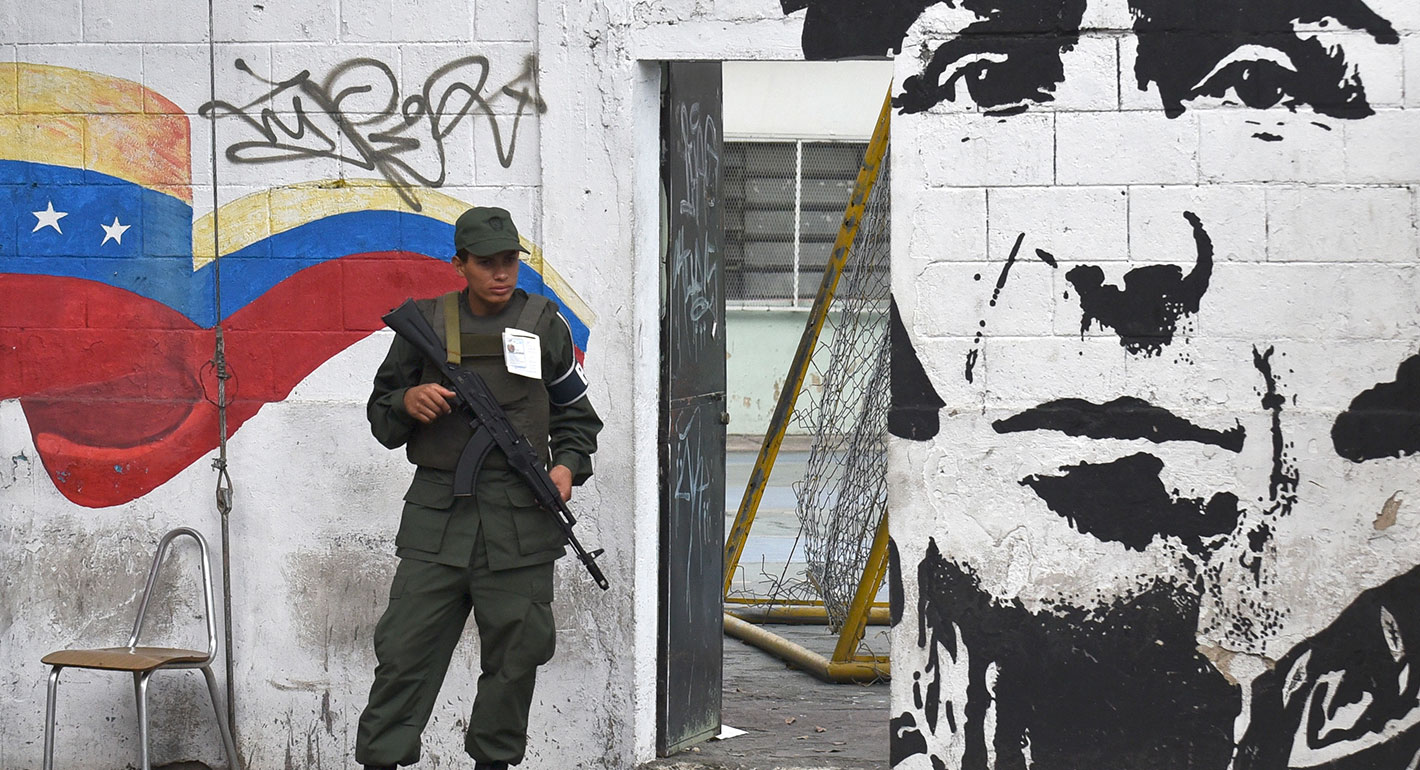
Source: Getty
A Venezuela free of the influences of the Russian autocracy and the Cuban dictatorship is an objective that the world’s democracies should support.
Source: El País
It’s all Barack Obama’s fault.
In 2014, the then-president of the United States declared – a bit disdainfully – that “Russia is a regional power that is threatening some of its immediate neighbors, not out of strength but out of weakness.”
Obama was right and that is likely why Putin never forgave him. The Russian leader spent his formative adult years as a spy for the KGB back in the days when the Soviet Union and the United States were the world’s undisputed superpowers, and could project their military might around the globe. But the Soviet Union collapsed and with it so did Russia’s global influence.
This decline had such a profound impact on Putin that, in 2005, he claimed that “the breakup of the Soviet Union was the greatest geopolitical tragedy of the 20th century.” To put this statement in perspective, it’s worth mentioning that the devastation of World War II and the deaths of 27 million Russians also occurred in the 20th century.
It should not be surprising, then, that restoring Russia’s lost stature as a superpower is a priority for Putin. At the beginning of the civil war in Syria, for example, the United States and the European Union were the key foreign players – with Iran also playing an important role. But Putin managed not only to intervene in the conflict and save Bashar al-Assad’s regime, but Russia also became a leading political and military protagonist. Today there is no possible solution to the Syrian civil war without the Kremlin’s active involvement.
But the boldest and most innovative expression of Russia’s new capabilities to shape world politics was its intervention in the 2016 US elections. According to US intelligence services, “Russia conducted an unprecedented influence campaign to interfere in the US electoral and political process.” And not only in the US. An investigation by the German Marshall Fund found that “Russia has meddled in the affairs of at least 27 European and North American countries since 2004 with interference that ranges from cyberattacks to disinformation campaigns.” The British newspaper The Guardian reported that Russia had interfered in the Brexit referendum, and EL PAÍS reported the same with regard to the crisis in Catalonia.
In light of all this, the surprising thing would be if Putin didn’t take a serious interest in influencing the crisis in Venezuela. This country, after all, is a former ally of the United States that could easily fall back into its orbit, it is located less than three hours by plane from Florida, has the largest proven oil reserves on the planet, and is currently in the midst of a world-class catastrophe. If the United States could intervene against Russia in its armed conflicts in Ukraine, Georgia, Abkhazia, and South Ossetia, why can’t the Kremlin intervene in Washington’s backyard?
But not everything is political: there is also a lot of money at stake. And oil. Venezuela owes a lot of money to Russia, and Chávez and Maduro have given Rosneft – the large Russian energy company – some of the best oil fields as partial payment. Rosneft also got as guarantee for its loans 49.9% of the shares in Citgo Petroleum, a coveted US subsidiary of the Venezuelan state-owned oil company, PDVSA.
It would seem, then, that Venezuela is the perfect target for Russian intervention. And Vladimir Putin must be savoring the fact that he can influence the politics and the economy of a country that is six thousand miles away.
But in the same way that the Russian winter defeated Napoleon’s invading troops in 1812 and those of Hitler in 1941, the mounting chaos in Venezuela could derail Russia’s attempt in 2019.
According to analyst Vladimir Rouvinski, “Russia’s relationship with Venezuela is also a story of missed business opportunities, multi-million dollar risky investments, dubious personal enrichment, and vast corruption… Moscow cannot afford for [Venezuela] to turn into a symbol of one of Putin’s greatest failures in the international arena.”
Others in Russia do not see it that way. At the highest levels of the Russian state there are three groups trying to sway Putin to their respective positions on Venezuela: the economists, the oligarchs, and the geopolitical strategists. For the economists, the immense cost of repairing the damage that Chávez and Maduro have done to the country is prohibitively high. From a purely economic perspective, Venezuela’s rescue and rebuilding is so risky and expensive that it cannot be justified. Putin’s oligarchs, in contrast, are dreaming of the enormous personal profits that could be reaped from having control of Venezuela’s oil and vast mineral wealth. And lastly, the geopolitical strategists dream of having a Russian satellite located in the United States’ backyard.
At this point it is hard to predict which of these three visions of Russia’s role in Venezuela will prevail.
But what should be much clearer is that a Venezuela free of the influences of the Russian autocracy and the Cuban dictatorship is an objective that the world’s democracies should support. And not only to help free Venezuela from the indefensible Maduro dictatorship, but also to contain the international adventurism of the autocracies that still roam the planet.

Distinguished Fellow
Moisés Naím is a distinguished fellow at the Carnegie Endowment for International Peace, a best-selling author, and an internationally syndicated columnist.
Recent Work



Rosa Balfour, Frances Z. Brown, Yasmine Farouk, …
Moisés Naím
Carnegie does not take institutional positions on public policy issues; the views represented herein are those of the author(s) and do not necessarily reflect the views of Carnegie, its staff, or its trustees.

The European far right might fail to steer EU policy in the direction Russia wants, but they will create enough chaos inside Europe to benefit the Kremlin.

Dimitar Bechev

Minsk clearly expected the dialogue with Washington to yield more results, in particular the lifting of EU sanctions and permission to export potash.

Artyom Shraibman

Russia’s ruling party would have benefited from Putin appearing as its distant patron, but as an active frontman imposing his views on the public, he has done nothing but harm both the party’s election campaign and the ruling system overall.

Andrey Pertsev

Depleted financial reserves and a shrinking tax base mean it is no longer possible to simultaneously deliver high defense spending, price stability, and economic growth.

Alexandra Prokopenko
Blurring the line between humans and animals is a long-standing tradition in social utopian prose. In his latest novel, Leonid Bershidsky reminds us that in social experiments, people are often treated no differently than animals.

Alexander Baunov