

Commentary
Cornelius Adebahr
{
  "authors": [
    "Cornelius Adebahr"
  ],
  "type": "legacyinthemedia",
  "centerAffiliationAll": "dc",
  "centers": [
    "Carnegie Endowment for International Peace",
    "Carnegie Europe"
  ],
  "collections": [
    "Europe’s Southern Neighborhood"
  ],
  "englishNewsletterAll": "ctw",
  "nonEnglishNewsletterAll": "",
  "primaryCenter": "Carnegie Europe",
  "programAffiliation": "EP",
  "programs": [
    "Europe"
  ],
  "projects": [],
  "regions": [
    "Middle East",
    "Iran"
  ],
  "topics": []
}
Source: Getty
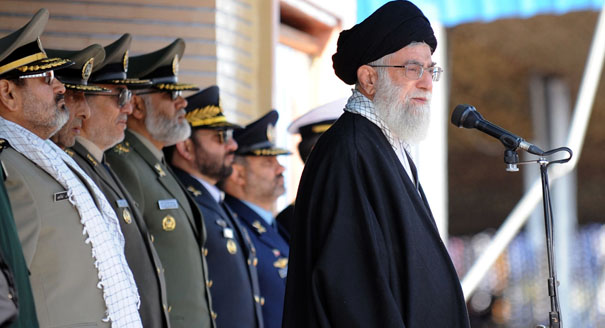
Faced with external and internal threats, Iran is resorting to old-style nationalism.
Source: Global Policy Journal
Six weeks after the Iranian leadership celebrated the 40th anniversary of the Islamic Revolution, with defiant pomp but under difficult circumstances, the next festivity comes along: Nowruz. The Persian New Year coincides with the beginning of spring on March 20, and is precisely about that: to rejoice at the new beginning, the rebirth of life after winter (in the Northern hemisphere, that is). People spend time with their families, they go outdoors with their loved ones, giving away patches of wheatgrass, apples, and garlic, but also goldfish or coins as symbols of purity, happiness, and fertility.
Needless to say that the past year, 1397 according to the Persian calendar, was not all that joyful for Iranians. The economy has been hit hard by re-instated US sanctions, inflation got out of control, and protests that erupted around the turn of the (Western) year 2017/18 over the dire domestic situation have not abated.
While the people are struggling to make ends meet, the regime is trying to make amends – at the ideological level, at least. Despite relentlessly professing its revolutionary credentials, it has given up on one of the cornerstones of Ayatollah Khomeini’s program: To overcome not just 2500 years of Iranian monarchy but also the notion of an Iranian nation, and instead to create a new system of Islamic governance that would be above any purely national interest. Post-1979 Iran considered itself a revolutionary state, not a conventional nation state, eventually uniting the entire community of Muslims.Now facing of what could be considered existential threats, the regime is doing what leaders usually do in a comparable situation: appealing to its citizens’ sense of identity and pride, asking them to resist – both external pressure and internal discontent – in the name of national unity. Admittedly, nationalism has been powerful throughout Iran’s modern history, with the Constitutional Revolution of 1906 and the attempted nationalization of the oil industry in 1953 as the more recent high watermarks. Yet it is the people’s apparent distancing from the Islamic revolution that has led even officials of the Islamic Republic to put more and more emphasis on Iran as a great nation in the world.
This steadily rising tide of Iranian nationalism can be seen in the New Year speeches of the country’s highest-ranking politicians. Supreme Leader Ali Khamenei praised the ‘Iranian nation’ for shining ‘brightly in the true sense of the word.’ Literally, he put the nation before the revolution when he said that ‘the people managed to show their power, their grandeur and their greatness in the face of the enmity and malevolence of the enemies and thereby – thank God – increase the reputation of our nation, our Revolution and our Islamic Republic.’
President Hassan Rouhani in his own speech, broadcast on radio and television, sang to the same tune. ‘The more we are united, and the more the enemy realizes that with these sanctions our nation becomes more cohesive, the sooner they will despair’, he vowed. Consequently, as a response to the hardship created by US sanctions, the leadership called the year 1398 to be the one of ‘boosting national production’ (which should, in language directly from the socialist handbook of the 20th century, bolster the ‘resistance economy’, one of the previous annual slogans).
Again, this would not be so extraordinary were it not for the original idea of overcoming the narrow confines of the nation by reaching both to the higher goals of a religious order and to the wider community of all Muslims worldwide. Yet, as Iranians turned away from the revolutionary ideals and started to embrace more materialist ones beginning with the ‘pragmatic turn’ and the economic opening after the end of the Iran-Iraq war, the leadership also changed its rhetoric. Much of the defence of Iran’s disputed nuclear program during the second half of the 2000s was premised on the idea that this scientific and engineering achievement was the pride of the nation that would not be easily traded away. Already at the beginning of his term in 2013, Foreign Minister Javad Zarif penned an article for Foreign Affairs explaining “What Iran really wants”. In this piece, he concedes that Iran is a nation-state like any other – and specifically asks ‘other states to scrupulously observe the sensitivities of the Iranian nation, particularly regarding its national dignity, independence, and achievements.’
In that sense, it is befitting that the leadership would make use of their Nowruz speeches to appeal to the nation. After all, this is an ancient tradition with Zoroastrian roots, thus predating even the Islamisation of Iran beginning in the 7th century. Given that the Sasanian empire then stretched from the Bosporus and the Nile to the Hindukush, it is not surprising that such celebrations take place well outside of Iran’s today’s borders.
Yet, with much talk today being about Iran’s ‘new expansionism’, it is striking that Iranian leaders would neither appeal to the world community of Muslims with revolutionary ideals nor to the historic community of Nowruz-celebrating countries. No doubt, the Islamic Republic is shrewdly using the space it is being granted by the fall or retreat of other powers, whether in Afghanistan, Iraq, or elsewhere in the region. However, while thriving on others’ weaknesses, it has apparently given up on the ideological underpinning for substantially expanding beyond its borders.
It’s hard to be a modern nation after all, in which citizens voice all sorts of demands, from bread on the table to freedom in – and around – their heads.

Former Nonresident Fellow, Carnegie Europe
Cornelius Adebahr was a nonresident fellow at Carnegie Europe. His research focuses on foreign and security policy, in particular regarding Iran and the Persian Gulf, on European and transatlantic affairs, and on citizens’ engagement.
Recent Work
Cornelius Adebahr

Cornelius Adebahr, Barbara Mittelhammer
Carnegie does not take institutional positions on public policy issues; the views represented herein are those of the author(s) and do not necessarily reflect the views of Carnegie, its staff, or its trustees.
Ongoing uncertainty in the Middle East allows Moscow to both increase its influence in Tehran and continue to enjoy the financial windfall of higher oil prices.

Nikita Smagin
This year’s wars have made alternative routes to transit through Russia no less risky for Central Asian countries.

Galiya Ibragimova
The Russian leadership wants to avoid a dangerous precedent in which it is squeezed out of Iran by the United States and Israel—and left powerless to respond in any meaningful way.
Nikita Smagin
Not only does the fighting jeopardize regional security, it undermines Russian attempts to promote alternatives to the Western-dominated world order.
Ruslan Suleymanov
The future trajectory of the U.S.-Iran war remains uncertain, but its impact on global energy trade flows and ties will be far-reaching. Moscow is likely to become a key beneficiary of these changes; the crisis in the Gulf also strengthens Russia’s hand in its relationships with China and India, where advantages might prove more durable.

Sergey Vakulenko