

Research
- +6
Yasmine Farouk, Nathan J. Brown, Maysaa Shuja Al-Deen, …
{
  "authors": [
    "Michele Dunne"
  ],
  "type": "legacyinthemedia",
  "centerAffiliationAll": "dc",
  "centers": [
    "Carnegie Endowment for International Peace"
  ],
  "collections": [],
  "englishNewsletterAll": "menaTransitions",
  "nonEnglishNewsletterAll": "",
  "primaryCenter": "Carnegie Endowment for International Peace",
  "programAffiliation": "MEP",
  "programs": [
    "Middle East"
  ],
  "projects": [],
  "regions": [
    "North Africa",
    "Egypt"
  ],
  "topics": [
    "Political Reform",
    "Democracy",
    "Security",
    "Global Governance",
    "Foreign Policy"
  ]
}
Source: Getty
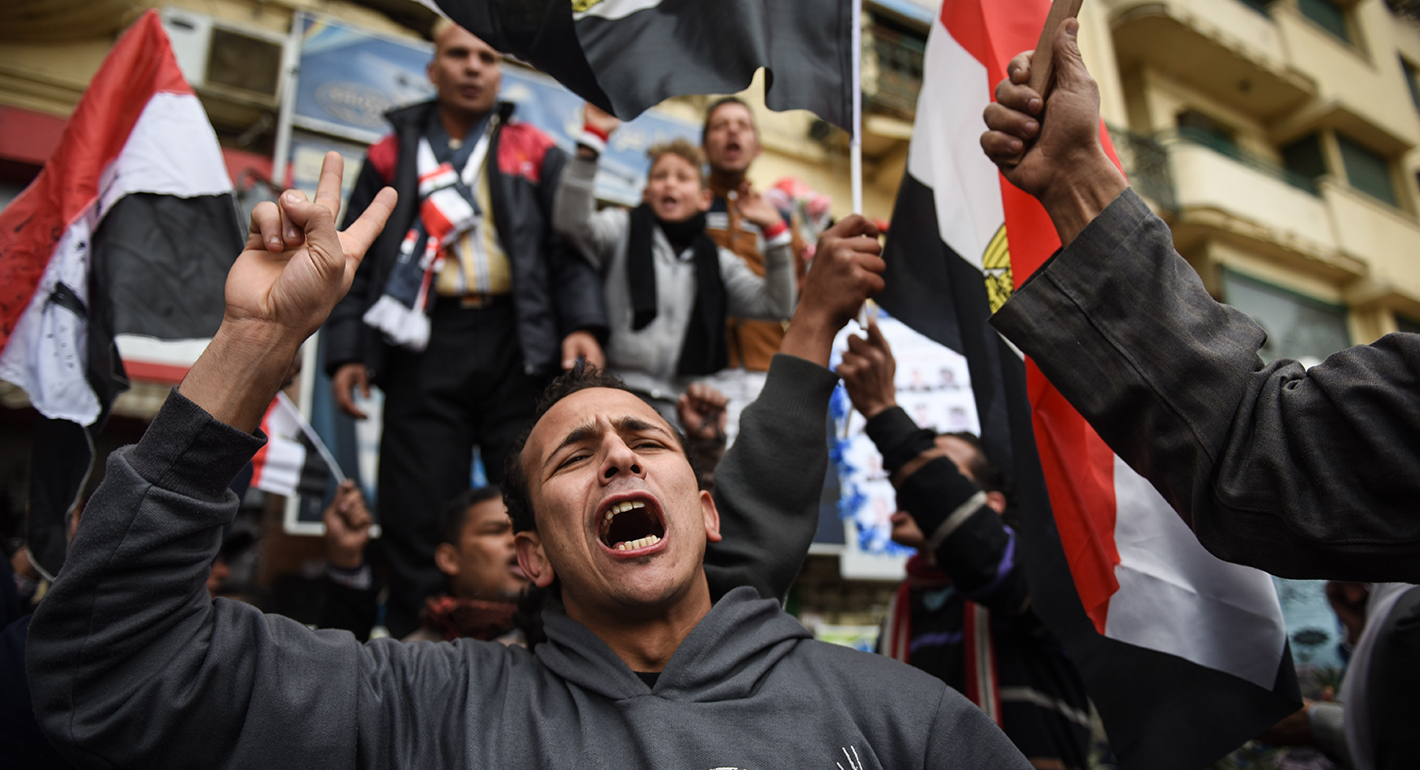
Nearly all political and social movements active before the coup have been crushed, leaving few leaders to formulate coherent protest demands or to negotiate with the military and security apparatus.
Source: Axios
Chaotic protests across Egypt this weekend — prompted by videos exposing corruption in President Abdel Fattah el-Sisi's military-backed government — underscore the population's weariness with economic hardship due in part to government austerity measures.
Why it matters: While Sisi markets Egypt as an island of stability in a turbulent region, popular dissatisfaction with his regime threatens that image. Whether the protests escalate or fizzle, the country remains a potential powder keg in a highly strategic location: straddling the Suez Canal, flanked by Israel and Libya, and across the Mediterranean from Europe.
Where it stands: Authorities have arrested several hundred protestors so far. Meanwhile, Sisi is in New York for the meeting of the UN General Assembly.
Background: Sisi has ruled with an iron fist, killing several thousand and imprisoning some 60,000.
Between the lines: While Sisi has sharply increased the military’s share of economic activity and political power, those benefits fall unequally, giving rise to internal power struggles.
The bottom line: While there is no clear path to peaceful change, Sisi’s continued rule promises to drive Egyptians into increasingly desperate circumstances, as well as to increase security headaches for Europe and the U.S., which funds Egypt’s military to the tune of $1.3 billion annually.

Former Nonresident Scholar, Middle East Program
Michele Dunne was a nonresident scholar in Carnegie’s Middle East Program, where her research focuses on political and economic change in Arab countries, particularly Egypt, as well as U.S. policy in the Middle East.
Recent Work



Yasmine Farouk, Nathan J. Brown, Maysaa Shuja Al-Deen, …
Robert Springborg, Emile Hokayem, Becca Wasser, …
Carnegie does not take institutional positions on public policy issues; the views represented herein are those of the author(s) and do not necessarily reflect the views of Carnegie, its staff, or its trustees.

In the tenth year of his presidency, President Mirziyoyev’s system is becoming even more personalized than that of his predecessor Karimov.

Galiya Ibragimova

With the growth in points of friction between the great powers, organizations like the SCO will continue to play a role in the strategic adaptation of the smaller powers caught between them.

Temur Umarov

The greater threat to Zelensky comes not from Fedorov alone, but from the convergence between the former defense minister’s political campaign and the anti-corruption investigations moving ever closer to the presidential administration.

Balázs Jarábik

With his public call for new elections in Ukraine, ex-defense minister Mykhailo Fedorov has opened Pandora’s box.

Konstantin Skorkin

In the discussions made possible by the State Duma election campaign, one question is being asked more and more loudly. “What next?”

Andrey Pertsev