

Other
Kim Ghattas
{
  "authors": [
    "Kim Ghattas"
  ],
  "type": "legacyinthemedia",
  "centerAffiliationAll": "dc",
  "centers": [
    "Carnegie Endowment for International Peace",
    "Malcolm H. Kerr Carnegie Middle East Center"
  ],
  "collections": [],
  "englishNewsletterAll": "menaTransitions",
  "nonEnglishNewsletterAll": "",
  "primaryCenter": "Carnegie Endowment for International Peace",
  "programAffiliation": "MEP",
  "programs": [
    "Middle East"
  ],
  "projects": [],
  "regions": [
    "North America",
    "United States",
    "Middle East",
    "Iran",
    "Iraq"
  ],
  "topics": [
    "Political Reform",
    "Security",
    "Military",
    "Foreign Policy",
    "Global Governance"
  ]
}
Source: Getty
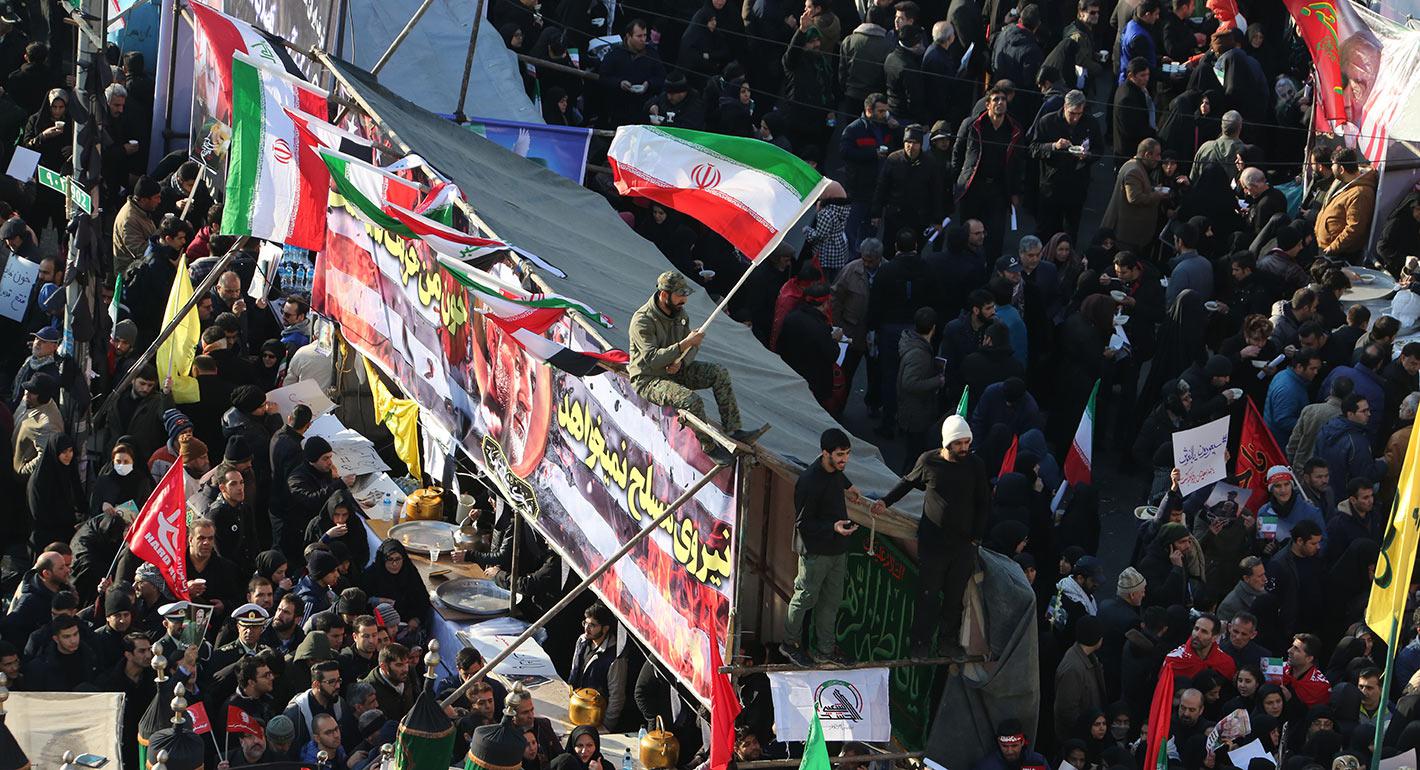
Soleimani was respected and feared, seen as either the evil mastermind behind policies of death and destruction or the genius architect of Iran’s expansionist policies.
Source: Atlantic
As soon as Qassem Soleimani, the leader of the Quds Force of Iran’s Islamic Revolutionary Guard Corps, was confirmed dead, lawyers and lawmakers in Washington began their debates. Was the strike that killed him legal? How would the attack play into the political cycle of impeachment and the 2020 presidential campaign? What are the potential consequences of conflict with Iran?
Yet in parts of the Middle East, the reaction was different. Soleimani, a man thought of as invincible and all-powerful in the region, was killed at about 1 a.m. local time, just as he was leaving Baghdad airport. By 4:30 a.m., a group of Iraqis was marching—running, even—though the country’s capital carrying a large Iraqi flag, celebrating his death. In one video, a man’s voice can be heard lauding the killing, saying the deaths of Iraqi protesters had been avenged.
Let’s be clear: Soleimani’s death sharply increases tensions in the Middle East. Just a few days ago, protesters breached the walls of the U.S. embassy in Baghdad. As Kathy Gilsinan and Mike Giglio note, his killing is more consequential than that of Osama bin Laden or Abu Bakr al-Baghdadi, because he has an entire state that could seek to avenge him.
Soleimani was respected and feared, seen as either the evil mastermind behind policies of death and destruction or the genius architect of Iran’s expansionist policies. He was also hated, not only by Sunnis who suffered at the hands of his proxy militias in Syria and Iraq, but also by fellow Shias, including some in Iraq and Iran, where he helped uphold a repressive system and was seen as the man responsible for Iran’s role in costly wars abroad. He was not simply on a mission to undo the unsatisfying score of the Iran-Iraq war and make up for the conflict’s devastating death toll and the humiliation it served his country; he had become the mission, the upholder of the Islamic revolution, keeping it alive for Supreme Leader Ali Khamenei. (Soleimani was also key to defeating the Islamic State, but this served very specific purposes for the Iranian commander.)
More recently, in Iraq, he was instrumental in the violent crackdown against protests that had erupted in October. The protesters’ ire targeted not only the corruption and mismanagement of their own politicians, but Iran’s role in both, as well as its overbearing control over the country through proxy Shiite militias loyal to Tehran. “We in Iran know how to deal with protesters,” Soleimani had reportedly told Iraqi officials in October. “This happened in Iran and we got it under control.” Though Iraqis have continued to take to the streets, more than 500 of them have been killed. Demonstrations in Iran were also brutally crushed—more than 1,000 died in the crackdown there, according to Iranian officials.
In Lebanon too, protests that began in October were initially focused on corruption, mismanagement, and sectarianism, but quickly took on an anti-Iran undertone. The Shiite militia and political party Hezbollah, a key ally and proxy of Iran since the ’80s, had become all-powerful in politics, a part of the establishment, and therefore was also a target of the protesters’ anger. It responded by sending thugs, or at least allowing them to repeatedly face off with protesters using bats and sticks. Notably, Soleimani had reportedly just flown into Baghdad from Beirut.
Antipathy toward Iran and its role in the politics of multiple Middle East countries had long been building, predating these latest protests. But the multi-front explosion of popular anger toward Tehran and its proxies, especially from within Shiite communities in Lebanon and Iraq, was perhaps the most complex challenge that Soleimani had faced so far. The recent protests, in fact, explain the relief many feel in Beirut and Baghdad, in Damascus and Sana’a—blaming Soleimani himself for what had befallen their country or community.
At times, it did indeed feel as though Soleimani was omnipresent. His decades-long career spanned the battlefields of the Iran-Iraq war and his role propping up Syria’s president, Bashar al-Assad; he flew to the country regularly to oversee a devastating war that has left more than half a million people dead. He was also blamed by the U.S. for the deaths of hundreds of American soldiers following the invasion of Iraq, and he helped organize Hezbollah’s efforts against Israel in the 2006 war in Lebanon.
Was he indispensable? No one ever is and some of his aura was probably overblown, but he will certainly be hard to replace. So there is anger too among his supporters, allies, and proxy militias, who were devoted to him, lionized him, and will now be lost without him, at least for a while. Though his deputy has been appointed to take his place, there is no one for the moment with his gravitas to step in.
(There was also outrage—on what grounds can the U.S. assassinate anyone, regardless of who Soleimani was? Then again, Iran and Soleimani did the same thing, in Latin America—remember Buenos Aires 1994?—and the Middle East. That doesn’t make the approach right, but anger only at American actions seems one-sided.)
Soleimani was so central to almost every regional event in the past two decades that even people who hate him can’t believe he could die, a bit like people couldn’t believe that Saddam Hussein was really gone. What happens in his absence? What comes next: war? Chaos? Limited retaliation? Nothing? No one like Soleimani has been assassinated in recent history. As the Lebanese journalist Alia Ibrahim tweeted: Donald Trump made his move; now it’s up to Khamenei, while the rest of us wait to find out whether tomorrow is a better day or a new phase in a seemingly endless cycle of violence. For now, in parts of Syria, some are passing trays of baklava to celebrate Soleimani’s death.

Author of Black Wave and FT contributing editor
Kim Ghattas is an Author of Black Wave and FT contributing editor.
Recent Work
Kim Ghattas
Carnegie does not take institutional positions on public policy issues; the views represented herein are those of the author(s) and do not necessarily reflect the views of Carnegie, its staff, or its trustees.

Putin’s conservative staffing policies and search for ever greater control have cemented parliament’s transformation into a bureaucratic appendage of the executive branch.

Andrey Pertsev

Russia’s AI-driven propaganda campaigns operate in a fragmented, chaotic, and often illogical manner. That’s not necessarily a problem for the Kremlin, though: It’s much easier to mimic genuine public debate that way.

Ilya Klishin

Without a ceasefire with Ukraine on attacking each other’s energy infrastructure—to which the Kremlin is unlikely to agree—the diesel agreement between Putin and Trump is largely for show, rather than representing a genuine increase in the volumes of Russian diesel on the global market.

Sergey Vakulenko

Russian strikes are weakening the economy sustaining Ukraine’s war effort. Closing the growing funding gap will require more European support and politically contentious reforms in Kyiv.

Balázs Jarábik

Ex-president Gurbanguly Berdimuhamedov remains interested in politics, but his son Serdar, Turkmenistan’s current president, is becoming increasingly independent and willing to break with his father’s legacy. If their covert rivalry goes too far, both risk losing power.

Galiya Ibragimova