

Q&A
Dara Massicot, Aaron David Miller, Andrew S. Weiss
{
  "authors": [
    "Aaron David Miller"
  ],
  "type": "legacyinthemedia",
  "centerAffiliationAll": "dc",
  "centers": [
    "Carnegie Endowment for International Peace"
  ],
  "collections": [],
  "englishNewsletterAll": "democracy",
  "nonEnglishNewsletterAll": "",
  "primaryCenter": "Carnegie Endowment for International Peace",
  "programAffiliation": "DCG",
  "programs": [
    "Democracy, Conflict, and Governance"
  ],
  "projects": [],
  "regions": [
    "Middle East",
    "Israel",
    "Palestine"
  ],
  "topics": [
    "Political Reform",
    "Democracy",
    "Global Governance",
    "Foreign Policy"
  ]
}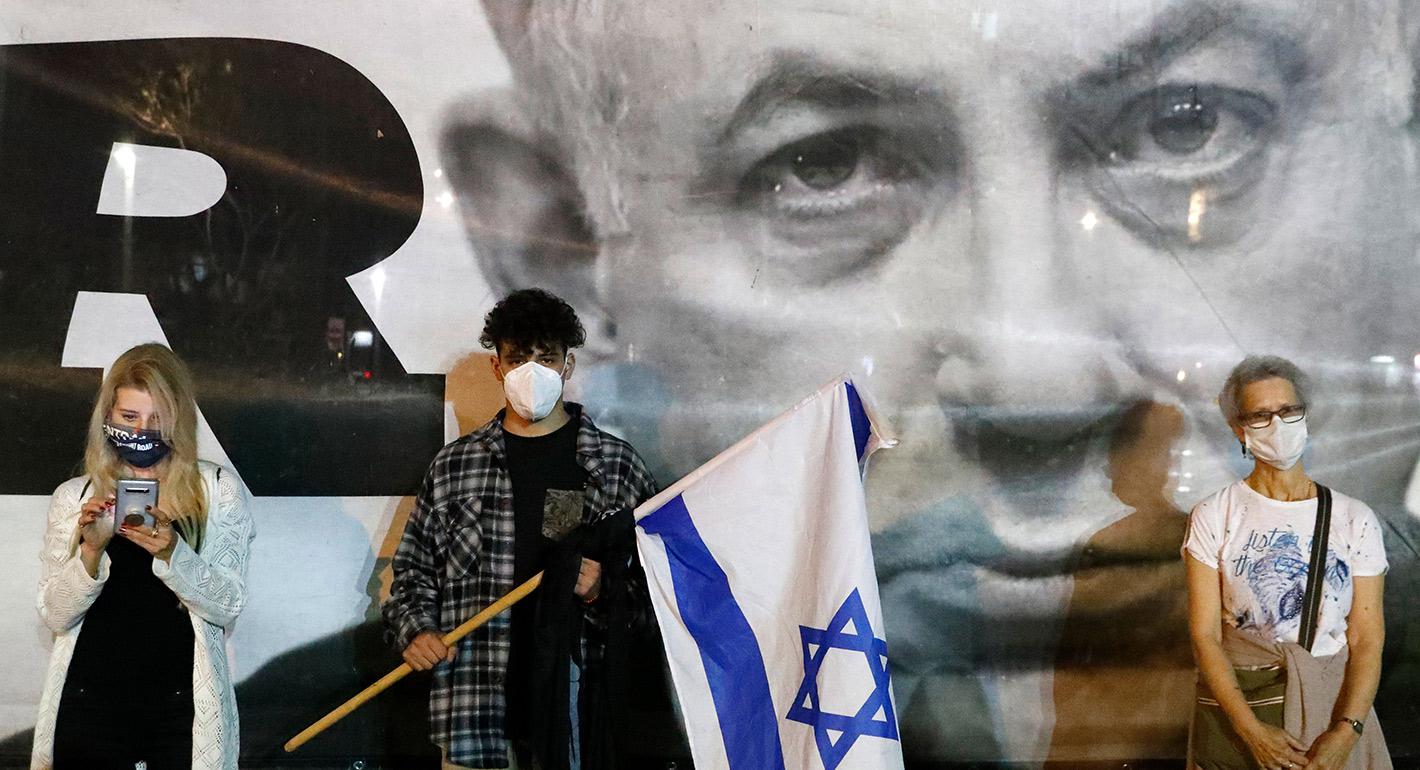
Source: Getty
Gantz handed Netanyahu a near-perfect arrangement that will allow him to remain the most powerful political figure in Israel for the next 18 months, if not beyond.
Source: CNN
Perhaps there's no country in the world where the novel coronavirus has had more of an immediate political impact than Israel. What three elections in barely a year could not accomplish -- the formation of a government -- a virus could.
But Covid-19 had help from a patriotic and risk-averse Benny Gantz, who ran last year, as leader of the Blue and White party, against Prime Minister Benjamin Netanyahu and his Likud party.
Gantz handed Netanyahu a near-perfect arrangement that will allow him to remain the most powerful political figure in Israel for the next 18 months, if not beyond.
Unlike for most leaders in the world, for Netanyahu Covid-19 presented both a challenge and an opportunity. He rose to the first and exploited the second.
In the wake of Israel's March 2 election -- the latest of three in a year's time, after the first two failed to produce a determinative outcome -- Netanyahu again lacked enough seats to assemble a government. Worse still, his chief opponent, Gantz, had an option of putting one together -- albeit a minority government that would have relied on the support of the Joint List, composed of a number of Israel's Arab parties, an arrangement even some in his own Blue and White party were dead against.
Enter the virus. Israel has now turned the corner and begun to ease restrictions. But throughout March, there was real fear and great uncertainty. In a Ministry of Health scenario that went public, it was estimated that as many as 25,000 Israelis might succumb.
And in these circumstances, Netanyahu did what he does best: He plunged himself into the middle of the crisis, taking early proactive measures, including a national lockdown closing borders; banning travel; and in news conferences became the pandemic fighter par excellence, instructing Israelis how to wash their hands and summoning up the dangers of the Spanish flu a century ago. Quarantined not once but twice, Netanyahu became the poster child for fighting the pandemic.
The grim reality of Covid-19 and Netanyahu's performance created a bad set of choices for Gantz. As Netanyahu burnished his image as a crisis manager, this was no time, the argument went, to focus on petty politics but on a national challenge.
The viability of a minority government was already looking untenable, and Gantz playing politics in a genuine national emergency would not have helped. He faced a choice between holding out for the highly uncertain prospects of a fourth election or accepting Netanyahu's offer of negotiations for a unity government. He chose the latter, and in doing so he went against his own commitment that he wouldn't serve under an indicted prime minister. He also fractured his own party in the process.
Under the new deal, Netanyahu will serve as prime minister for the next 18 months, at which point he and Gantz will switch, with the latter serving in that role for the next 18.
It's hard to exaggerate the magnitude of Netanyahu's win. Yes, he will go on trial May 24, facing accusations of bribery, fraud and breach of trust. Yet, even if he is convicted, the legal process might last as long as two years, with appeals. In the meantime, Netanyahu will remain Prime Minister for the next year and a half.
He's rehabbed his image, navigated the pandemic (in a population of nine million, as of now Israel has just 202 deaths), and now presides over a government with the endorsement of his chief rival, and even that of the head of the Labor party.
Even after the rotation, he will remain the effective "alternate" prime minister of a government where three quarters of its members have no real allegiance to Gantz. According to the deal, Netanyahu will even be allowed to remain in the prime minister's residence on Balfour Street in Jerusalem, after he stops being prime minister and Gantz takes over.
It's more than likely that when Gantz becomes prime minister, given Netanyahu's political skills and support by Israel's dominant right wing, he, not Gantz, will remain the most powerful and influential political figure in Israel.
On policy, Netanyahu's other accomplishment has been to create a new consensus on annexing parts of West Bank. The coalition agreed not to advance any non-Covid-19 legislation for six months -- except that after July 1, the government is free to introduce legislation advancing annexation.
If and when that happens depends on many things, including the view of the Trump administration, the work of a US-Israeli Joint Committee delineating borders and Netanyahu's calculation of how the Arab states -- most notably Egypt, Jordan and Saudi Arabia -- and even a possible Joe Biden administration might view the matter. The key takeaway is that Netanyahu knows -- annexation or not -- that he will continue to have a hand in ensuring that any serious movement toward a two-state solution will remain closed for the season.
In Israeli politics, the old saw goes, you can be dead or dead and buried. Right now, Benjamin Netanyahu -- aka "the Magician" -- is neither. Against all odds, not only has he survived -- he's very much alive with a great many cards up his sleeve yet left to play.

Senior Fellow, American Statecraft Program
Aaron David Miller is a senior fellow at the Carnegie Endowment for International Peace, focusing on U.S. foreign policy.
Recent Work

Dara Massicot, Aaron David Miller, Andrew S. Weiss

Sophia Besch, Eric Ciaramella, Steve Feldstein, …
Carnegie does not take institutional positions on public policy issues; the views represented herein are those of the author(s) and do not necessarily reflect the views of Carnegie, its staff, or its trustees.

Trump has promised Belarus a massive potash deal. But Minsk is seeking something greater: restored Western transit and greater room for maneuver from Russia.

Balázs Jarábik

The European far right might fail to steer EU policy in the direction Russia wants, but they will create enough chaos inside Europe to benefit the Kremlin.

Dimitar Bechev

Minsk clearly expected the dialogue with Washington to yield more results, in particular the lifting of EU sanctions and permission to export potash.

Artyom Shraibman

If the Russian-speaking community in Latvia cannot articulate their interests without being seen as disloyal, they could end up embracing a pro-Kremlin agenda.

Sergejs Potapkins

Russia’s ruling party would have benefited from Putin appearing as its distant patron, but as an active frontman imposing his views on the public, he has done nothing but harm both the party’s election campaign and the ruling system overall.

Andrey Pertsev