
• Research
  • Politika
  • About
Carnegie Russia Eurasia center logoCarnegie lettermark logo
  • Donate
{
  "authors": [
    "Philippe Le Corre",
    "John Ferguson"
  ],
  "type": "legacyinthemedia",
  "centerAffiliationAll": "dc",
  "centers": [
    "Carnegie Endowment for International Peace"
  ],
  "collections": [],
  "englishNewsletterAll": "ctw",
  "nonEnglishNewsletterAll": "",
  "primaryCenter": "Carnegie Endowment for International Peace",
  "programAffiliation": "EP",
  "programs": [
    "Europe"
  ],
  "projects": [],
  "regions": [
    "East Asia",
    "China",
    "Western Europe",
    "France",
    "Germany",
    "Iran"
  ],
  "topics": [
    "Political Reform",
    "Foreign Policy"
  ]
}

Source: Getty

In The Media

China’s Diplomatic Duo Fails to Engineer a Successful Summit with Europe

The meeting—although depicted as a decisive diplomatic victory by Chinese state media—was especially disappointing to Chinese leadership considering they were trying to accomplish larger geostrategic goals. One was to prevent the creation of a united transatlantic front against China.

Link Copied
By Philippe Le Corre and John Ferguson
Published on Sep 21, 2020

Source: National Interest

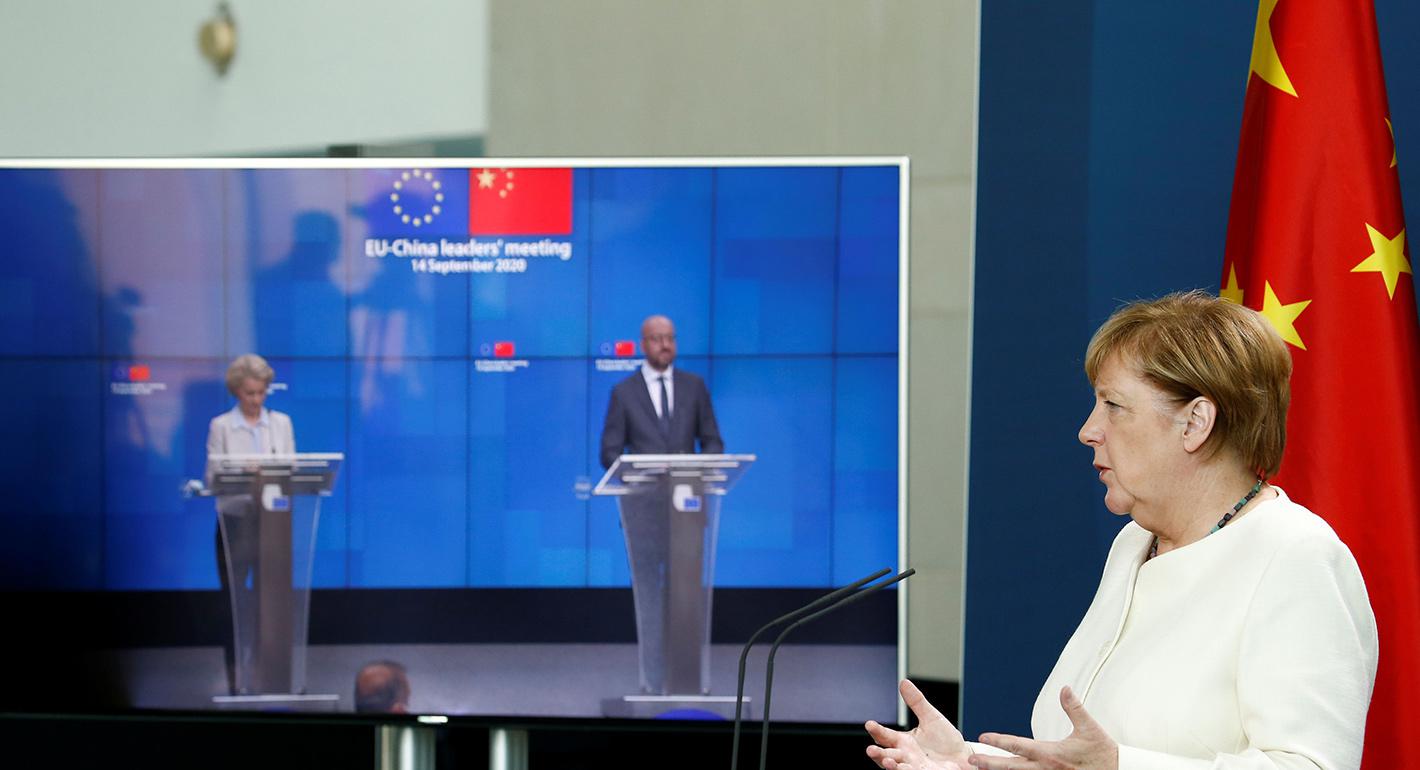
While China had declared 2020 a critical year for relations with Europe, the EU-China virtual summit which took place on September 14 between Chinese president Xi Jinping and EU leaders German Chancellor Angela Merkel, European Council head Charles Michel, and Commission President Ursula von der Leyen fell short of expectations. Some Europeans were optimistically hoping to conclude the negotiations on the long-awaited Common Agreement on Investment, which have now dragged into their seventh year. Others in Brussels were relieved that the summit didn’t take place in Leipzig in the presence of the twenty-eight leaders (twenty-seven EU countries and China) as was originally planned by Germany, the holder of the six-month rotating presidency. In the end, despite statements about what has been achieved in the meeting by European leaders—addressing Chinese state aid and addressing technology transfers from Europe to China—the actual outcome had little substance. In particular, China did not agree on economic reciprocity—the primary demand from the European side.

The meeting—although depicted as a decisive diplomatic victory by Chinese state media—was especially disappointing to Chinese leadership considering they were trying to accomplish larger geostrategic goals. One was to prevent the creation of a united transatlantic front against China, spurred on by recent visits to Western and Central Europe by U.S. Secretary of State Mike Pompeo and National Security Adviser Robert O’Brien. Rejecting any kind of strategic alignment either in the direction of the United States or China, President Charles Michel told reporters afterward “Europe is a player, not a playing field.” The second broad Chinese goal was to reassure Europeans after souring relations this year after coronavirus. Still reeling from the pandemic, the accompanying economic recession, and now—what many perceive to be an opportunistic expansion of Chinese aggression—Europe has recently channeled pain and anger into pushback on contentious foreign policy issues against China, mainly on Huawei (5G) and Hong Kong, but also on the treatment by the PRC of the Uighur minority in Xinjiang.

Read the Full Text

This article was originally published by the National Interest.

About the Authors

Philippe Le Corre

Former Nonresident Senior Fellow, Europe Program

Philippe Le Corre was a nonresident senior fellow in the Europe Program at the Carnegie Endowment for International Peace.

John Ferguson

John Ferguson is a research assistant at the Harvard Kennedy School’s M-RCBG.

Authors

Philippe Le Corre
Former Nonresident Senior Fellow, Europe Program
John Ferguson

John Ferguson is a research assistant at the Harvard Kennedy School’s M-RCBG.

Political ReformForeign PolicyEast AsiaChinaWestern EuropeFranceGermanyIran

Carnegie does not take institutional positions on public policy issues; the views represented herein are those of the author(s) and do not necessarily reflect the views of Carnegie, its staff, or its trustees.

More Work from Carnegie Russia Eurasia Center

  • Commentary
    Carnegie Politika
    Power, Pathways, and Policy: Grounding Central Asia’s Digital Ambitions

    Central Asia’s digital ambitions are achievable, but only if policy is aligned with the region’s physical constraints.

      Aruzhan Meirkhanova

  • Commentary
    Carnegie Politika
    The Afghanistan–Pakistan War Poses Awkward Questions for Russia

    Not only does the fighting jeopardize regional security, it undermines Russian attempts to promote alternatives to the Western-dominated world order.

      Ruslan Suleymanov

  • Commentary
    Carnegie Politika
    Moldova Floats a New Approach to Its Transnistria Conundrum

    Moldova’s reintegration plan was drawn up to demonstrate to Brussels that Chișinău is serious about the Transnistria issue—and to get the West to react.

      Vladimir Solovyov

  • Commentary
    Carnegie Politika
    After Ilia II: What Will a New Patriarch Mean for Georgia?

    The front-runner to succeed Ilia II, Metropolitan Shio, is prone to harsh anti-Western rhetoric and frequent criticism of “liberal ideologies” that he claims threaten the Georgian state. This raises fears that under his leadership the Georgian Orthodox Church will lose its unifying role and become an instrument of ultraconservative ideology.

      Bashir Kitachaev

  • Commentary
    Carnegie Politika
    Lukashenko’s Bromance With Trump Has a Sell-By Date

    Lukashenko is willing to make big sacrifices for an invitation to Mar-a-Lago or the White House. He also knows that the clock is ticking: he must squeeze as much out of the Trump administration as he can before congressional elections in November leave Trump hamstrung or distracted.

      Artyom Shraibman

Get more news and analysis from
Carnegie Russia Eurasia Center
Carnegie Russia Eurasia logo, white
  • Research
  • Politika
  • About
  • Experts
  • Events
  • Contact
  • Privacy
  • For Media
Get more news and analysis from
Carnegie Russia Eurasia Center
© 2026 Carnegie Endowment for International Peace. All rights reserved.








