

Paper
Yezid Sayigh
{
  "authors": [
    "Yezid Sayigh"
  ],
  "type": "other",
  "centerAffiliationAll": "dc",
  "centers": [
    "Carnegie Endowment for International Peace",
    "Malcolm H. Kerr Carnegie Middle East Center"
  ],
  "collections": [
    "Civil-Military Relations in Arab States"
  ],
  "englishNewsletterAll": "menaTransitions",
  "nonEnglishNewsletterAll": "",
  "primaryCenter": "Malcolm H. Kerr Carnegie Middle East Center",
  "programAffiliation": "MEP",
  "programs": [
    "Middle East"
  ],
  "projects": [],
  "regions": [
    "Egypt",
    "North Africa"
  ],
  "topics": [
    "Political Reform",
    "Security",
    "Economy"
  ]
}
Source: Getty
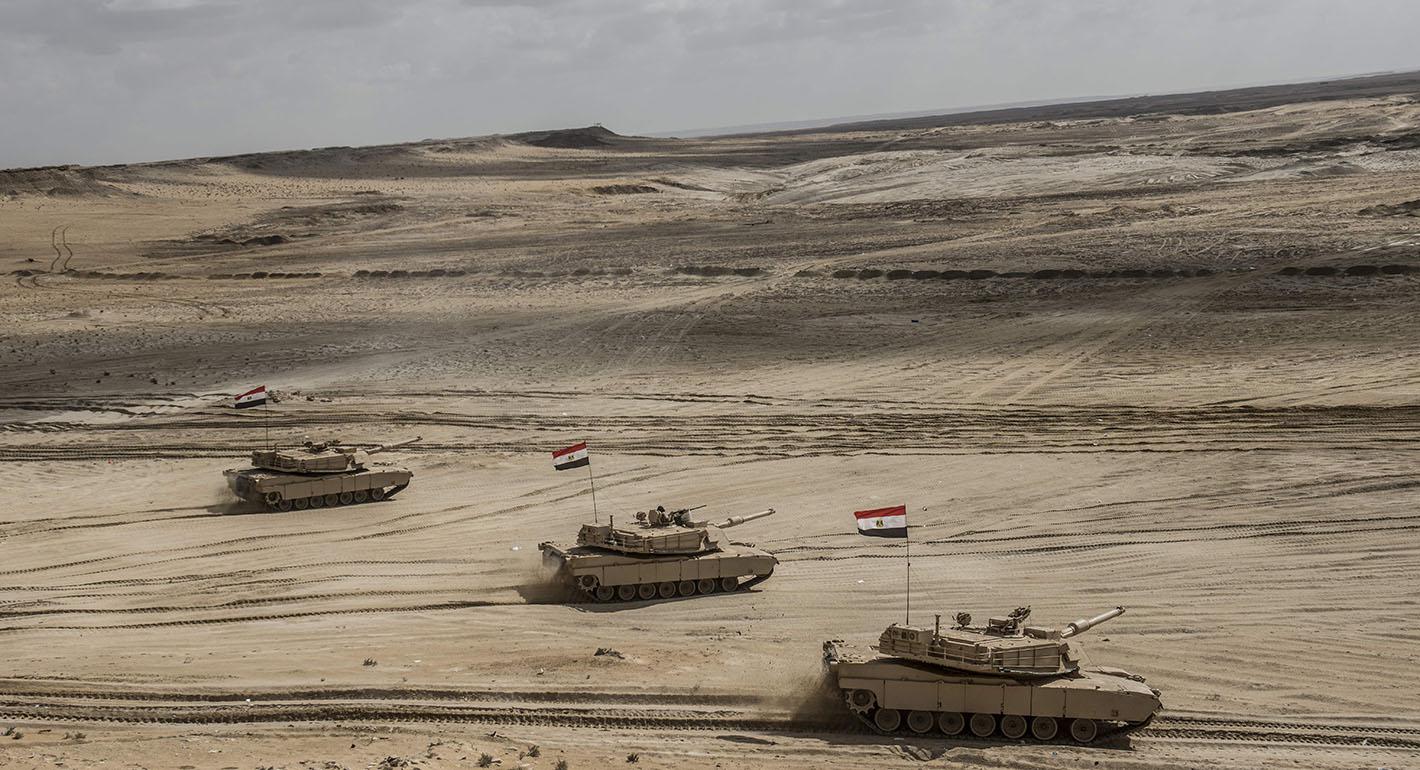
The Egyptian military’s involvement in the economy has come at a high cost, contributing to underperformance in development and auguring a new ruling class of military officers.
The Carnegie report “Owners of the Republic: An Anatomy of Egypt’s Military Economy” details how the involvement of the Egyptian Armed Forces in the economy has undergone a transformation in scope and scale under President Abdel-Fattah el-Sisi, giving rise to a new version of Egyptian state capitalism. The Egyptian military’s involvement in the economy has come at a high cost, contributing to underperformance in development and auguring a new ruling class of military officers. The Egyptian economy relies heavily on the military-led public sector, which has proven unable to provide the long-term, quality growth necessary to pull millions out of poverty. The Sisi administration has expanded its business interests to sideline cronies of the government it overthrew, but its economic activities will make it difficult to implement the reforms necessary to stimulate growth.
Egypt’s Military as the Spearhead of State Capitalism, Yezid Sayigh
The Chronic Underperformance of Egypt’s Military Economy, Bessma Momani
Egypt’s Emerging Ruling Class, Shana Marshall
The Egyptian Economy: In the Clutches of the Deep State, George T. Abed
Armed Forces in Power and in Business, Ishac Diwan

Senior Fellow, Malcolm H. Kerr Carnegie Middle East Center
Yezid Sayigh is a senior fellow at the Malcolm H. Kerr Carnegie Middle East Center in Beirut, where he leads the program on Civil-Military Relations in Arab States (CMRAS). His work focuses on the comparative political and economic roles of Arab armed forces, the impact of war on states and societies, the politics of postconflict reconstruction and security sector transformation in Arab transitions, and authoritarian resurgence.
Recent Work
Yezid Sayigh
Yezid Sayigh
Carnegie does not take institutional positions on public policy issues; the views represented herein are those of the author(s) and do not necessarily reflect the views of Carnegie, its staff, or its trustees.

For every ruble allocated to social policy, health, and education in 2027, double that amount is earmarked for the army, the police, and the security services.

Alexandra Prokopenko

Sergei Kiriyenko used Russia’s parliamentary vote to further hone his strategy of corporate mobilization that is designed to maximize votes for United Russia.

Andrey Pertsev

The European far right might fail to steer EU policy in the direction Russia wants, but they will create enough chaos inside Europe to benefit the Kremlin.

Dimitar Bechev

If the Russian-speaking community in Latvia cannot articulate their interests without being seen as disloyal, they could end up embracing a pro-Kremlin agenda.

Sergejs Potapkins

Russia’s ruling party would have benefited from Putin appearing as its distant patron, but as an active frontman imposing his views on the public, he has done nothing but harm both the party’s election campaign and the ruling system overall.
Andrey Pertsev