

Commentary
Alexander Baunov
{
  "authors": [
    "Alexander Baunov"
  ],
  "type": "commentary",
  "centerAffiliationAll": "",
  "centers": [
    "Carnegie Endowment for International Peace",
    "Carnegie Russia Eurasia Center"
  ],
  "collections": [],
  "englishNewsletterAll": "",
  "nonEnglishNewsletterAll": "",
  "primaryCenter": "Carnegie Endowment for International Peace",
  "programAffiliation": "",
  "programs": [],
  "projects": [],
  "regions": [
    "North America",
    "United States",
    "Russia"
  ],
  "topics": []
}
Source: Getty
Putin has long positioned himself as a global opposition figure, and will now be able to feel like one of the Russian opposition politicians with whom the authorities refuse to engage for fear of creating a political equivalence.
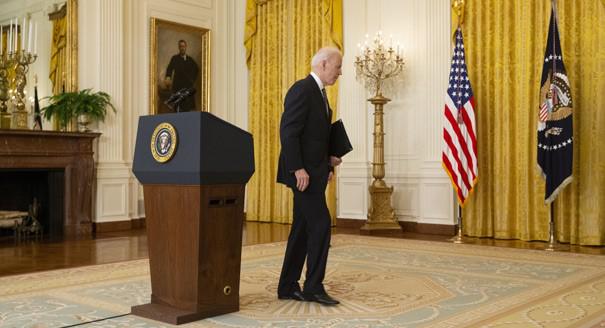
There are several ways of interpreting U.S. President Joe Biden’s decision to answer “yes” when a journalist asked him whether he thought Putin was a killer. Above all, Biden revealed that domestic politics are more important to him than international relations. The most pressing concern for the new president was to avoid ambiguity.
In a 2017 interview, then U.S. president Donald Trump answered a similar question by trying to be more diplomatic: “There are a lot of killers. You think our country’s so innocent?” he told his interviewer. Trump did not reject outright the questioner’s assertion that Putin was a killer, but managed to dilute his answer. Caught in the same journalist trap, Biden put maximum distance between himself and Trump. In contrast to his predecessor, the new president is showing that he will not indulge dictators: he’s honest, straightforward, and, if necessary, will call a villain a villain.
Biden’s blunt assessment was meant to show the rest of the world that the United States is returning to world leadership based on high moral standards. This should be met with particular approval by U.S. allies who are under pressure from Russia: Biden will not cut deals with Putin behind their backs. As long as Biden is not afraid to accuse Putin, he’s not afraid of Putin—or Russia—and will not worry about what they think of him. And that means U.S. allies protecting the borders of the West can rest easy.
Trump may have been considered a pro-Putin president, but it is Biden who has actually done several things desired by Russia (and left unaddressed by Trump): he extended the New START treaty, returned to the Iran deal, and shifted the U.S. stance toward the Nord Stream 2 gas pipeline.
Biden is obviously not doing these things to curry favor with Russia, or because he likes Putin. They have been achieved because, unlike Trump, Biden promised he would consult with America’s European allies (the Germans want to combine punishment for Russia with completing Nord Stream), and because, in certain areas, American interests align with Russia’s. Biden apparently finds it necessary to make all that very clear.
As Biden was one of the architects of the unsuccessful “reset” with Russia during Barack Obama’s first presidential term, it’s important for him to make it clear that no amount of common interest or work on specific policy areas means a new reset is in the offing. It’s key for President Biden to distance himself not only from ex-president Trump, but also from his own vice presidency of a decade ago.
In Biden’s characterization of Putin, there is a discernible desire to pay back the Russian leader in kind. To call a foreign leader a “killer” is, without a doubt, an escalation. But Biden likely thinks it will show Putin that such behavior will no longer work.
Ever since Putin’s infamous speech to the Munich Security Conference in 2007—and perhaps even before then—escalation has been one of the most important weapons in Putin’s arsenal. Time and again, he has wrong-footed the West with unexpectedly fierce statements or aggressive actions, and served up home truths in big dollops, presenting Western leaders with one fait accompli after another. And now Biden has acted in the same spirit: dishing out harsh truths without getting bogged down in diplomatic niceties. The ball is now firmly in Moscow’s court.
Putin is not only a master of escalation, but also de-escalation. When he’s feeling confident or wants to smooth over a problem, he readily turns the other cheek. It was in this spirit that he declined to react proportionally to Obama’s expulsion of Russian diplomats in early 2017, thereby extending a hand of friendship to then president-elect Trump. Similarly, he ignores aggressive statements made by Ukrainian presidents, seeing them as the by-product of Ukrainian domestic politics.
Putin may, in fact, perceive the unexpected bluntness of Biden’s words as a sign of the American president’s weakness, not strength: an indication of Biden’s anxiety, and a need to prove himself to others.
When it came, Putin’s public answer to Biden was an example of his brand of jokey, pugnacious de-escalation. His response was made up of three parts: political trolling, a history lecture, and an invitation to debate. Firstly, he reminded Biden of his age (suggesting Biden was in poor health and that someone as old as him should not worry so much) and used a childish retort (along the lines of “it takes one to know one”) to jokingly suggest it was actually Biden who was the murderer. Secondly, he delivered an amateur history lecture, of the sort Putin is fond of giving, which should be seen as the most serious part of his response: Putin doesn’t joke about historical analysis. The third part of Putin’s answer was the most original. Although he is known as internet-averse, Putin unexpectedly suggested Biden might like a virtual public debate with him, instead of a private phone call on a secure line.
Essentially, Putin is inviting Biden to repeat his allegation to Putin’s face. Of course, Biden will not accept, and such a debate would be seen in the United States as a trap by Putin that would not befit the office of the U.S. president. Putin has long positioned himself as a global opposition figure, and will now be able to feel like one of the Russian opposition politicians with whom the authorities refuse to engage for fear of creating a political equivalence.
At the same time, it’s unlikely the Russian president ever expected Biden to agree to his suggestion. Despite the fact that this exchange of remarks looks like a serious deterioration in the U.S.-Russian relationship, both sides will actually go away satisfied with how they conducted themselves in a difficult situation. And that’s a good reason to hope that this particular confrontation will go no further.
This article was published as part of the “Relaunching U.S.-Russia Dialogue on Global Challenges: The Role of the Next Generation” project, implemented in cooperation with the U.S. Embassy to Russia. The opinions, findings, and conclusions stated herein are those of the author and do not necessarily reflect those of the U.S. Embassy to Russia.

Senior Fellow, Editor-in-Chief, Carnegie Russia Eurasia Center
Baunov is a senior fellow and editor-in-chief at the Carnegie Russia Eurasia Center.
Recent Work
Alexander Baunov
Alexander Baunov
Carnegie does not take institutional positions on public policy issues; the views represented herein are those of the author(s) and do not necessarily reflect the views of Carnegie, its staff, or its trustees.

Russia’s ruling party would have benefited from Putin appearing as its distant patron, but as an active frontman imposing his views on the public, he has done nothing but harm both the party’s election campaign and the ruling system overall.

Andrey Pertsev

Depleted financial reserves and a shrinking tax base mean it is no longer possible to simultaneously deliver high defense spending, price stability, and economic growth.

Alexandra Prokopenko
Blurring the line between humans and animals is a long-standing tradition in social utopian prose. In his latest novel, Leonid Bershidsky reminds us that in social experiments, people are often treated no differently than animals.
Alexander Baunov
While France and Australia are seeking to establish the legal obligations of messaging apps like Telegram, Russia wants total subordination.

Maria Kolomychenko
The recent uncovering of Dmitry Donskoy’s relics in the Cathedral of the Archangel is yet another attempt by the Russian Orthodox Church to help the state solve its problems. However, parroting the state’s version of Russian history leaves the Church with no message except “patriotism.”
Alexander Zanemonets