

Q&A
- +1
Amr Hamzawy, Andrew Leber, Eric Lob, …
{
  "authors": [
    "Marwan Muasher"
  ],
  "type": "commentary",
  "centerAffiliationAll": "dc",
  "centers": [
    "Carnegie Endowment for International Peace",
    "Malcolm H. Kerr Carnegie Middle East Center"
  ],
  "collections": [],
  "englishNewsletterAll": "menaTransitions",
  "nonEnglishNewsletterAll": "",
  "primaryCenter": "Carnegie Endowment for International Peace",
  "programAffiliation": "MEP",
  "programs": [
    "Middle East"
  ],
  "projects": [],
  "regions": [
    "Middle East",
    "Israel",
    "Palestine",
    "Levant"
  ],
  "topics": [
    "Political Reform",
    "Democracy"
  ]
}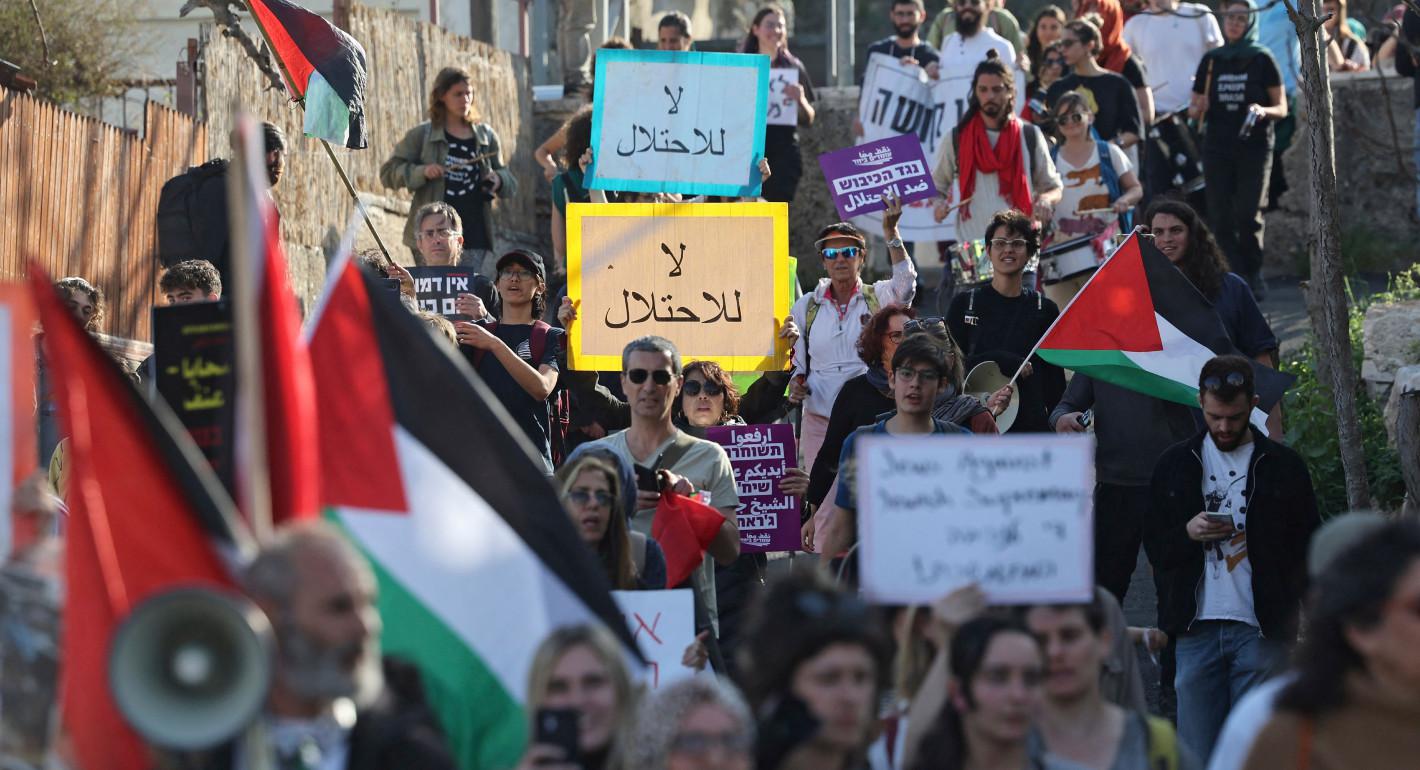
Source: Getty
Attempts to end the conflict can no longer ignore equal rights and instead must be the guiding light.
It is time to admit what has been obvious for a few years: the two-state solution to end the Palestinian-Israel conflict is dead and cannot be revived. The longer the international community clings to this impossible solution, the deeper the hole it digs for itself, and it will have to start dealing with a potentially more difficult problem of the daily violation of Palestinian rights in the occupied territories.
The Arab-Israeli conflict is dramatically shifting. Since the 1993 Oslo Accords, the international community has focused on ways to bring about a two-state solution that would end the Israeli occupation of Palestinian land, establish a Palestinian state alongside Israel, and end all further claims to the conflict. Then, as the conditions for that solution became impossible, the arguments started shifting in the scholarly world. The Israeli government has demonstrated an absence of a political will to end the occupation, and the international community has shown no serious effort in the past ten years to make it happen.
The presence of some 750,000 settlers in the West Bank and East Jerusalem today makes the principle of separation of the two communities—the basis for a two-state solution—impossible to achieve. In the academic world, the argument has shifted to seeking creative ways to find an integrative solution, such as confederalism or federalism. But even this possibility seems distant.
All these attempts have ignored two fundamental issues. First, all attempts to find a solution assume that potential partners—whether the Israelis, Palestinians, or the United States—are willing and able. This is not the case today. Second, Palestinian rights issues have been consistently ignored. The peace process assumed that once a solution is found, the issue would become moot. However, since the number of Palestinians living in areas under Israel’s control is already a majority, that question can no longer be put aside.
But there is a third issue, which I call the deteriorating status quo scenario. In addition to having no viable solution (one-state or two-state), the Israeli government is applying two separate legal systems, discriminating between Palestinian and Jewish citizens of Israel through its 2018 basic nation state law. It has limited the right of self-determination in Israel to Jewish people only, while Palestinians under occupation and the settlers in the West Bank have two separate legal systems. The international community has shied away from applying the legal definition of apartheid to this situation, but Beit T’Selem (the largest human rights organization in Israel), Human Rights Watch, Amnesty International, and others are using that label. The failure of the Oslo process to result in a two-state solution thirty years after its inception, despite some valiant efforts along the way, has led us to today’s situation.
The result: A third Palestinian intifada has already started. Different from the first (peaceful, with local leadership) and the second (violent, with leadership by the Palestine Liberation Organization), this one is violent and leaderless. The younger Palestinian generation seems to have given up on the ability of its own leadership, and that of the international community, to find a sustainable solution. It appears to be taking matters in its own hands, as individuals or in small groups—with all the problems that entails.
As if all of this is not enough, the new Israeli government is threatening the rights of large segments of Jewish Israeli citizens and the system of checks and balances that has allowed Israel to claim it is a democratic country. With its current attempts to grant the legislative branch excessive powers over the judiciary, the democratic label can no longer withstand scrutiny.
I have worked on a peaceful solution to the Arab-Israeli conflict for most of my political career, and I now believe that all who seek peace in the region have to fundamentally revise their positions. The issue of equal rights for both Palestinians and Israelis can no longer be ignored. Instead, it must be the guiding light in any discussion about a possible shape of a solution. The solution can no longer be to shape the solution first and worry about rights later. Rather, we need a new paradigm that emphasizes a rights-based approach, regardless of solution. This we can do.
Hoping to arrive at a solution today is unrealistic. But approaching the issue from a rights-based perspective ensures that both sides can lay down a solid basis for a democratic and sustainable solution.

Vice President for Studies
Marwan Muasher is vice president for studies at Carnegie, where he oversees research in Washington and Beirut on the Middle East. Muasher served as foreign minister (2002–2004) and deputy prime minister (2004–2005) of Jordan, and his career has spanned the areas of diplomacy, development, civil society, and communications.
Recent Work



Amr Hamzawy, Andrew Leber, Eric Lob, …
Marwan Muasher
Carnegie does not take institutional positions on public policy issues; the views represented herein are those of the author(s) and do not necessarily reflect the views of Carnegie, its staff, or its trustees.

Putin’s conservative staffing policies and search for ever greater control have cemented parliament’s transformation into a bureaucratic appendage of the executive branch.

Andrey Pertsev

Ex-president Gurbanguly Berdimuhamedov remains interested in politics, but his son Serdar, Turkmenistan’s current president, is becoming increasingly independent and willing to break with his father’s legacy. If their covert rivalry goes too far, both risk losing power.

Galiya Ibragimova

Sergei Kiriyenko used Russia’s parliamentary vote to further hone his strategy of corporate mobilization that is designed to maximize votes for United Russia.
Andrey Pertsev

The European far right might fail to steer EU policy in the direction Russia wants, but they will create enough chaos inside Europe to benefit the Kremlin.

Dimitar Bechev

If the Russian-speaking community in Latvia cannot articulate their interests without being seen as disloyal, they could end up embracing a pro-Kremlin agenda.

Sergejs Potapkins