

Commentary
Oliver Stuenkel, Adrian Feinberg
{
  "authors": [
    "Oliver Stuenkel"
  ],
  "type": "commentary",
  "centerAffiliationAll": "dc",
  "centers": [
    "Carnegie Endowment for International Peace"
  ],
  "collections": [],
  "englishNewsletterAll": "democracy",
  "nonEnglishNewsletterAll": "",
  "primaryCenter": "Carnegie Endowment for International Peace",
  "programAffiliation": "DCG",
  "programs": [
    "Democracy, Conflict, and Governance"
  ],
  "projects": [],
  "regions": [
    "North America",
    "South America"
  ],
  "topics": [
    "Economy"
  ]
}
Source: Getty
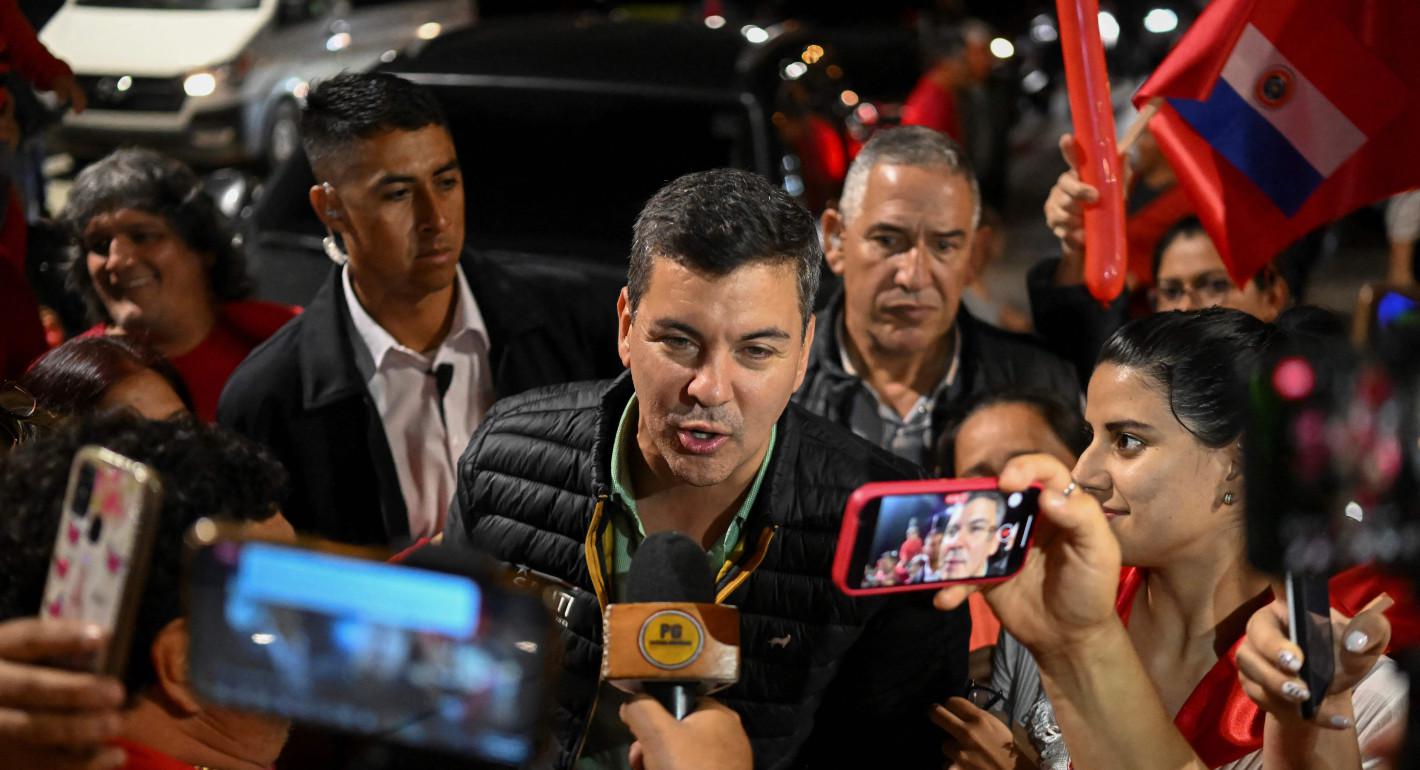
Corruption allegations, a drought, and economic struggles may threaten the Colorado Party’s seven-decade rule in upcoming elections.
In the past fifteen free and fair presidential elections across Latin America, opposition candidates rode to office on a wave of deep-seated anti-incumbency sentiment, irrespective of ideological orientation. On Sunday, this trend will be up against another long-standing tradition in Paraguay—the dominance of the Colorado Party—when voters head to the polls to elect their next president.
A massive incumbency advantage and a formidable political machine have allowed the Colorado Party to govern Paraguay for much of the past seventy years, from the dictatorship of Alfredo Stroessner from 1954 to 1989 through the first free elections in 1993 until now. The conservative Colorado Party’s Santiago Peña is facing Authentic Liberal Radical Party (PLRA) candidate Efraín Alegre, who in 2018 obtained 45 percent of the votes but lost to the current president, Mario Abdo. The centrist Alegre is heading a big-tent alliance ranging from the left to the center-right of twenty-three parties and two movements that have united to defeat the Colorado Party.
Contrary to most of its neighbors, Paraguay does not allow presidents to seek reelection, nor does it have a runoff contest. Polls predict a tight race, but they may fail to factor in the Colorado Party’s capability to mobilize election day turnout. Voters will also choose new governors, regional legislators, and deputies for the House of Representatives and Senators on Sunday.
Alegre and his running mate, former housing minister Soledad Núñez, chose “mafia or fatherland” as one of the key themes of their campaign and promised improvements in the economy, public services, and the fight against corruption. If victorious, Núñez would be the first female vice president in Paraguay’s history (all presidents have been men). Peña, on the other hand, has run a classic conservative campaign focused on crime, drugs, and his opposition to the legalization of abortion—usually popular views in what is often seen as Latin America’s most Catholic country.
Yet the case for continuity is a challenging one to make, as few voters believe the country is doing well. After a timid recovery in 2021, when the country’s GDP grew by 4.1 percent, the economy grew merely 0.1 percent in 2022, in part due to a drought that severely affected the agricultural sector. This merely added to Paraguay’s profound socioeconomic challenges, such as a poverty rate above 25 percent and more than half of residents working in the informal economy. According to the World Bank, a child born in Paraguay will, on average, only attain 53 percent of the productivity that they could have achieved with complete access to health and education. In a poll conducted last year, 70 percent of Paraguayans said they believed the country required profound changes.
In addition to disappointing economic indicators, there are two additional reasons for why the opposition senses an opportunity.
First, even for a country that has dealt with corruption for decades, the scandals that have rocked the ruling party over the past years have been unusual. Last year, the country’s interior minister released evidence linking former president Horacio Cartes to smuggling and connections to organized crime. A few months later, the United States government blacklisted both Cartes, under whom Peña served as finance minister, and current Vice President Hugo Velázquez, who had been expected to lead the Colorado Party into the election but was forced to withdraw due to “significant corruption.” Cartes also faces criminal allegations in neighboring Brazil.
Investigations against Velázquez and Cartes, who is the country’s richest businessman, are ongoing and have been systematically exploited by the opposition. In response, several Colorado politicians embraced a patriotic discourse and denounced what they called an undue U.S. interference in Paraguay’s domestic affairs, an accusation that has been echoed by at least one Republican representative in the U.S. Congress. Yet given that Peña won the Colorado primaries thanks to Cartes’s support, the Colorado candidate has struggled to distance himself from the scandals. As a consequence, corruption has emerged as one of voters’ key concerns in this electoral cycle, followed by public health, security, and employment.
Second, after years of decline, the homicide rate has been rising since 2020 in Paraguay. This spike is largely due to an increasingly violent turf war between two Brazilian cartels—the PCC (First Command of the Capital) and the CV (Red Command)—that are warring over cocaine delivery routes that cross Paraguay. In May 2022, Paraguay’s top prosecutor was murdered while on vacation in Colombia. A month later, a prison director was murdered, likely over his role in shutting down a drug lab inside the penitentiary.
Many Paraguayans share the perception that the government is struggling to maintain order and—more worryingly—that organized crime possesses a growing influence on political decisionmaking processes. Former president Luis Ángel González Macchi, for example, has argued that drug cartel leaders no longer only buy off politicians, but also run for office themselves.
While the election in Paraguay has received scant attention, the result may have geopolitical consequences, too. Alegre has signaled that, if successful, he may switch diplomatic allegiance from Taiwan to China—a move that would deal a blow to Taipei. Over the past few years, the Dominican Republic, Panama, El Salvador, and Nicaragua (among others) have all switched their allegiances to Beijing—a change that can largely be explained by expectations that it may lead to greater Chinese investments. Paraguay’s agribusiness leaders are increasingly concerned that Asunción’s pro-Taiwan stance hurts their relationship with the People’s Republic of China, so Paraguay will likely recognize the government in Beijing sooner rather than later—though Peña has not signaled he would do so. Yet as economic ties between Paraguay and China grow—roughly one-third of the country’s exports currently go to China—and all of Paraguay’s neighbors have long formally recognized Beijing, Asunción’s stance increasingly looks like an anomaly.
Irrespective of the candidates’ policy differences, Paraguay’s presidential elections highlight the risks corruption and low-quality public services pose to democracy. Moreover, they reveal the growing threat that organized crime poses to democratic governance across Latin America—a topic at times forgotten amid the frequent debates about lackluster economic growth and polarization. At the same time, despite widespread discontent, Paraguay has not seen the emergence of more radical political outsiders who have prominently upended political landscapes in countries such as Brazil and El Salvador.
Senior Fellow, Democracy, Conflict, and Governance Program
Oliver Stuenkel is an associate professor at the School of International Relations at Fundação Getulio Vargas (FGV) in São Paulo, Brazil. He is also a senior fellow affiliated with the Democracy, Conflict, and Governance Program at the Carnegie Endowment for International Peace.
Recent Work
Oliver Stuenkel, Adrian Feinberg
Oliver Stuenkel, Adrian Feinberg
Carnegie does not take institutional positions on public policy issues; the views represented herein are those of the author(s) and do not necessarily reflect the views of Carnegie, its staff, or its trustees.

Russian strikes are weakening the economy sustaining Ukraine’s war effort. Closing the growing funding gap will require more European support and politically contentious reforms in Kyiv.

Balázs Jarábik

For every ruble allocated to social policy, health, and education in 2027, double that amount is earmarked for the army, the police, and the security services.

Alexandra Prokopenko

Depleted financial reserves and a shrinking tax base mean it is no longer possible to simultaneously deliver high defense spending, price stability, and economic growth.
Alexandra Prokopenko

A much-discussed disagreement over internet restrictions in Russia was never an existential threat for Putin: It was about elite groups protecting their interests.
Alexandra Prokopenko

The demands of the Kremlin’s war in Ukraine, demographic problems, and public hostility toward Central Asians mean Russia does not have enough workers.

Salavat Abylkalikov