A version of this piece was published by Munhwa Ilbo on March 8, 2024.
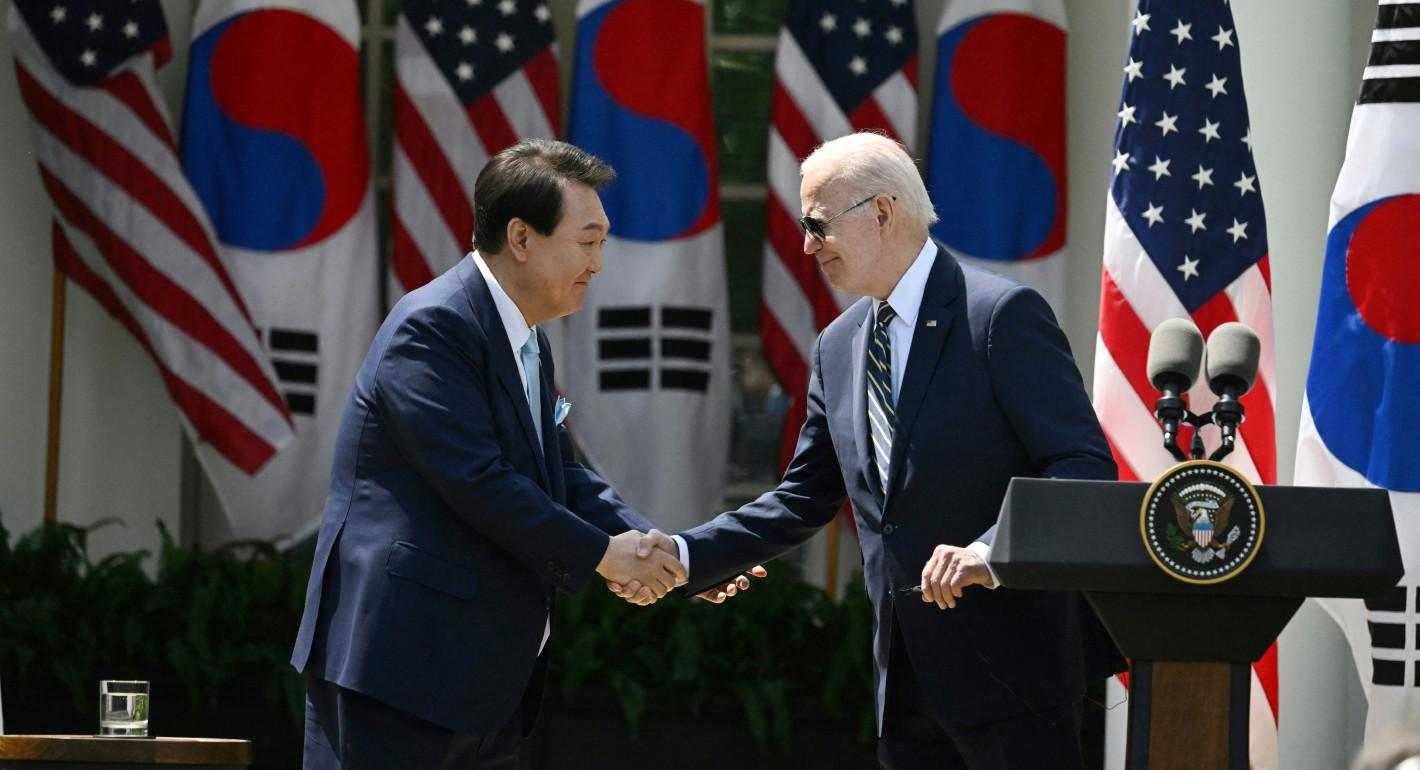
South Korean President Yoon Suk Yeol’s visit to Washington last year yielded several new measures to deter North Korea’s nuclear arsenal, but the most innovative idea is also the one that has received the least attention. At the summit, U.S. President Joe Biden committed to consult with South Korea on any possible nuclear use on the peninsula, a promise the United States has never so explicitly offered another ally. The idea has the potential to not only transform how the allies plan to confront a nuclear crisis on the peninsula but also to address some of the long-standing concerns South Koreans have had about the U.S. nuclear umbrella.
The United States guarantees South Korea’s security with “the full range of U.S. capabilities, including nuclear.” Both allies have said that any North Korean nuclear attack will lead to the end of the regime. Importantly, neither statement is a promise that the United States will use a nuclear weapon. While U.S. officials are resolved to use nuclear weapons if necessary to defend South Korea, they also want to have credible and effective nonnuclear options.
How would the United States decide on nuclear use? In a crisis, the president can initiate a nuclear decision conference that would gather senior civilian and military advisors to assess the options. They would consider many aspects of the situation—whether nuclear use is militarily necessary, whether it could really stop an invasion or prevent an attack, whether it would violate international law or contaminate allied territory, whether it would risk pulling China or Russia into a conflict or lead to a broader nuclear war. A president would almost certainly compare nuclear and nonnuclear options.
The new simulations and consultative group that emerged from the summit will help the allies exchange information on these factors in advance and develop plans, but the new channel for presidential consultation is critical to assuring officials in Seoul that their preferences would reach the White House during a crisis.
In a way, it is a common sense commitment. Seoul should have a say in whether the United States should use nuclear weapons on or around the peninsula, and Washington needs to know South Korea’s preference to make an informed decision. But the commitment is also not trivial. It should mean adding a new step to the decision conference, which was built in the Cold War to allow rapid deliberation as Soviet missiles were in the air. And it requires an extremely secure channel for the presidents to consult, which South Korean Deputy National Security Advisor Kim Tae-hyo hinted is now in place.
These are excellent first steps, but both allies have more hard work ahead to ensure that they are ready to consult effectively. Both before and during a crisis, Pentagon officials should work with their counterparts so that Yoon can be briefed about the same kinds of nuclear and nonnuclear options that would be offered to the U.S. president in a crisis.
These briefings will allow the presidents to discuss why North Korea carried out the attack and how to respond. Yoon and his successors can explain why they believe a specific nuclear response would be necessary or whether the alliance has better nonnuclear options available. This information will be invaluable to an American president who must ultimately make this fateful decision.
The system will be especially valuable if former U.S. president Donald Trump returns to the White House next year. Now that the system is in place, Trump would likely be prompted to consult with Yoon before deciding on nuclear use, which could offer a chance to persuade him or other U.S. officials who must assess the legality of a nuclear strike. The more robust and institutionalized the process is, the more information it will provide to South Korean leaders.
The allies should rehearse and publicize a presidential consultation on nuclear use. Both sides should go through their briefing processes so the presidents can see what it would be like to make the most harrowing decision of their lives. Jointly releasing pictures of a rehearsal can remind North Korea’s leaders and the South Korean public that the alliance is united and prepared for crisis. Importantly, Washington and Seoul should agree on how to describe the consultation process publicly, in peacetime and in a crisis.
No president wants to have to consider using a nuclear weapon. But preparing to consult in a nuclear crisis can ensure that the presidents of both countries are ready to make the most informed decision possible, together.