

Q&A
- +1
Amr Hamzawy, Andrew Leber, Eric Lob, …
{
  "authors": [
    "Marwan Muasher"
  ],
  "type": "commentary",
  "centerAffiliationAll": "dc",
  "centers": [
    "Carnegie Endowment for International Peace"
  ],
  "englishNewsletterAll": "menaTransitions",
  "nonEnglishNewsletterAll": "",
  "primaryCenter": "Carnegie Endowment for International Peace",
  "programAffiliation": "MEP",
  "programs": [
    "Middle East"
  ],
  "projects": [],
  "regions": [
    "Saudi Arabia",
    "United States",
    "Israel"
  ],
  "topics": [
    "Foreign Policy",
    "Defense"
  ]
}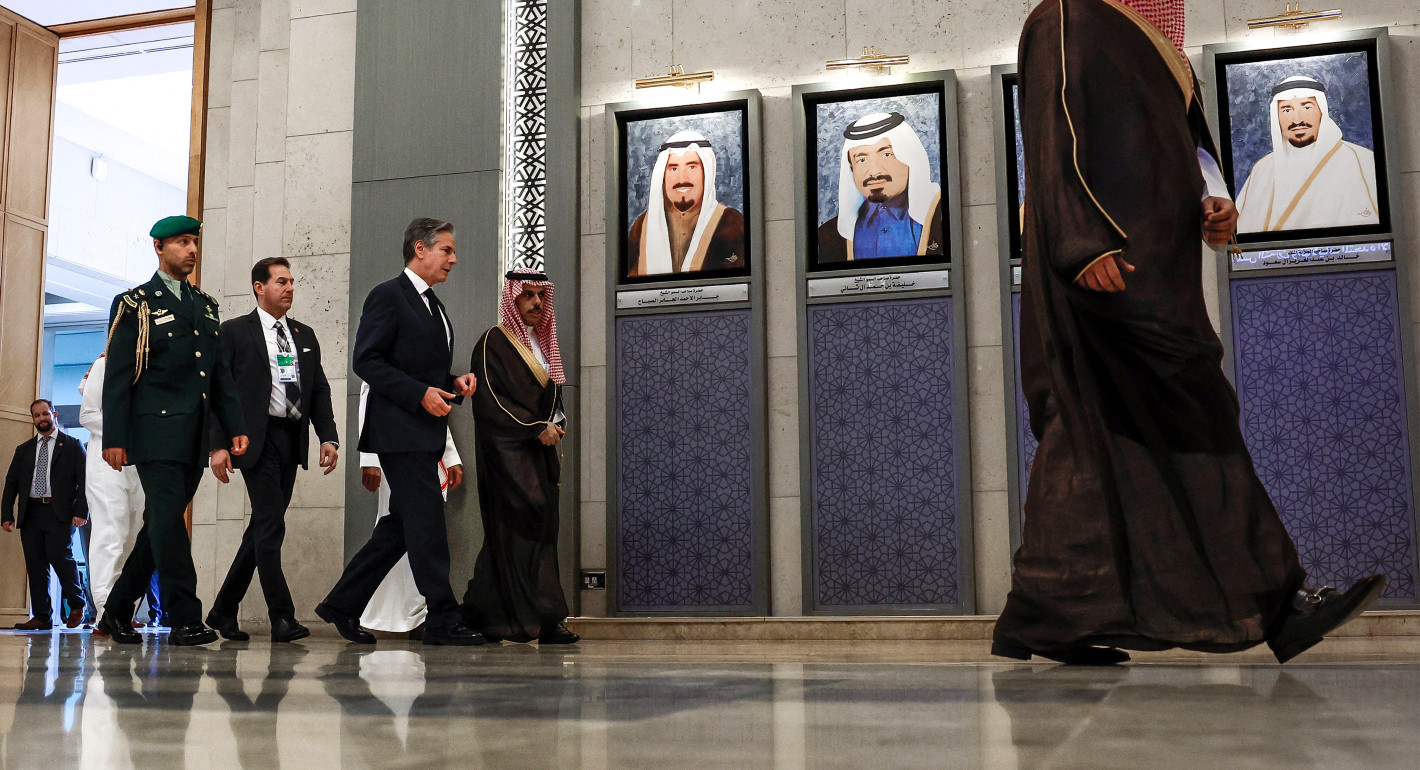
Blinken and his Saudi counterpart, Prince Faisal bin Farhan, in Riyadh in April . (Photo by Evelyn Hockstein/pool/AFP via Getty Images)
For months, the White House has been claiming that a U.S.-Saudi deal to normalize diplomatic relations between the kingdom and Israel is near completion. But many sticking points remain. The most crucial of those concerns Israel’s unwillingness to seriously consider a two-state solution in Palestine, which Saudi leaders say is a precondition for any agreement. Yet even if this stipulation is somehow met, the chances for a ratification of the deal by the U.S. Senate are remote, and the administration’s focus on the agreement has distracted it from other, more pressing issues.
Prior to the October 7 Hamas attacks on Israel, U.S. President Joe Biden’s administration saw the agreement as a top Middle East priority. The negotiations seemed to be nearly complete, with several top U.S. officials—including Secretary of State Antony Blinken and National Security Advisor Jake Sullivan—visiting Riyadh multiple times. Saudi officials appeared to be content with an Israeli commitment to a two-state solution, even without a serious plan to implement it, in return for Washington’s acceptance of a peaceful Saudi nuclear program and the acquisition of advanced U.S. weaponry (and halting purchases of Chinese military equipment). And perhaps most importantly, the deal included a defense pact that would require the United States to protect Saudi Arabia from an external attack from an adversary such as Iran.
However, a U.S. defense treaty requires ratification from two-thirds of the Senate. On October 4, 2023, a group of twenty Democratic senators—enough to possibly jeopardize the vote—voiced their opposition to such a treaty. Their concerns included Saudi Arabia’s human rights record and the possibility that a peaceful nuclear energy program might eventually be converted into a military one, to produce a nuclear weapon. More recently, they have indicated that the only path forward is if the agreement includes a robust provision for ending the Gaza war and resolving the Palestine-Israel conflict through a two-state solution.
October 7 also changed Saudi Arabia’s calculus: a peace agreement with Israel is now very difficult without a serious plan for a Palestinian state. Israel, however, remains unprepared to offer any commitment to a two-state solution, even a nominal one. Last month, Israeli Prime Minister Benjamin Netanyahu described a two-state solution as “a reward for terrorism.” Israel’s current coalition government has stated publicly and repeatedly its opposition to ending the occupation and accepting a Palestinian state. Such an ideological position appears to be far more important to the government than a formal peace treaty with Saudi Arabia, particularly when bilateral relations between the two countries are progressing anyway, albeit informally.
But to formalize the relationship, Saudi leaders need a two-state commitment from Israel, even if it is nominal. Riyadh spearheaded the effort that led to the 2002 Arab Peace Initiative, which promised full peace and security for Israel by all Arab states if Israel withdrew to its 1967 borders. Settling for anything less, particularly after October 7, is nearly impossible for Saudi Arabia.
Realizing this, Saudi and American officials appear to have switched to a bilateral agreement that does not include Israel. The Biden administration still finds such an agreement desirable to steer the kingdom away from a possible rapprochement with China.
However, switching to this alternative plan by no means guarantees that any agreement will be ratified by the Senate, especially in an election year. Many Democrats likely will find it difficult to ratify without a commitment to a serious peace process, while many Republicans also likely will find an absence of normalization with Israel difficult to swallow. Gathering the needed sixty-seven votes will be difficult.
If the administration changes in January, the possibility of an agreement becomes almost nonexistent, as very few Democrats are likely to agree to it under any circumstances. If Biden is re-elected, and if Israel commits to a two-state solution, then an agreement may happen, but the chances for ratification are still not guaranteed.
What also needs to be said concerns the opportunity costs of Biden’s excessive, obsessive focus on the normalization deal. It is not the panacea the administration makes it out to be. Focusing on it has blinded the administration to the real problems in the region and left it with less energy and bandwidth to focus on addressing these problems—namely, ending the occupation and achieving lasting peace in the region.

Vice President for Studies
Marwan Muasher is vice president for studies at Carnegie, where he oversees research in Washington and Beirut on the Middle East. Muasher served as foreign minister (2002–2004) and deputy prime minister (2004–2005) of Jordan, and his career has spanned the areas of diplomacy, development, civil society, and communications.
Recent Work



Amr Hamzawy, Andrew Leber, Eric Lob, …
Marwan Muasher
Carnegie does not take institutional positions on public policy issues; the views represented herein are those of the author(s) and do not necessarily reflect the views of Carnegie, its staff, or its trustees.

Japan’s long-term security policy is driven by concerns about China, and there is little appetite for (or interest in) pursuing a confrontation with Moscow.

James D.J. Brown

The truth of the strategic situation is that Europe and Russia are extremely unlikely to be able to “turn the page” on their confrontation within the next two decades.

Arkady Moshes

Russia spent years building a “sovereign internet,” concentrating web infrastructure exclusively within Russian territory. Ukrainian drone attacks have shown how vulnerable that approach has left the Russian internet.

Maria Kolomychenko

Without a ceasefire with Ukraine on attacking each other’s energy infrastructure—to which the Kremlin is unlikely to agree—the diesel agreement between Putin and Trump is largely for show, rather than representing a genuine increase in the volumes of Russian diesel on the global market.

Sergey Vakulenko

Despite a new textbook, an influx of Russian teachers and managers, and an end to the teaching of Ukrainian, the Kremlin is unlikely to have “reprogrammed” locals.

Konstantin Skorkin