• Research
  • Politika
  • About
Carnegie Russia Eurasia center logoCarnegie lettermark logo
  • Donate
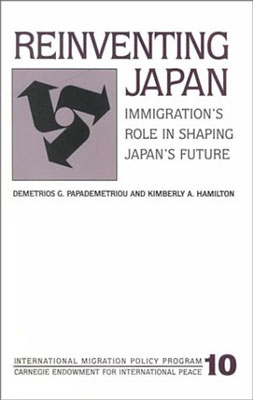
Reinventing Japan: Immigration's Role in Shaping Japan's Future
Book

Reinventing Japan: Immigration's Role in Shaping Japan's Future

Much attention has been given to Japan's need to restructure its economy and its bureaucracy, but little critical analysis has addressed the necessary role of immigration policy in Japan's reform process. A series of economic, demographic, and political factors are converging to require that Japan adopt a more open policy toward immigration if it is to ensure its place as a global leader.

Link Copied
By Dr. Demetrios Papademetriou and Kimberly Hamilton
Published on Sep 13, 2000

Additional Links

Chapter OneTable of ContentsPaperback - $12.00

Source: Washington

Much attention has been given to Japan's need to restructure its economy and its bureaucracy, but little critical analysis has addressed the necessary role of immigration policy in Japan's reform process. Japan does not have a history of substantial immigration, and Japanese attitudes toward foreigners have traditionally been very closed. Even today, immigration to Japan is very low compared to other industrialized countries, primarily because of Japanese policies aimed at restricting immigration. In this monograph, Papademetriou and Hamilton argue that this restrictionist approach is ripe for change. A series of economic, demographic, and political factors are converging to require that Japan adopt a more open policy toward immigration if it is to ensure its place as a global leader.

About the Authors
Demetrios G. Papademetriou was a senior associate and co-director of the International Migration Policy Program at the Carnegie Endowment.

Kimberly A. Hamilton is a senior international program officer at Alcoa Foundation.

About the Authors

Dr. Demetrios Papademetriou

Former Senior Associate

Kimberly Hamilton

Authors

Dr. Demetrios Papademetriou
Former Senior Associate
Kimberly Hamilton
East AsiaJapanEconomyTrade

Carnegie does not take institutional positions on public policy issues; the views represented herein are those of the author(s) and do not necessarily reflect the views of Carnegie, its staff, or its trustees.

More Work from Carnegie Russia Eurasia Center

  • Commentary
    Carnegie Politika
    Georgia’s Fall From U.S. Favor Heralds South Caucasus Realignment

    With the White House only interested in economic dealmaking, Georgia finds itself eclipsed by what Armenia and Azerbaijan can offer.

      Bashir Kitachaev

  • Commentary
    Carnegie Politika
    Does Russia Have Enough Soldiers to Keep Waging War Against Ukraine?

    The Russian army is not currently struggling to recruit new contract soldiers, though the number of people willing to go to war for money is dwindling.

      Dmitry Kuznets

  • Commentary
    Carnegie Politika
    Japan’s “Militarist Turn” and What It Means for Russia

    For a real example of political forces engaged in the militarization of society, the Russian leadership might consider looking closer to home.

      James D.J. Brown

  • Commentary
    Carnegie Politika
    Lithuania’s Potash Dilemma Raises Questions About Sanctions’ Effectiveness

    What should happen when sanctions designed to weaken the Belarusian regime end up enriching and strengthening the Kremlin?  

      Denis Kishinevsky

  • Commentary
    Carnegie Politika
    Venezuela Is No Oil Eldorado, Despite U.S. and Russian Claims

    Geological complexity and years of mismanagement mean the Venezuelan oil industry is not the big prize officials in Moscow and Washington appear to believe.

      • Sergey Vakulenko

      Sergey Vakulenko

Get more news and analysis from
Carnegie Russia Eurasia Center
Carnegie Russia Eurasia logo, white
  • Research
  • Politika
  • About
  • Experts
  • Events
  • Contact
  • Privacy
Get more news and analysis from
Carnegie Russia Eurasia Center
© 2026 Carnegie Endowment for International Peace. All rights reserved.