

Commentary
Japan’s long-term security policy is driven by concerns about China, and there is little appetite for (or interest in) pursuing a confrontation with Moscow.
James D.J. Brown
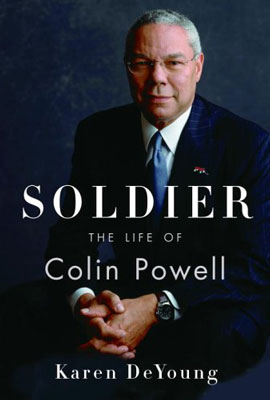
Colin Powell became a national hero. From his humble origins to the highest levels of government in four administrations, he helped guide the nation through some of its most heart-wrenching hours.
Source: Knopf
Over the course of a lifetime of service to his country, Colin Powell became a national hero, a beacon of wise leadership and, according to polls, “the most trusted man in America.” From his humble origins as the son of Jamaican immigrants to the highest levels of government in four administrations, he helped guide the nation through some of its most heart-wrenching hours. Now, in the first full biography of one of the most admired men of our time, award-winning Washington Post journalist Karen DeYoung takes us from Powell’s Bronx childhood and meteoric rise through the military ranks to his formative roles in Washington’s corridors of power and his controversial tenure as secretary of state.
With psychological acumen and a reporter’s eye for detail, DeYoung introduces us to the racially integrated neighborhood where Powell grew up, his courtship of and marriage to Alma Johnson, and his years as a promising young Army officer. We are witness to the pivotal events that helped shaped his world view, including two tours of duty in Vietnam, where he was disillusioned by a breakdown in leadership and the lack of a clear objective, and a 1988 meeting as President Reagan’s national security adviser with Mikhail Gorbachev, who looked at him dead-on and effectively declared an end to the Cold War. We are privy to his reasoning as the architect of Operation Desert Storm and the chairman of the Joint Chiefs of Staff under George H. W. Bush and Bill Clinton, a position that made him a household name and an international celebrity. And we experience his agonizing deliberations in the face of a groundswell of public desire that he run for the presidency.
Yet it was his capacity as America’s chief diplomat in the administration of George W. Bush that brought Powell the most renown—and criticism. Charged with the formidable task of making the case for war with Iraq, he convinced a wary nation that it was both necessary and right, only to find his own credibility hanging in the balance as the justification for invasion began to unravel. At odds with the White House on a range of foreign policy issues, Powell’s counsel went unheeded and his reputation was tarnished.
With dramatic new information about the inner workings of an administration locked in ideological combat, DeYoung makes clearer than ever before the decision-making process that took the nation to war and addresses the still-unanswered questions about Powell’s departure from his post shortly after the 2004 election. Drawing on interviews with U.S. and foreign sources as well as with Powell himself, and with unprecedented access to his personal and professional papers, Soldier is a revelatory portrait of an American icon: a man at once heroic and all-too-humanly fallible.
Karen DeYoung is an associate editor at The Washington Post, where she has held a number of senior editing positions and served as a foreign policy reporter in Washington and correspondent abroad.
Former Visiting Scholar
Carnegie does not take institutional positions on public policy issues; the views represented herein are those of the author(s) and do not necessarily reflect the views of Carnegie, its staff, or its trustees.

Japan’s long-term security policy is driven by concerns about China, and there is little appetite for (or interest in) pursuing a confrontation with Moscow.

James D.J. Brown

Without a ceasefire with Ukraine on attacking each other’s energy infrastructure—to which the Kremlin is unlikely to agree—the diesel agreement between Putin and Trump is largely for show, rather than representing a genuine increase in the volumes of Russian diesel on the global market.

Sergey Vakulenko

Despite a new textbook, an influx of Russian teachers and managers, and an end to the teaching of Ukrainian, the Kremlin is unlikely to have “reprogrammed” locals.

Konstantin Skorkin

Cargo traffic through Russia’s Northern Sea Route has increased because of the disruption caused by the conflict in the Middle East, the Ukraine war, and U.S.-China tensions.

Mikhail Korostikov

Trump has promised Belarus a massive potash deal. But Minsk is seeking something greater: restored Western transit and greater room for maneuver from Russia.

Balázs Jarábik