

Other
Sharon Squassoni
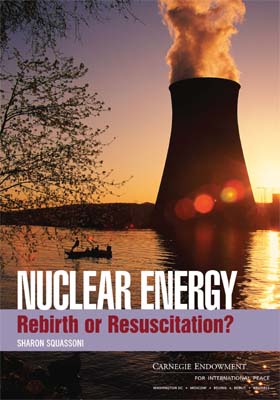
Increased interest in nuclear power has fueled talk of a "nuclear renaissance." But the reality of nuclear energy’s future is more complicated. Without major changes in government policies and aggressive financial support, nuclear power is actually likely to account for a declining percentage of global electricity generation.
After several decades of disappointing growth, nuclear energy seems poised for a comeback. Talk of a “nuclear renaissance” includes perhaps a doubling or tripling of nuclear capacity by 2050, spreading nuclear power to new markets in the Middle East and Southeast Asia, and developing new kinds of reactors and fuel-reprocessing techniques. But the reality of nuclear energy’s future is more complicated. Without major changes in government policies and aggressive financial support, nuclear power is actually likely to account for a declining percentage of global electricity generation.
Projections for growth assume that government support will compensate for nuclear power’s market liabilities and that perennial issues such as waste, safety, and proliferation will not be serious hurdles. Before embarking on such a path, policy makers need to achieve greater certainty across a wide range of issues. In the meantime, all possible efforts should be made to minimize the risks of any nuclear expansion that might occur. These include strengthening the rules of nuclear commerce and transparency, deemphasizing the element of national prestige with respect to nuclear energy, undertaking clear-eyed assessments of all available options for generating electricity, and limiting the acquisition of sensitive nuclear technologies like uranium enrichment and spent-fuel reprocessing.
Former Senior Associate, Nuclear Policy Program
Squassoni came to Carnegie from the Congressional Research Service. She also served for nine years in the executive branch. Her last position at the State Department was director of Policy Coordination in the Nonproliferation Bureau.
Recent Work
Sharon Squassoni
Nima Gerami, Sharon Squassoni
Carnegie does not take institutional positions on public policy issues; the views represented herein are those of the author(s) and do not necessarily reflect the views of Carnegie, its staff, or its trustees.

Without a ceasefire with Ukraine on attacking each other’s energy infrastructure—to which the Kremlin is unlikely to agree—the diesel agreement between Putin and Trump is largely for show, rather than representing a genuine increase in the volumes of Russian diesel on the global market.

Sergey Vakulenko

Trump has promised Belarus a massive potash deal. But Minsk is seeking something greater: restored Western transit and greater room for maneuver from Russia.

Balázs Jarábik

Minsk clearly expected the dialogue with Washington to yield more results, in particular the lifting of EU sanctions and permission to export potash.

Artyom Shraibman

With the growth in points of friction between the great powers, organizations like the SCO will continue to play a role in the strategic adaptation of the smaller powers caught between them.

Temur Umarov

When faced with fuel shortages in the past, Central Asian governments could always count on additional supplies from Moscow. That safety net no longer exists.

Galiya Ibragimova