

Article
Marina Ottaway, Omar Hossino
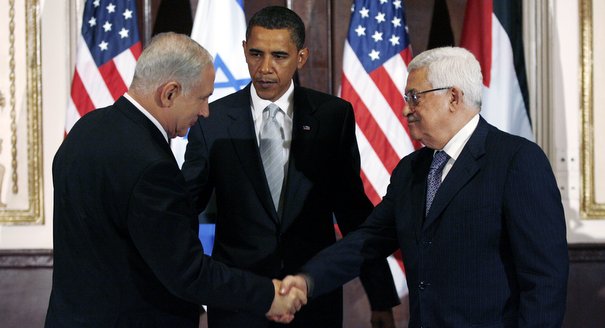
Source: Getty
New Israeli Foreign Minister Avigdor Lieberman has issued a challenge to which the Obama administration must reply decisively: as an opening salvo on taking office, he has declared that “The Annapolis conference, it has no validity,” thus Israel is not bound to seek a two-state solution.
New Israeli Foreign Minister Avigdor Lieberman has issued a challenge to which the Obama administration must reply decisively: as an opening salvo on taking office, he has declared that “The Annapolis conference, it has no validity,” thus Israel is not bound to seek a two-state solution.
President Obama must react forcefully. Already his credibility in the Middle East is suffering, thanks to a combination of strong statements and indecisive action. Obama has declared support for the two-state solution. Even before finalizing the choice of an assistant secretary of state for the region, he has appointed a special envoy to deal with the conflict. But he has not made the hard decisions that would transform a rhetorical commitment into a policy, and Arabs are questioning his intentions.
Obama has inherited a particularly difficult situation in the Middle East, with a barely contained conflict in Gaza, a split in the Palestinian ranks, and an Israeli government reneging on previous Israeli commitments. But the administration cannot wait for a more favorable time. The chances of achieving a two-state solution will be even dimmer in the future.
Halting settlement expansion is the first priority. The Israeli Ministry of Construction and Housing recently approved the building of 15,000 new units, and permits are pending for almost 50,000 more. This was under the old government, before new Prime Minister Benjamin Netanyahu declared that construction on the West Bank would not stop. Secretary of State Hillary Clinton replied that settlement expansion is not helpful -- which essentially means that the U.S. will take no action. The administration needs to make clear to Israel that U.S. opposition to settlement expansion, long on the book but hardly ever enforced, is real: all construction must stop, whether it is “in-filling” of old settlements or the development of new ones.
Hamas must be included in the peace process, not because it should be rewarded for violence, but because there can be no meaningful negotiations or lasting agreement without it. The administration must thus declare its supports for Arab efforts to reach the reconciliation between Fatah and Hamas and accept that Hamas will become part of a Palestinian national unity government. Such a unity government, however, must accept the Middle East Quartet’s conditions: renouncing violence, recognizing Israel, and respecting previous agreements between Israel and the PLO. Implicitly, Hamas must thus accept the Quartet’s terms, even if it refuses to do so explicitly.
Israel will strongly oppose these steps, while Arab countries will support them. But Obama must also put Arab countries on notice that, if they are serious about the Arab Initiative -- the comprehensive peace plan first proposed by Saudi Arabia in 2002 -- and want U.S. support for it, they must be ready to negotiate with Israel. The Initiative calls for the formation of a Palestinian state, including Gaza and the West Bank, within the 1967 boundaries, and the simultaneous recognition of Israel by all Arab states. The Arab League has repeatedly endorsed the plan, as has the Obama administration. Arab countries have tabled the proposal, but they too have taken no concrete steps to make it a reality.
If his commitment is genuine, President Obama must openly oppose and sanction Israeli policies aimed at preventing the formation of a Palestinian state. And he must spend political capital by firmly opposing the planned expansion of Israeli settlements on the West Bank, declaring that Hamas must be part of a peace deal but must also compromise, and making it clear to Arab states that they must do a lot more if they want to reach the peace settlement envisaged by the Arab Initiative. If this is more than he is willing to do, he may well have doomed the chances for a two-state solution for good.
The steps recommended here represent a significant break with past U.S. positions and will be highly controversial, but the circumstances on the ground have changed dramatically, making it impossible to reach a two-state solution without departing from past policies and generating controversy. This would be hard for any administration, and particularly for a new one, but it will not be as hard as allowing Israel to abandon its commitment to a two-state solution, which remains the only viable option for peace. Obama himself recognized that his administration could afford no delays in rolling up its sleeves. He should act decisively now.

Former Senior Associate, Middle East Program
Before joining the Endowment, Ottaway carried out research in Africa and in the Middle East for many years and taught at the University of Addis Ababa, the University of Zambia, the American University in Cairo, and the University of the Witwatersrand in South Africa.
Recent Work
Marina Ottaway, Omar Hossino
Marina Ottaway
Carnegie does not take institutional positions on public policy issues; the views represented herein are those of the author(s) and do not necessarily reflect the views of Carnegie, its staff, or its trustees.

Despite a new textbook, an influx of Russian teachers and managers, and an end to the teaching of Ukrainian, the Kremlin is unlikely to have “reprogrammed” locals.

Konstantin Skorkin

Cargo traffic through Russia’s Northern Sea Route has increased because of the disruption caused by the conflict in the Middle East, the Ukraine war, and U.S.-China tensions.

Mikhail Korostikov

Trump has promised Belarus a massive potash deal. But Minsk is seeking something greater: restored Western transit and greater room for maneuver from Russia.

Balázs Jarábik

Minsk clearly expected the dialogue with Washington to yield more results, in particular the lifting of EU sanctions and permission to export potash.

Artyom Shraibman

With the growth in points of friction between the great powers, organizations like the SCO will continue to play a role in the strategic adaptation of the smaller powers caught between them.

Temur Umarov